What Pool Service Contractor CRM Management Software Should Do in 2026
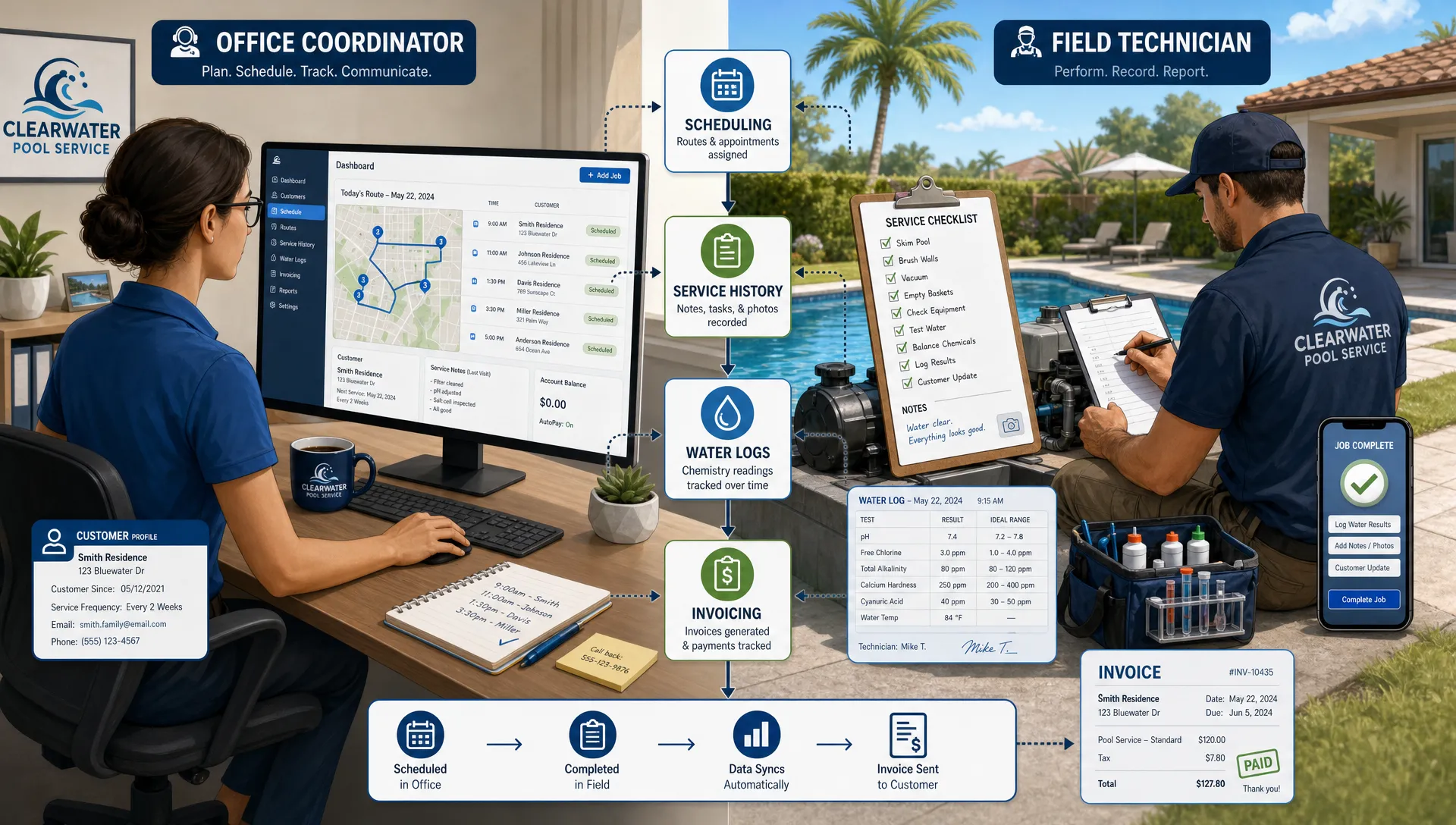
Pool service companies are no longer choosing CRM software just to store names, phone numbers, and addresses. In 2026, a pool service contractor needs a system that connects the office, the route, the technician, the homeowner, and the invoice in one operational flow.
That is especially true for growing companies that have outgrown spreadsheets, paper checklists, shared calendars, text threads, and disconnected payment tools. When customer information lives in one place, route notes in another, and water readings on paper, small errors become expensive. Missed follow-ups, forgotten gate codes, incomplete service histories, and delayed invoices can all slow down growth.
Modern CRM management software for pool service contractors should do more than manage contacts. It should help you run the business.
That is the role SplashIQ is built to play. As described on SplashIQ.ai, the platform brings CRM, scheduling, water-quality logging, equipment tracking, homeowner billing, and field operations into one app for pool service companies.
Why generic CRM software is not enough for pool service contractors
A generic CRM can help you track leads and customer conversations. That is useful, but pool service work has details that most general-purpose tools do not understand.
A pool company needs to know which property has a locked side gate, which pool has a salt system, what equipment was installed, when the filter was last serviced, what the water chemistry looked like on previous visits, and whether the homeowner has approved a repair or paid the latest invoice.
A contact record alone cannot handle that operational complexity.
For a pool service contractor, the customer is only part of the picture. The property, pool, equipment, service history, route schedule, technician notes, photos, chemicals, and payments all matter. If your CRM does not connect those pieces, your team ends up rebuilding the truth manually every day.
In 2026, the best CRM for pool service businesses should act less like a digital address book and more like a central operating system.
What pool service contractor CRM management software should do in 2026
The right system should make daily work simpler for owners, office staff, field technicians, and homeowners. Here are the core capabilities to expect.
1. Keep customer, property, and pool details in one place
A strong CRM starts with organized records. For pool service contractors, that means each customer profile should include more than basic contact information.
Your team needs quick access to property details, service preferences, access notes, equipment information, visit history, and follow-up tasks. If a homeowner calls about a heater issue, the office should not need to search through old texts, invoices, and technician notebooks to understand the account.
SplashIQ’s pool service CRM software is designed around this exact need, helping organize customers, properties, equipment, gate codes, visit history, leads, and follow-ups for pool service businesses.
That kind of structure is especially important when companies add technicians or expand routes. New team members can serve accounts more confidently when the account history is already organized.
2. Turn leads into scheduled work without losing follow-ups
Lead management is one of the most common places pool service companies lose revenue. A homeowner may request a quote, ask about weekly service, or need a repair, but if the next step is buried in a notebook or text thread, the opportunity can go cold.
CRM management software should help pool contractors track prospects from first contact to booked service. That includes capturing lead details, assigning follow-ups, and keeping the sales conversation connected to the customer record once the account becomes active.
In practical terms, the software should help answer questions like:
- Who requested service this week?
- Which estimates still need follow-up?
- Which new customers need to be added to a route?
- Which repair opportunities came from recent service visits?
When those answers are visible, owners can manage growth instead of relying on memory.
3. Connect CRM records to smart route scheduling
For pool companies, scheduling is not separate from customer management. A customer’s address, service frequency, access instructions, and technician assignment all affect the route.
In 2026, CRM software should connect directly to route scheduling so the office can plan work efficiently and technicians can see what they need before they arrive. Smart route scheduling helps reduce wasted drive time, lower confusion, and make daily operations more predictable.
This matters even more during peak season, when a small scheduling issue can ripple across the whole day. If a technician is reassigned or an urgent repair is added, the system should help keep the route, customer record, and field notes aligned.
SplashIQ includes smart route scheduling as part of its platform, which makes it relevant for pool service contractors who want the CRM to support operations, not sit apart from them.
4. Give technicians an offline field app
Field teams do not always have perfect connectivity. Pool service contractors often work in backyards, gated communities, rural areas, or locations where mobile signal can be unreliable.
That is why a modern pool service CRM should support field work even when the technician is offline. An offline field app helps technicians keep working without waiting for a connection. They can access the information they need, complete visit notes, and keep the day moving.
For the office, this reduces the communication gap between what happened in the field and what is visible at headquarters. For technicians, it reduces frustration and makes the service process more consistent.
A CRM that only works well from a desktop is not enough for a mobile service business.
5. Record water-quality logs and service history
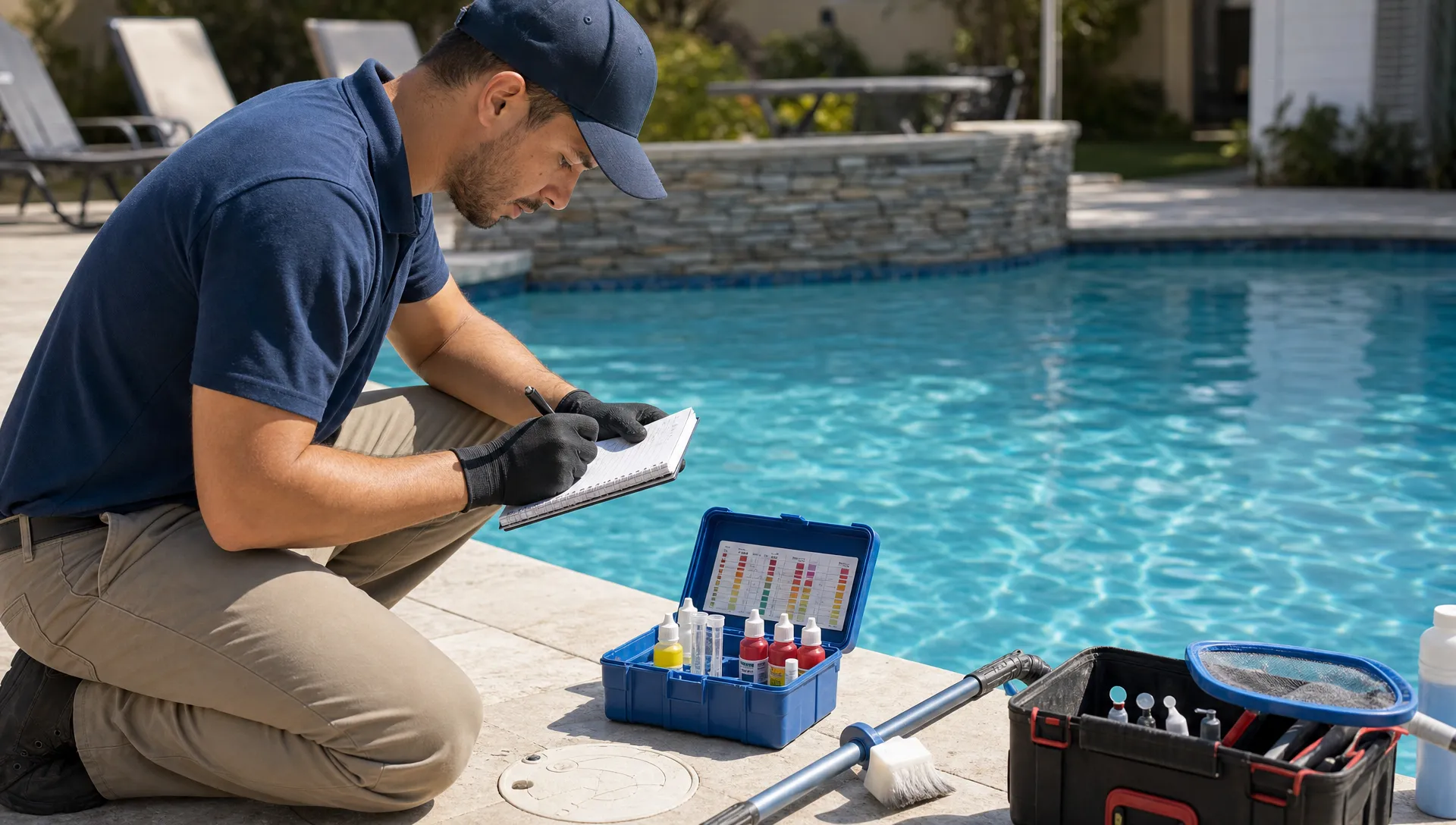
Water-quality tracking is one of the clearest examples of why pool companies need industry-specific software. A generic CRM may track a customer call, but it usually does not help a technician log readings, record treatment notes, and build a service history around the pool itself.
Pool service contractor CRM management software should make water-quality logs part of the customer and property record. That way, the company can review previous readings, document what was done, and answer homeowner questions with confidence.
Consistent logs also support better internal accountability. If a customer reports cloudy water or recurring balance issues, the service history gives the team context. Instead of guessing, the company can look back at prior visits and make a better decision.
6. Track equipment, photos, and job context
Pool equipment is a major part of customer service. Pumps, filters, heaters, automation systems, cleaners, and salt systems all have histories that matter. A modern CRM should help pool contractors track that equipment and connect it to the property record.
Before and after photos are also increasingly important. They help document work, show homeowners what was completed, and reduce misunderstandings. Photos can be useful for cleanups, repairs, green-to-clean jobs, equipment installs, and visible issues discovered during a route stop.
SplashIQ includes equipment tracking and before/after photos, which makes the CRM more useful for real service situations. Instead of keeping equipment notes in someone’s head or in a disconnected spreadsheet, the information can become part of the operational record.
| CRM capability | Why it matters for pool service contractors in 2026 |
|---|---|
| Customer and property CRM | Keeps homeowner, property, access, and service details organized |
| Smart route scheduling | Helps coordinate daily work and reduce route confusion |
| Water-quality logs | Documents readings, treatments, and service history over time |
| Equipment tracking | Keeps pool equipment context connected to the property |
| Offline field app | Supports technicians when mobile service is unreliable |
| Homeowner portal | Gives customers a clearer way to view information and interact |
| Online payments | Helps reduce billing friction and speed up collections |
| Technician scorecards | Gives owners better visibility into field performance |
7. Improve homeowner communication through a portal
Homeowners expect transparency. They want to know whether service was completed, what was found, what needs attention, and how to pay. If every update depends on manual texts and phone calls, the office can quickly become overloaded.
A homeowner portal gives customers a more organized way to interact with the service company. For pool contractors, this can reduce repetitive communication and create a more professional customer experience.
The value is not just convenience. Better communication can reduce disputes, improve trust, and help homeowners feel more confident that their pool is being maintained properly.
SplashIQ includes a homeowner portal, which fits the direction pool service software should be moving in 2026: clearer communication, less manual chasing, and better visibility for everyone involved.
8. Bring billing, online payments, and financing closer to the service workflow
Billing should not be an afterthought. When invoices are delayed or payment collection depends on manual follow-up, cash flow suffers.
Pool service CRM software should help connect completed work to homeowner billing. Online payments are now a baseline expectation for many customers, and they can make it easier for pool service companies to collect without relying only on checks or phone payments.
For larger repairs or equipment work, homeowner financing can also help reduce friction. If a homeowner needs a major repair but wants payment flexibility, financing options can support the conversation. SplashIQ lists both online payments and homeowner financing among its platform features, making it more than a CRM that stops at customer records.
The goal is to shorten the distance between service completed, homeowner informed, invoice sent, and payment received.
9. Give owners visibility into technician performance
As a pool service company grows, the owner cannot personally inspect every stop, review every note, or follow every route in real time. The business needs systems that create visibility without micromanagement.
Technician scorecards can help owners understand field performance patterns. While every company may define performance differently, the broader value is the same: better accountability and better coaching.
A CRM connected to field operations can help show whether service documentation is being completed, whether visits are consistent, and where additional training may be needed. This is where CRM management software becomes a management tool, not just a recordkeeping system.
How SplashIQ fits the 2026 CRM standard for pool service contractors
SplashIQ is positioned specifically for pool service companies, which is important. Contractors do not need a generic sales database with a few custom fields. They need a platform that understands the workflow from first lead to final invoice.
Based on its published feature set, SplashIQ supports the operational areas that matter most to pool service contractors:
- Customer CRM for organizing accounts, properties, and history
- Smart route scheduling for coordinating field work
- Water-quality logs for documenting pool conditions
- Equipment tracking for property-specific service context
- Offline field app support for technicians in the field
- Homeowner portal for clearer customer communication
- Before/after photos for documentation and trust
- Online payments and homeowner financing for billing workflows
- Technician scorecards for operational visibility
This combination is what pool service contractor CRM management software should look like in 2026. The CRM should not sit apart from scheduling, field notes, billing, and customer communication. It should tie those workflows together.
Questions to ask before choosing pool service CRM software
Before committing to a system, pool service contractors should evaluate whether the software can support how the company actually works. A polished contact database is not enough if the team still needs spreadsheets and paper forms to finish the job.
Good evaluation questions include:
- Can the CRM store both customer and property-level information?
- Can technicians access the details they need from the field?
- Does the software support water-quality logging?
- Can equipment information be tracked by property?
- Does scheduling connect naturally to the customer record?
- Can homeowners receive updates or access information more easily?
- Are payments connected to the service workflow?
- Will the system still work as the company adds routes and technicians?
If the answer is no to several of these, the tool may create more work than it removes.
A practical way to move away from spreadsheets
Switching software does not need to happen all at once. The best approach is usually to start with the areas causing the most friction.
For many pool service contractors, that begins with customer records and scheduling. Once those are organized, the company can add better field documentation, water-quality logs, equipment history, photos, billing, and performance visibility.
The key is to avoid rebuilding the same messy process inside a new tool. CRM implementation is a chance to standardize how the team captures information, communicates with homeowners, and follows up on work.
In 2026, the companies that win will be the ones that make operations easier to repeat. A strong CRM helps turn daily service work into a consistent system.
Frequently Asked Questions
What is pool service contractor CRM management software? It is software that helps pool service companies manage customer records, property details, leads, follow-ups, scheduling, service history, communication, and billing in one organized system.
Why should pool contractors use an industry-specific CRM instead of a generic CRM? Pool service companies need to track property access, equipment, water-quality logs, route schedules, technician notes, photos, and homeowner billing. Generic CRMs often require workarounds for those field-service details.
What should a pool service CRM include in 2026? It should include customer and property records, route scheduling, mobile field access, water-quality logs, equipment tracking, homeowner communication, online payments, and operational visibility for owners.
How can SplashIQ help a pool service contractor? SplashIQ can help by connecting CRM, scheduling, field operations, water-quality logging, equipment tracking, homeowner communication, payments, and technician visibility in one platform built for pool service companies.
Is CRM software only useful for large pool service companies? No. Smaller contractors can benefit from organized records, cleaner scheduling, faster follow-up, and better documentation. The value often increases as the company adds more customers, routes, and technicians.
Run your pool service business from one connected system
Pool service contractors do not need another disconnected tool. They need CRM management software that supports the way pool service actually works, from the first lead to the last invoice.
SplashIQ brings customer CRM, route scheduling, field documentation, water-quality logs, equipment tracking, homeowner communication, payments, and operational visibility into one platform for pool service businesses.
If your company is ready to replace spreadsheets, paper checklists, and scattered communication, visit SplashIQ.ai to see how a purpose-built pool service operating system can support your next stage of growth.