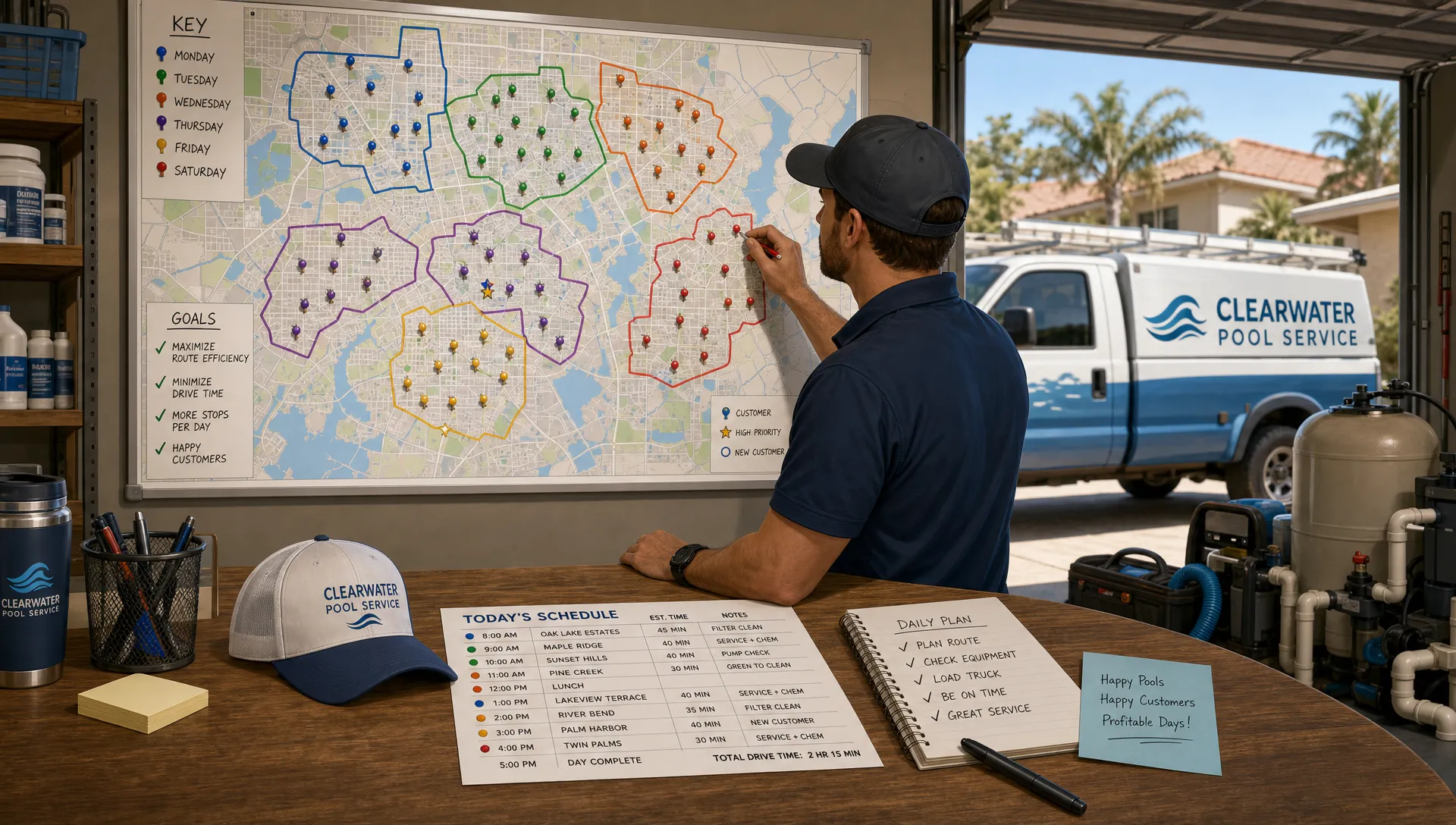
For a pool contractor, profit is rarely won or lost on one dramatic decision. It usually leaks out in small places: a technician driving across town for one pool, a repair squeezed into the wrong time slot, a missing gate code, a return trip for a part that should have been on the truck, or an invoice sent three days late.
That is why running jobs more profitably is not just about charging more. Pricing matters, but the bigger opportunity is operational: knowing how long jobs actually take, blocking the day around real work patterns, and calculating travel time between pools before the schedule is full.
A busy route can still be unprofitable. A lighter route can be highly profitable if the stops are dense, the jobs are scoped correctly, and the field team has what it needs before the first truck rolls out.
Start with the real unit of profit: completed work per route day
Many pool service companies think in terms of customers, stops, or weekly revenue. Those numbers are useful, but they can hide what is happening inside the day. The more useful question is: how much profitable work can one technician complete in one route day without creating callbacks, overtime, or rushed service?
A route day includes more than brushing, skimming, testing, dosing, and equipment checks. It also includes loading the truck, driving, finding access, documenting the visit, answering customer questions, handling surprises, and closing out the job. If your schedule only accounts for service time, your margins will look better on paper than they do in the bank account.
Use a simple baseline to understand each job type:
| Job type | Time to measure | Profit risk if ignored |
|---|---|---|
| Weekly maintenance | Service time, travel time, chemical usage, notes, photos | Routes look full but contain too much unpaid drive time |
| Green-to-clean | Labor hours, chemicals, repeat visits, customer communication | Price may not reflect total recovery effort |
| Equipment repair | Diagnosis, part sourcing, installation, testing, follow-up | Return trips and missing parts reduce margin |
| Filter clean | Setup, cleaning, reassembly, cleanup, disposal, documentation | Add-on work gets underpriced or rushed |
| New customer onboarding | Initial inspection, equipment notes, water baseline, expectations | Future service becomes harder and slower |
Once you know the real time profile of each job type, scheduling becomes a profit tool instead of an administrative task.
Time block the week before you fill the schedule
Time blocking helps pool contractors stop treating every open slot as equal. A 45-minute opening on the calendar is not always available capacity. If it sits across town, between two tight recurring stops, it may cost more than it earns.
Instead of letting jobs land randomly, build your week around dedicated blocks. Recurring maintenance should have protected route windows. Repairs should be grouped into blocks where the technician has enough time for diagnosis, setup, installation, and testing. Estimates and new customer inspections should be assigned to windows that do not disrupt high-density service routes.
A practical weekly time-blocking structure might include:
- Recurring route blocks for weekly service customers in the same area
- Repair blocks for jobs requiring parts, tools, or extra documentation
- Diagnostic blocks for uncertain issues that may turn into larger work
- Admin blocks for invoicing, follow-ups, route review, and customer updates
- Buffer blocks for weather delays, urgent leaks, equipment failures, or callbacks
The key is to protect the most profitable work from being interrupted by reactive scheduling. If a technician loses 20 minutes leaving a dense route to check a low-priority issue, the real cost is not only 20 minutes. It may be the stop that gets rushed later, the note that does not get entered, or the invoice that does not get sent before the office closes.
Time blocking also makes customer expectations easier to manage. Instead of promising “sometime tomorrow,” your office can offer appointment windows that match how your company actually operates.
Calculate travel time between pools, not just minutes on site
Travel time is one of the most underestimated costs in pool service. It is easy to estimate that a maintenance stop takes 20 minutes. It is harder, and more important, to calculate how long it takes to get from pool to pool.
A simple route profitability formula looks like this:
Total route time = service minutes + travel minutes + loading/admin time + buffer time
If you only schedule based on service minutes, you may accidentally build routes that are impossible to complete profitably. For example, 14 maintenance stops at 22 minutes each equals 308 minutes of service time. That sounds manageable. But if the average drive between stops is 12 minutes, and the route includes travel from and back to the shop, the day can quickly exceed capacity.
Here is how travel changes the picture:
| Route assumption | Example impact |
|---|---|
| 14 stops at 22 minutes each | 308 minutes of service time |
| 13 drives between stops at 12 minutes each | 156 minutes of travel time |
| 30 minutes for loading, fuel, and end-of-day closeout | 30 minutes of support time |
| 30 minutes of realistic buffer | 30 minutes for delays or customer issues |
| Total scheduled day | 524 minutes, or about 8.7 hours |
That schedule may technically fit into a day, but it leaves little room for weather, locked gates, traffic, chemical adjustments, a slow pump prime, or a customer question. If the same 14 stops are reorganized so the average drive drops from 12 minutes to 8 minutes, the route saves 52 minutes before any field process changes.
That is nearly an hour of capacity recovered by routing better, not working faster.
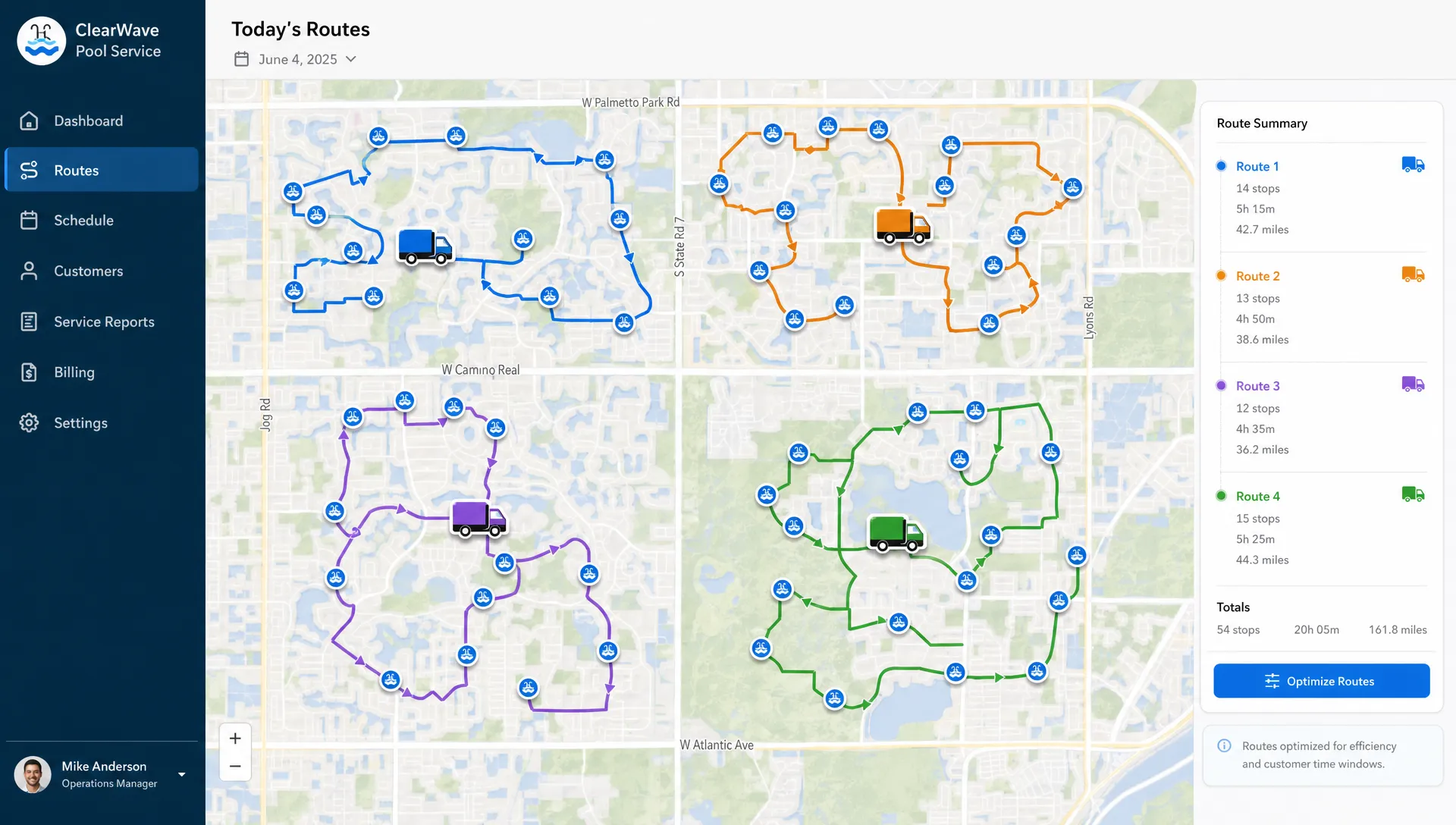
When reviewing routes, look at travel in three ways. First, measure average drive time between stops. Second, identify outlier customers that force the route away from its natural cluster. Third, compare revenue per stop against the cost of reaching that stop. A high-paying customer far from the route may still be worth keeping, but it should be priced with the travel reality included.
If you use vehicle cost in your job costing, remember that fuel is only part of the expense. Wear, maintenance, insurance, and depreciation matter too. The IRS standard mileage rate can be a useful reference point, but your internal model should reflect your actual vehicles, payroll, geography, and service area.
Build route density before adding more customers
Growth feels good, but scattered growth can make a pool company less profitable. Adding five new accounts in five different neighborhoods may increase revenue while lowering route efficiency. Adding five accounts in one community can improve margins immediately because the crew spends more time servicing pools and less time driving.
Route density should influence sales, marketing, and scheduling. If you already have strong customer clusters in certain neighborhoods, prioritize those areas for new customers. If an incoming lead is outside your current service footprint, price it carefully or consider whether it belongs on a different day with nearby work.
This is where geography and service type should work together. A route should not only be compact on a map. It should also match the technician’s workload. A day with only quick, balanced pools may support more stops. A day with several pools that regularly need chemical correction, heavy debris removal, or equipment attention needs more buffer.
Standardize job information before the truck leaves
A profitable job often starts before the technician arrives. Missing information creates delays, and delays compound across the day. Gate codes, pet notes, equipment location, preferred contact method, recent water readings, and prior repair history should not live in someone’s memory or a paper folder at the office.
When property details are organized in a pool service CRM, the office and field team can work from the same customer record instead of chasing information across texts, spreadsheets, and handwritten notes. That matters because every avoidable call to the office is time taken away from the route.
At a minimum, each job record should make these details easy to find:
- Customer contact information and communication preferences
- Property access notes, gate codes, pets, and parking instructions
- Pool type, equipment details, and known service issues
- Visit history, photos, water readings, and prior recommendations
- Open estimates, approved work, outstanding invoices, and follow-ups
This kind of standardization does not just save minutes. It reduces mistakes. A technician who can see the pump model, prior issue, and customer-approved scope is less likely to make a second trip or perform unapproved work.
Separate “fast work” from “uncertain work”
One common profitability mistake is scheduling uncertain jobs like predictable jobs. A filter clean is usually straightforward. A heater that “sometimes works” is not. A cloudy pool after a storm may be simple, or it may reveal circulation, filtration, or chemistry problems.
Uncertain work needs a different scheduling approach. Give diagnostics their own block, and do not pack them tightly between recurring stops. If the issue turns out to be simple, the technician gains time. If it is complex, the route does not collapse.
This is especially important for repair jobs. The first visit should define the problem, document the equipment, confirm access, and determine parts or approvals needed. If your company treats the diagnostic visit as free-floating time, the real cost can disappear into the schedule. If you track it as a job stage, you can price and plan the follow-up work more accurately.
Reduce callbacks with better documentation
Callbacks are expensive because they consume capacity that has already been sold once. Some callbacks are unavoidable, but many come from incomplete notes, unclear customer expectations, poor handoffs, or rushed service.
Documentation protects profit in several ways. Water-quality logs show what was tested, what was added, and how conditions changed over time. Before/after photos help verify work and reduce disputes. Equipment notes make future repairs faster. Clear customer updates reduce unnecessary calls to the office.
The goal is not to bury technicians in admin. The goal is to capture the minimum information needed to prevent confusion later. A good field workflow should make documentation part of the job, not a separate burden after the route is done.
For recurring maintenance, documentation can also reveal patterns. If one pool consistently takes longer than others on the same route, it may need a price adjustment, a service conversation, or an equipment recommendation. If one route has repeated chemistry issues, it may need a different sequence, different inventory, or more realistic time blocks.
Price based on capacity, not only market averages
It is useful to know what competitors charge, but your pricing should be grounded in your own cost structure. Two pool contractors in the same city can have very different margins depending on route density, technician efficiency, overhead, vehicle costs, software costs, and customer mix.
A simple job pricing model should include:
- Loaded labor cost, including wages, payroll taxes, benefits, and supervision
- Travel cost, including technician time and vehicle expense
- Materials, chemicals, parts, and disposal costs
- Overhead allocation for office staff, insurance, software, rent, and tools
- Target profit margin that reflects business risk and reinvestment needs
For recurring service, the question is not only “What can we charge per month?” It is “How much route capacity does this customer consume, and what margin does that capacity produce?” A customer with a difficult access situation, long drive time, heavy debris, or frequent communication needs may require a different price than a similar-size pool in a dense neighborhood.
For repair work, avoid pricing only by the visible task. Include diagnosis, procurement, travel, testing, documentation, and customer communication. If financing is available for larger homeowner projects, it can help customers move forward with needed work, but the job still needs to be priced profitably.
Track technician performance without rewarding rushed work
Technician scorecards can improve profitability, but only if they measure the right things. If you reward only speed, you may create callbacks and customer complaints. If you measure only customer satisfaction, you may miss route inefficiency.
Balanced scorecards should include both productivity and quality. Useful metrics include completed stops, on-time route completion, callback rate, documentation completion, average stop duration by job type, customer feedback, and chemical or inventory variance. The goal is not to pressure every technician into the same pace. The goal is to understand what top performers do consistently and turn those habits into training.
Scorecards are also helpful for spotting scheduling problems. If every technician struggles on a certain route, the issue may be route design, not performance. If one job type consistently runs over, the estimate or time block may need adjustment.
Shorten the cash cycle after the job is done
A job is not fully profitable until it is billed and collected. Delayed invoicing creates administrative drag and cash-flow pressure. It also increases the chance of customer questions because the work is no longer fresh in their mind.
The best time to prepare the invoice is when the job details are complete. If the technician has logged the work, photos, readings, and parts used, the office should not have to reconstruct the visit later. Online payments can reduce friction for homeowners and help the business collect faster.
For pool contractors, this is especially important during peak season. When the office is buried in calls, scheduling changes, and emergency repairs, billing can slip. A cleaner field-to-office workflow helps protect revenue that has already been earned.
Review route profitability every month
Routes are not static. Customers move, pools age, equipment fails, neighborhoods grow, and traffic patterns change. A route that was profitable in April may be overloaded by July. A route that looked inefficient last year may become profitable after adding customers in the same subdivision.
A monthly route review does not need to be complicated. Look at the number of completed stops, total revenue, total labor hours, drive time, callbacks, overtime, and customer issues. Then identify which routes need action.
Common fixes include moving customers to a different day, creating tighter neighborhood clusters, adjusting prices for outlier accounts, changing technician assignments, adding buffer around complex jobs, or turning certain one-off tasks into scheduled add-ons.
The important part is consistency. Profitability improves when route review becomes a normal management habit, not a rescue project after margins have already slipped.
FAQ
How can a pool contractor know if a job is profitable? Track the full cost of the job, including labor, travel, chemicals, parts, documentation time, overhead, and payment collection. A job that looks profitable based only on service time may lose margin once drive time and return trips are included.
What is the easiest way to reduce travel time between pools? Build denser routes by grouping customers geographically and reviewing drive time between stops. Even saving a few minutes between each pool can recover significant capacity over a full route day.
Should repair jobs be scheduled separately from maintenance routes? In most cases, yes. Repairs and diagnostics are less predictable than recurring maintenance. Giving them dedicated time blocks helps prevent one uncertain job from disrupting an entire route.
How often should pool contractors review routes? Monthly is a practical rhythm for most companies, with additional reviews during peak season or after major customer growth. Review route revenue, labor hours, travel time, callbacks, and overtime together.
Does better documentation really improve profitability? Yes. Clear water logs, equipment notes, photos, and visit history reduce confusion, callbacks, disputes, and office follow-up. Documentation also helps identify customers or job types that need price or process changes.
Run more profitable pool jobs with better systems
Pool contractors do not improve margins by guessing harder. They improve margins by seeing the full workflow clearly, from lead to schedule to field work to invoice.
SplashIQ helps pool service companies replace scattered spreadsheets and paper checklists with one operating system for CRM, scheduling, water-quality logs, equipment tracking, homeowner communication, field work, and payments. If your team is ready to tighten routes, reduce delays, and run jobs with more control, SplashIQ gives your office and technicians a shared place to manage the work.