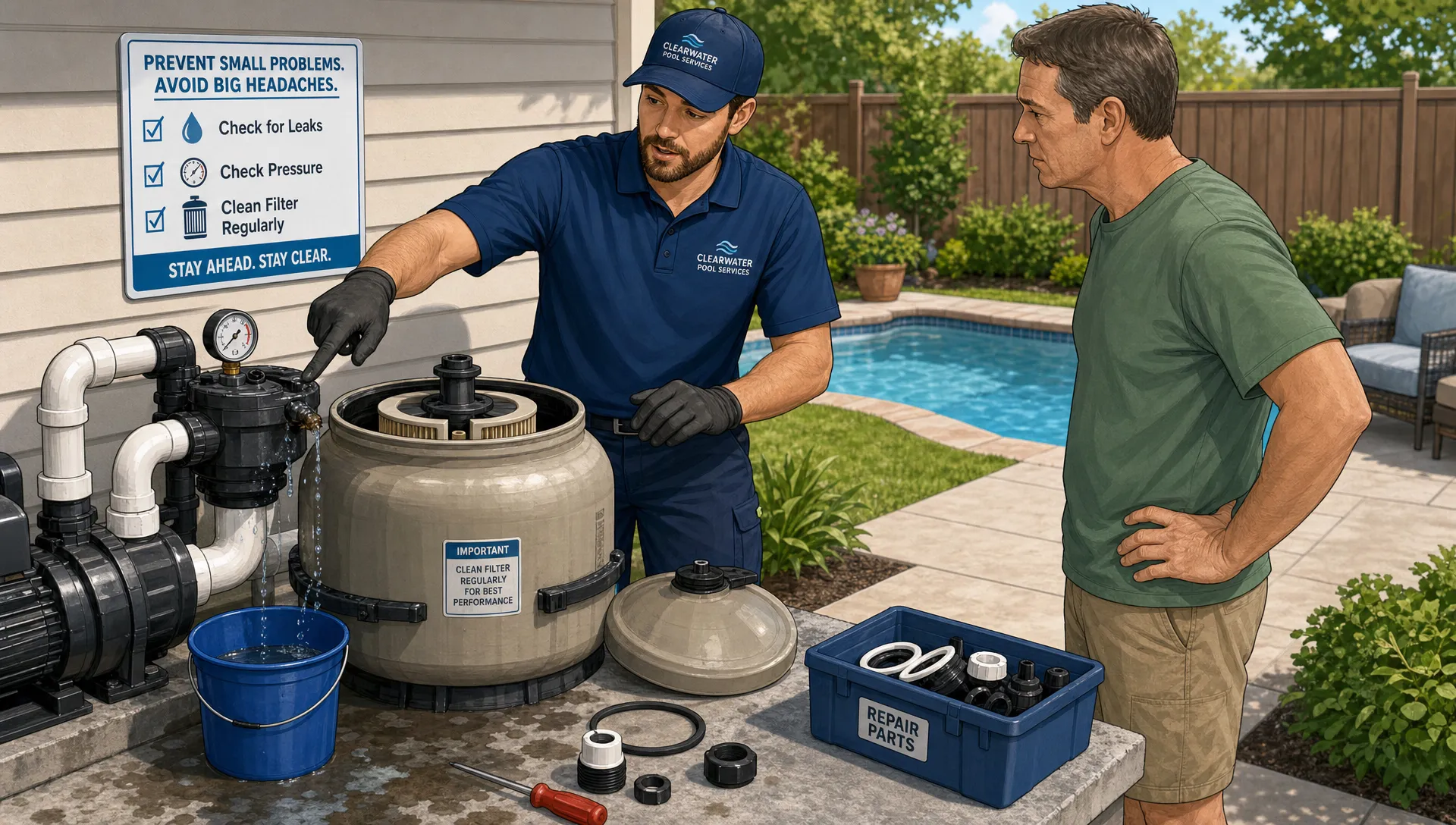
Emergency pool calls rarely start with a filter that failed out of nowhere. More often, the filter spent weeks giving clues: pressure crept above its normal range, return flow weakened, debris came back into the pool, or a small leak appeared around a clamp, union, valve, or drain plug.
For pool service companies, the goal is not to eliminate every urgent visit. Storms, power issues, cracked housings, and customer misuse still happen. The goal is to catch predictable filter problems early enough to turn them into planned pool filter repairs, not after-hours calls, angry texts, cloudy-water complaints, or a green pool rescue.
Good filter repair is both technical and operational. The technician needs to know what to inspect, the office needs visibility into the equipment history, and the homeowner needs a clear explanation of why a small repair now prevents a bigger disruption later.
Why filter problems turn into emergencies
The pool filter sits in the middle of water clarity, circulation, sanitation, and customer satisfaction. When it is restricted, leaking, bypassing debris, or using failing media, the rest of the system has to work harder. The pump may run under strain, sanitizer demand may increase, and the customer may notice cloudy water long before they understand what caused it.
This is especially important for weekly route businesses. A minor issue found on Monday can become a weekend emergency if it is not documented, priced, approved, and scheduled quickly. A cracked cartridge end cap, worn spider gasket, torn DE grid, or faulty pressure gauge may look small during a routine stop, but each can create a callback if ignored.
Filter issues also create customer trust problems. Homeowners often judge service quality by what they can see: clear water, clean tile line, strong return flow, and no leaks at the equipment pad. If the pool turns cloudy two days after service, they may assume the visit was incomplete, even if the root cause was an aging filter part that needed approval.
That is why pool filter repairs should be treated as a preventive maintenance category, not just a reaction to breakdowns.
Repair or replace: how to decide
Not every filter issue requires a full replacement. Many common problems are caused by wear parts, damaged internals, loose fittings, failing gauges, gaskets, valves, or neglected cleaning intervals. At the same time, some filters should not be patched indefinitely, especially when safety, tank integrity, or repeated failures are involved.
Use a simple decision framework so technicians and office staff make consistent recommendations.
| Situation | Usually repair | Consider replacement |
|---|---|---|
| Pressure gauge is stuck, fogged, or inaccurate | Replace the gauge and record a new clean baseline | Rarely needs full filter replacement |
| Clamp, lid, or drain plug has a minor leak | Replace or lubricate the correct O-ring, inspect seating surfaces, tighten to manufacturer specs | Replace if the tank, lid, or clamp assembly is damaged or unsafe |
| Cartridge filter has weak flow | Clean or replace cartridges, inspect bands, cores, manifolds, and air relief parts | Replace if the tank is undersized, damaged, or repeatedly failing |
| Sand returning to pool | Inspect laterals, hub, standpipe, and multiport valve | Replace if parts are obsolete or the filter body is compromised |
| DE returning to pool | Inspect grids, manifold, air bleeder, and backwash valve | Replace if internal parts are no longer available or the tank is unsafe |
| Filter tank is cracked or bulging | Do not patch pressure-vessel damage as a routine fix | Recommend replacement and follow manufacturer guidance |
The key is consistency. If one technician recommends replacing cartridges while another simply rinses them for the third visit in a row, customers get mixed messages and the office loses control of the repair pipeline.
The pool filter repair checklist that prevents callbacks
A good checklist turns filter inspection from a quick glance into a repeatable process. It also protects your company when a homeowner later asks why a repair was recommended.
Start by recording the clean operating pressure after a proper cleaning or media service. This number becomes the baseline. Future pressure readings only matter if the technician knows what is normal for that specific pool, filter, plumbing layout, pump speed, and return configuration.
Then inspect the visible system under operation. Look for leaks, air bubbles, vibration, weak return flow, pressure fluctuation, unusual noises, and discharge from the waste line. A filter can look fine while the system is off and reveal the real issue only when pressure builds.
| Warning sign | Likely issue to investigate | Repair that can prevent an emergency |
|---|---|---|
| Pressure rises quickly after cleaning | Dirty media, undersized filter, algae load, scale, or internal restriction | Deep clean, media replacement, cartridge replacement, or water balance correction |
| Pressure stays unusually low | Bad gauge, pump suction issue, internal bypass, or broken filter part | Replace gauge, inspect internal assembly, verify pump prime and flow |
| Debris returns to pool | Torn cartridge, damaged DE grid, broken lateral, bad manifold, or valve bypass | Replace damaged internal components and retest return clarity |
| Water leaks at the lid or clamp | Worn O-ring, dirty sealing surface, loose clamp, or damaged lid | Clean sealing surfaces, replace O-ring, inspect clamp and lid condition |
| Air collects in the filter | Suction leak, faulty air relief, low water level, or plumbing issue | Repair air relief parts, correct water level, inspect suction-side fittings |
| Waste line drips during filtration | Multiport valve gasket or diverter issue | Replace spider gasket or service valve according to manufacturer instructions |
Technicians should also note whether the repair is urgent, soon, or monitor. This keeps the office from treating every recommendation the same way and helps customers understand priority.
High-value repairs by filter type
Different filter types fail in different ways. Training technicians to recognize those patterns helps reduce unnecessary callbacks and improves first-visit repair rates.
Cartridge filter repairs
Cartridge filters are common in residential service because they are efficient and do not require backwashing. Their weak point is that dirty, damaged, or collapsed cartridges can restrict flow and create cloudy-water complaints.
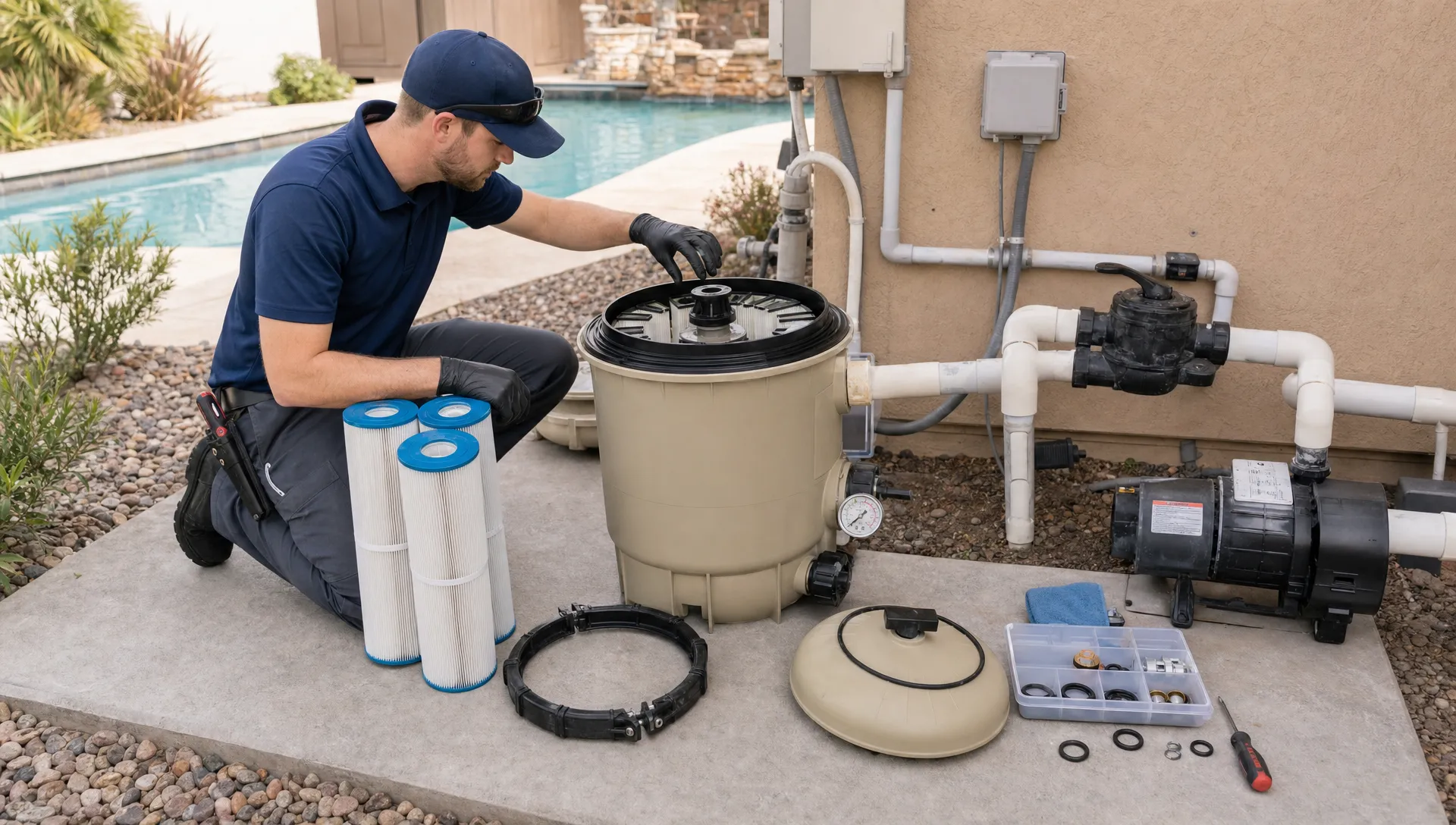
A proper repair inspection should include the cartridge fabric, end caps, center cores, bands, manifold, air relief screen, and tank O-ring. If cartridges are crushed, fuzzy, cracked, chemically damaged, or no longer cleaning up after a soak and rinse, replacement is usually more economical than repeated labor.
Technicians should avoid diagnosing cartridge condition by appearance alone. A cartridge can look acceptable but still restrict flow if oils, scale, or fine debris have embedded deep in the pleats. Pair visual inspection with pressure readings, return flow observations, and water-quality history.
Sand filter repairs
Sand filters are durable, but they are not maintenance-free. Common repair points include laterals, standpipes, drain assemblies, multiport valves, spider gaskets, pressure gauges, and unions.
Sand in the pool is a classic warning sign, but it is not always a simple media issue. It may point to a cracked lateral, damaged hub, broken standpipe, or incorrect reassembly after media service. A leaking or bypassing multiport valve can also cause water-quality complaints because water is not being routed properly through the filter bed.
When changing sand or glass media, document the media type, quantity, date, and any internal parts replaced. That record becomes valuable when a future technician sees recurring symptoms.
DE filter repairs
DE filters can deliver excellent water clarity, but they are sensitive to torn grids, cracked manifolds, damaged air bleeders, incorrect DE amounts, and valve issues. When DE powder returns to the pool, customers often notice quickly because the water may look dusty or cloudy after startup.
A preventive DE repair should include a careful inspection of grids, seams, manifold connections, standpipes, O-rings, and backwash or separation tank components where applicable. If the same pool repeatedly needs extra DE, has powder in the pool, or shows pressure instability, do not stop at a backwash. Find the bypass point.
Valve, gauge, and O-ring repairs
Small parts cause a large share of emergency calls. A stuck pressure gauge can hide a restriction. A dry O-ring can create a leak that worsens after the technician leaves. A worn spider gasket can send water where it should not go. A loose union can drip until the pad is wet and the homeowner panics.
These repairs are usually inexpensive compared with an emergency dispatch. They are also easy to explain with photos: show the cracked gasket, the flattened O-ring, the fogged gauge, or the leak under pressure. Visual proof makes approval easier and reduces the chance that a customer thinks the repair was optional upselling.
Build filter repairs into a seasonal maintenance rhythm
Pool filter repairs become easier to sell and schedule when they are part of a seasonal rhythm. Instead of surprising customers with urgent recommendations, set expectations in advance.
| Timing | What to inspect | Why it matters |
|---|---|---|
| Opening or spring startup | Filter internals, pressure gauge, O-rings, unions, valves, media condition | Finds winter damage, dry seals, and parts that may fail once usage increases |
| Mid-season | Pressure trend, cleaning frequency, return flow, water clarity, cartridge or grid condition | Catches load-related issues before peak summer complaint volume |
| After storms or heavy debris | Pressure rise, skimmer and pump baskets, filter restriction, waste-line leaks | Prevents debris events from turning into cloudy or green pools |
| Before closing or off-season | Leaks, drain plugs, clamp condition, media age, parts needed for next season | Creates planned winter or early-spring repair opportunities |
This rhythm also helps with inventory planning. If your company knows which routes have aging cartridge sets, failing multiport valves, or DE grids nearing replacement, you can stock parts more intelligently and reduce return trips.
Do not ignore water source and surrounding systems
Sometimes the filter is blamed for a problem that starts elsewhere. High debris load, metals, scale, poor water balance, suction leaks, drainage problems around the pad, and fill-water issues can all affect filter performance.
For example, hard or iron-heavy fill water can increase staining, scale, and filter loading. Poor drainage around an equipment pad can make small leaks seem worse or create electrical and safety concerns. Homeowners may also confuse pool plumbing with household plumbing, especially when equipment sits near exterior drains, hose bibbs, or utility areas.
When the problem is outside the pool system, it is better to say so clearly and coordinate with the right trade. For homeowners dealing with related plumbing, drain, or water-treatment issues, a local specialist such as licensed plumbing, drain cleaning, and water treatment services can address problems that fall outside the pool service scope.
That kind of boundary protects your technicians and strengthens trust. Customers appreciate when you solve what you can and point them to the right expert for what you should not touch.
Document every filter recommendation like it may become a callback
The best filter repair program depends on documentation. Without it, each visit starts from scratch. The technician may not know the last clean pressure, the office may not know which parts were recommended, and the customer may not remember why a repair was declined.
At minimum, your team should capture:
- Filter make, model, type, and approximate age when available
- Clean pressure baseline and current pressure reading
- Photos of damaged cartridges, grids, laterals, valves, leaks, or gauges
- Water-quality readings that may explain filter loading
- Repair recommendation, urgency, and customer approval status
- Parts used, labor performed, and next inspection date
This is where software matters. When equipment notes, visit history, customer communication, and follow-ups live in one place, filter repairs stop falling through the cracks. SplashIQ’s pool service CRM is built to organize customer and property details, equipment, visit history, leads, and follow-ups so teams can see the context behind each service recommendation.
Documentation also helps you coach technicians. If one route has a high number of filter-related callbacks, the issue may be training, parts availability, unclear customer communication, or incomplete inspection notes. Technician scorecards and visit records can reveal patterns that are hard to see from memory alone.
Make the homeowner conversation simple
Customers do not need a lecture on hydraulics. They need a clear explanation of the risk, the repair, and the consequence of waiting.
A strong filter repair recommendation sounds like this: The filter is running 10 psi above its clean baseline, and the cartridges are no longer cleaning up properly. That means the pump is working harder and the pool is more likely to turn cloudy between visits. We recommend replacing the cartridge set before the weekend instead of waiting for an emergency call.
Another example: We found DE returning to the pool and traced it to a damaged grid. Backwashing will not fix that. Replacing the grid now should stop powder from returning and protect water clarity.
The best conversations include a photo, a pressure reading, and a simple next step. If your company offers online payments, homeowner financing, or a homeowner portal, use those tools to make approval easier while the issue is fresh.
Turn emergency calls into scheduled work
Pool filter repairs are a profit and retention opportunity when handled proactively. They reduce after-hours stress, improve route efficiency, protect water quality, and show homeowners that your company is paying attention.
The operational formula is straightforward: inspect consistently, document clearly, explain simply, and schedule promptly. A pressure gauge replacement today may prevent a cloudy-pool complaint next week. A cartridge replacement before a holiday weekend may prevent an emergency dispatch. A documented valve repair may prevent repeated water-loss calls.
No checklist or software can prevent every failure. But a disciplined filter repair process can dramatically reduce preventable emergencies and help your team look more professional at every visit.
Frequently Asked Questions
What are the most common pool filter repairs? The most common pool filter repairs include replacing pressure gauges, O-rings, cartridges, DE grids, manifolds, laterals, spider gaskets, drain plugs, unions, and air relief parts. The exact repair depends on the filter type and symptoms.
How often should pool filters be inspected? Pool filters should be visually checked during routine service, with deeper inspections at opening, mid-season, after heavy debris events, and before closing. Always adjust frequency based on pool use, water conditions, manufacturer guidance, and local requirements.
When should a pool filter be replaced instead of repaired? Replacement is usually the safer choice when the tank is cracked, bulging, structurally damaged, obsolete, undersized, or repeatedly failing despite proper repairs. Pressure-vessel damage should not be treated like a routine patch job.
Why does filter pressure keep rising after cleaning? Fast pressure rise can come from algae, fine debris, scale, oils, worn media, undersized equipment, or cartridges and grids that no longer clean properly. Record the clean baseline pressure and compare it with current readings to guide the diagnosis.
How can pool service companies reduce filter-related emergency calls? Standardize inspections, record pressure readings, photograph damage, track equipment history, communicate repair urgency clearly, and schedule approved repairs before peak-demand periods.
Ready to make filter maintenance less reactive? SplashIQ helps pool service companies manage CRM, scheduling, water-quality logs, equipment tracking, field operations, homeowner communication, and billing in one operating system built for pool service teams.