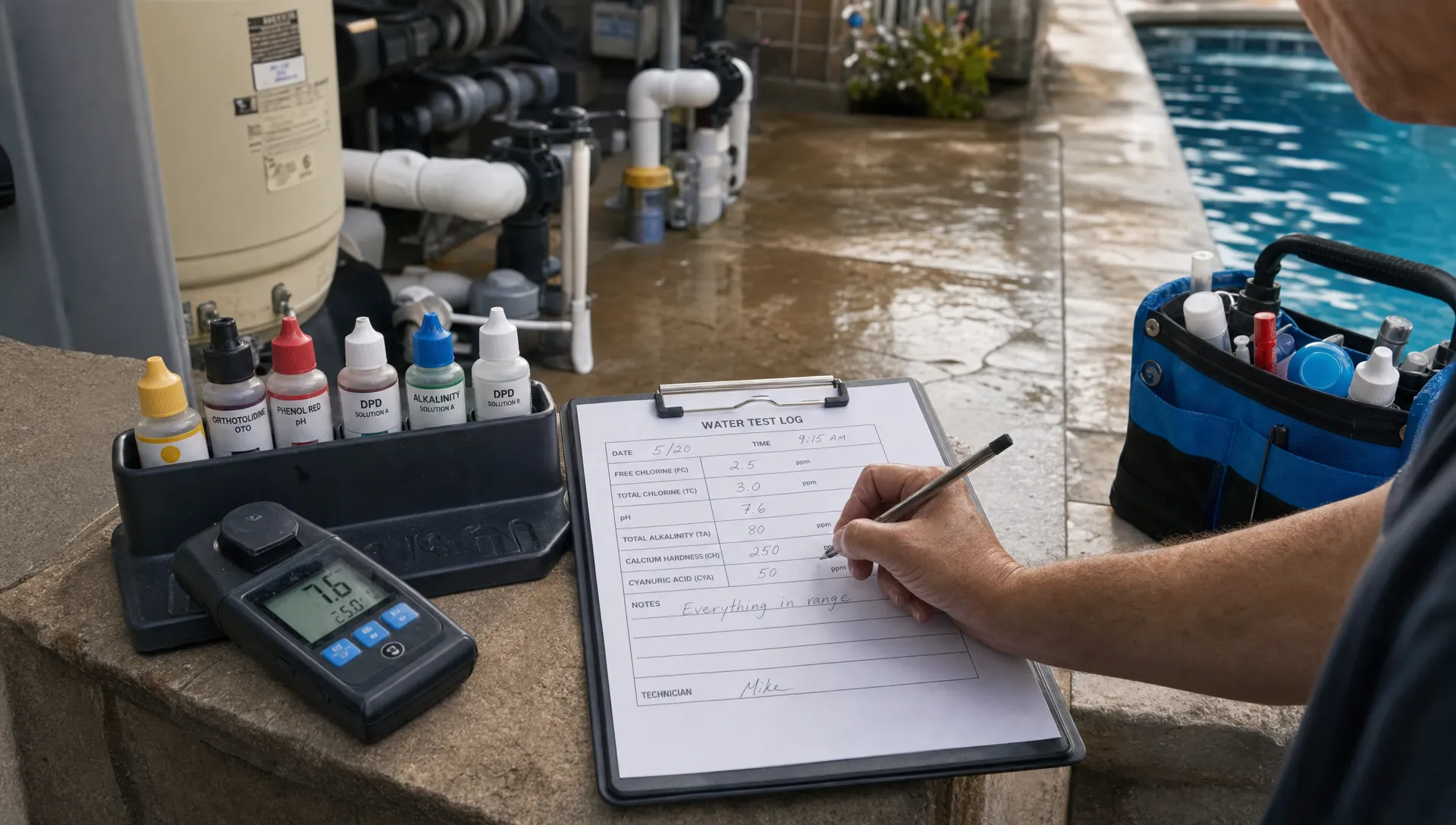
A pool water test only helps if the result turns into a clear decision. For pool service companies, the hard part is rarely taking a reading. It is remembering what happened last week, seeing whether the chemistry is drifting and proving to the homeowner that the visit actually improved the water.
Good records make chemistry easier because they turn scattered readings into a pattern. When the office, route manager and technician can see the same history, they do not have to guess whether low sanitizer is a one-time issue, a swimmer-load problem, a dosing mistake or a circulation issue hiding in plain sight.
Why chemistry gets harder when records are weak
Pool chemistry is cumulative. A reading taken today reflects yesterday's weather, last week's chemical dose, recent debris load, equipment performance, bather use and how consistently the pool has been serviced. If those details live on paper slips, in text messages or in one technician's memory, the next visit starts with missing context.
That is why repeat problems often look like chemistry failures when they are really recordkeeping failures. A tech sees low chlorine, adds product and moves on. The next tech sees the same issue days later, adds more product and still has no explanation. Without a trend, the team treats the symptom over and over.
The CDC's Healthy Swimming resources also reinforce a simple point: sanitizer and pH control are central to safe, usable water. For residential service companies, the business lesson is just as practical. If those readings are not captured consistently, it becomes harder to protect water quality, train technicians and explain your work.
What a pool water test record should include
A useful record is not a chemistry novel. It is a structured snapshot that captures the conditions, the readings, the treatment and the reason behind the treatment. The goal is to help the next person make a faster, better decision.
For target ranges and dosing reference points, keep a separate standard your team can rely on, such as this pool water chemistry cheat sheet. The service record should show what happened at the property during the actual visit.
| Record field | What to capture | Why it helps |
|---|---|---|
| Visit context | Date, time, technician, route, weather notes and visible pool condition | Explains why readings may differ from the prior visit |
| Test method | Strip, drop kit, photometer or store test, when relevant | Makes results easier to compare across technicians |
| Core readings | Free chlorine, combined chlorine if used, pH, alkalinity, calcium hardness, CYA, salt and temperature when needed | Creates a trend line instead of a single number |
| Treatment | Product added, amount, location and any brushing or circulation step | Shows the action tied to the reading |
| Equipment notes | Pump operation, filter pressure, salt cell status, leaks, automation alerts and visible damage | Connects chemistry problems to circulation or equipment issues |
| Homeowner factors | Heavy use, pets, parties, fill water, recent storms or landscaping debris | Adds context the test alone cannot provide |
| Proof of service | Photos, task checklist and homeowner-facing summary | Reduces disputes and improves trust |
A complete pool water test record should separate what the technician observed from what the technician did. That distinction matters because a later technician may need to decide whether the prior treatment worked, whether the problem returned or whether another cause is likely.
From readings to decisions: how to make logs useful
The best records are easy to scan. If a supervisor has to open five notes, two photos and a text thread to understand a pool, the record is too fragmented. A technician should be able to see recent readings, recent treatments and unresolved notes before stepping into the backyard.
Treat each pool water test as a service decision, not a detached measurement. For example, low sanitizer plus normal pH may point to one action. Low sanitizer plus high CYA may point to a different conversation. High pH with rising alkalinity may suggest fill-water patterns, spillover aeration or a recurring homeowner habit.
Good records also protect against overcorrection. When the previous dose is visible, a technician can avoid stacking chemicals too aggressively. When the last several readings are visible, the team can see whether a pool is slowly stabilizing even if today's result is not perfect yet.
What Reddit discussions reveal about missing context
Reddit is not a substitute for certified training or your company's standards, but it is a useful place to see how confusing pool chemistry feels to homeowners. In r/pools discussions about test results and green water, the same pattern appears again and again: people post a symptom, then commenters ask for the full test results before giving useful advice.
That pattern is worth noticing. Homeowners often remember the visible problem, not the water history. They know the pool turned cloudy, the chlorine disappeared or the surface feels rough. They usually do not know whether the issue started after a storm, a heavy swim weekend or a missed equipment warning.
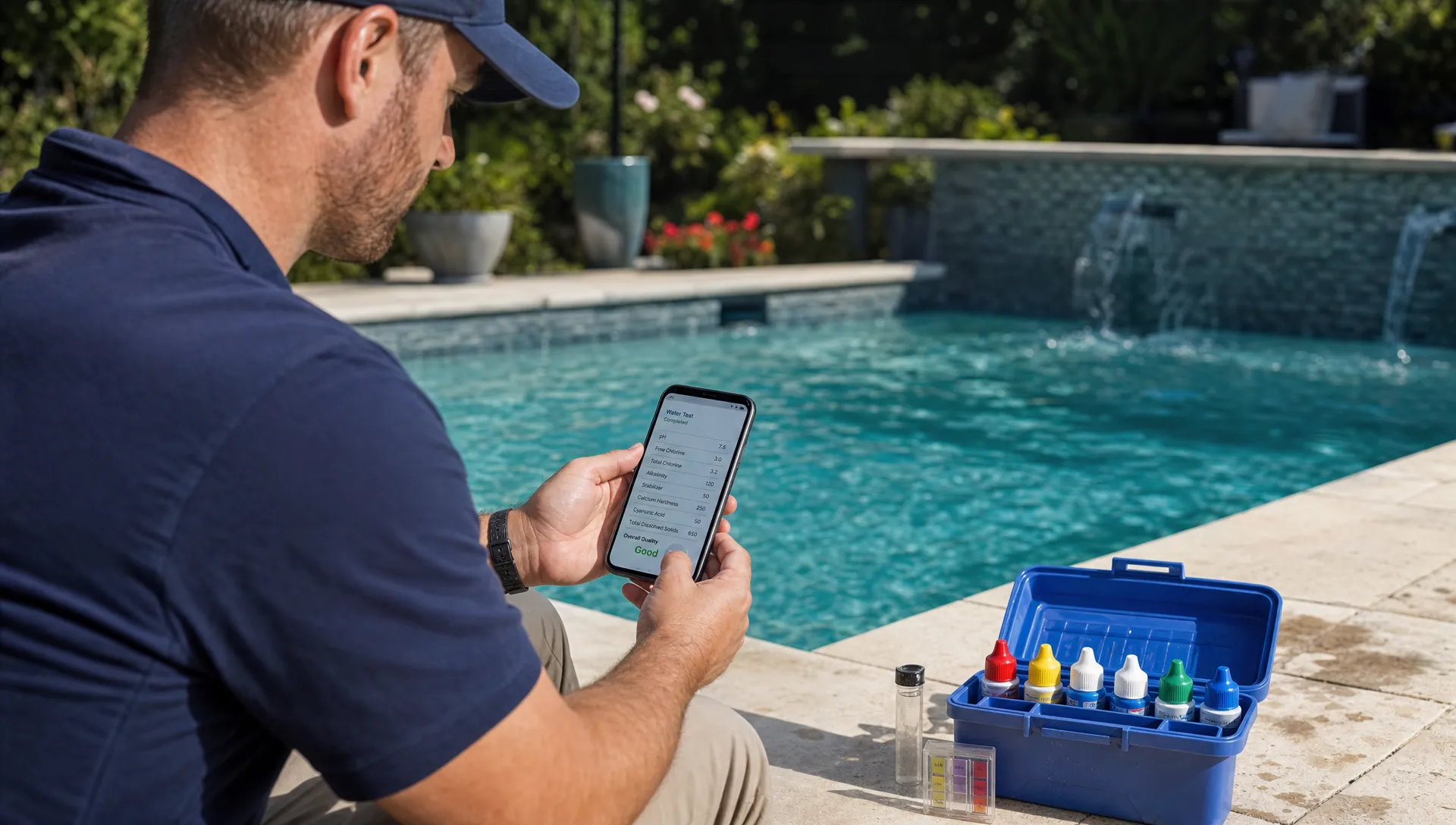
The value of a pool water test record is that it gives the next person the full story without forcing them to rebuild it from memory. It also helps the office answer homeowner questions with specifics instead of vague reassurance.
Records that technicians can actually maintain
A record system only works if technicians can use it quickly in the field. If logging takes too long, busy routes will expose the weak spots. If it depends on perfect cell service, rural routes and backyard dead zones will create gaps. If fields are optional, each technician will develop a different version of the truth.
Service companies usually get better compliance when the workflow is standardized around a short set of required fields. The technician should not have to design the note from scratch at every stop. They should follow the same sequence: inspect, test, record, treat, document, notify.
This is where mobile tools matter. A field app can make readings, photos and visit notes part of the same workflow instead of separate chores. SplashIQ's pool service technician app and chemical calculator is built for treatment planning, water-test tracking and visit reports, which helps techs capture the data while they are still at the property.
Offline access is also important for consistency. If a technician can complete the record without a reliable signal, then sync it later, the company avoids blank visits caused by connection issues rather than service issues.
How chemistry records help pool businesses scale
When a pool company has one owner-operator, chemistry history often lives in that owner's head. That can work for a small route, but it breaks down when the business adds technicians, office staff, new service areas and more demanding homeowners.
Contractor CRM articles, including Jobber's guide to contractor CRM software, make a broader scaling point: service businesses grow more cleanly when customer history, scheduling, estimates, notes and follow-up live in one organized system. Pool companies have the same need, with one extra layer. Their customer history includes water quality and equipment behavior, not just calls and invoices.
With the right process, a pool water test becomes part of the customer history. A manager can review problem accounts, spot training gaps and see whether certain routes have more repeat chemistry issues. A dispatcher can send the right technician back to a complex property. The office can answer homeowner questions without interrupting the route.
If callbacks are a recurring issue, the connection between service documentation and repeat visits is worth tightening. SplashIQ has a deeper breakdown of how better records help pool technicians prevent callbacks, especially when readings, equipment notes and homeowner communication are captured together.
A simple record template for weekly service
You do not need a complicated form to improve chemistry decisions. Start with a consistent template that every technician can finish quickly. The best pool water test record is the one your team will actually complete on a normal, hot, behind-schedule service day.
A practical weekly template can include these fields:
- Property, visit date, technician and route
- Pool condition on arrival, including clarity, debris and visible algae
- Core water readings, with test method if your team uses more than one
- Chemicals added, dose amount and reason for treatment
- Equipment status, including pump, filter, heater, salt system and automation notes
- Photos when condition, repairs or homeowner proof are needed
- Homeowner message, next-step recommendation or issue to review
That template gives technicians enough structure to stay consistent without turning the visit into paperwork. It also gives managers a clean way to compare service quality across routes.
Make records useful for homeowners too
Homeowners do not need every internal note, but they do appreciate proof that the visit happened and that the water is being managed. A clear after-visit update can translate technical readings into plain language, especially when the pool needs monitoring or a follow-up recommendation.
For example, instead of saying only pH adjusted, the update can say that pH was high on arrival, product was added to bring it back toward the service range and the team will recheck it at the next visit. That kind of message reduces anxiety because it explains the condition, the action and the next step.
SplashIQ supports homeowner outreach, arrival and service notifications, a homeowner portal, before and after photos, online payments and billing workflows. When water-quality logs live alongside those customer touchpoints, chemistry documentation becomes part of the service experience rather than an internal file nobody sees.
Frequently Asked Questions
How long should a pool service company keep water-quality records? Keep enough history to understand seasonal patterns, recurring issues and service disputes. Many companies benefit from having prior readings, treatments, photos and equipment notes available for the full customer relationship, especially for accounts with repeat chemistry or equipment problems.
What should be included in a pool water test record? A pool water test record should include the visit context, core readings, test method, chemicals added, equipment observations, photos when useful and any homeowner-facing recommendation or follow-up note.
Are photos as important as chemical readings? Photos do not replace readings, but they add proof and context. They are especially useful for cloudy water, algae, storm debris, low water levels, damaged equipment and before or after service documentation.
Should homeowners receive every chemistry detail after service? Usually, homeowners need a clear summary rather than a technical data dump. Share the readings and actions that matter, explain concerns in plain language and document next steps so expectations are clear.
Turn water records into an easier service workflow
Chemistry gets easier when technicians do not have to rely on memory, paper notes or disconnected photos. Consistent records help the team see trends, reduce repeat work and communicate with homeowners more confidently.
SplashIQ brings CRM, scheduling, water-quality logging, equipment tracking, homeowner communication and billing into one operating system for pool service companies. If your team is ready to replace scattered checklists with a cleaner workflow, SplashIQ can help make every visit easier to manage from first lead to final invoice.