When a pool technician gets called back to fix cloudy water, a tripped breaker or a homeowner complaint, the real problem is not always the work performed. Often it is the record left behind: incomplete readings, vague notes, missing photos or no clear explanation of what changed since the last visit. Better records turn each stop into a usable history, which helps service companies prevent repeat visits before they eat up route capacity and profit.
For pool service owners, callbacks are more than an operational annoyance. They create unpaid drive time, push scheduled work later in the day and make customers question whether the weekly visit was thorough. The fix is not only “work harder.” It is to make every visit easier to understand for the next tech, the office and the homeowner.
Why better records matter for every pool technician
A callback usually starts with a gap in context. The homeowner says the pool was clear on Monday and green on Thursday. The office asks what was tested, what was added and whether the pump was running. If the visit note says “serviced pool,” nobody has enough information to separate a missed step from a new issue.
Good records make the service visit defensible and repeatable. They show what the technician saw, what they tested, what they adjusted and what needs attention next. That matters when a customer disputes a bill, when a new tech inherits a route or when a recurring equipment issue keeps showing up at the same property.
For a pool technician, records also reduce mental load. Instead of remembering which DE filter had rising pressure, which gate code changed or which homeowner dislikes early-morning arrivals, the tech can rely on the account history. The best teams treat records as part of the service, not as after-the-fact admin work.
What to record at every pool service visit
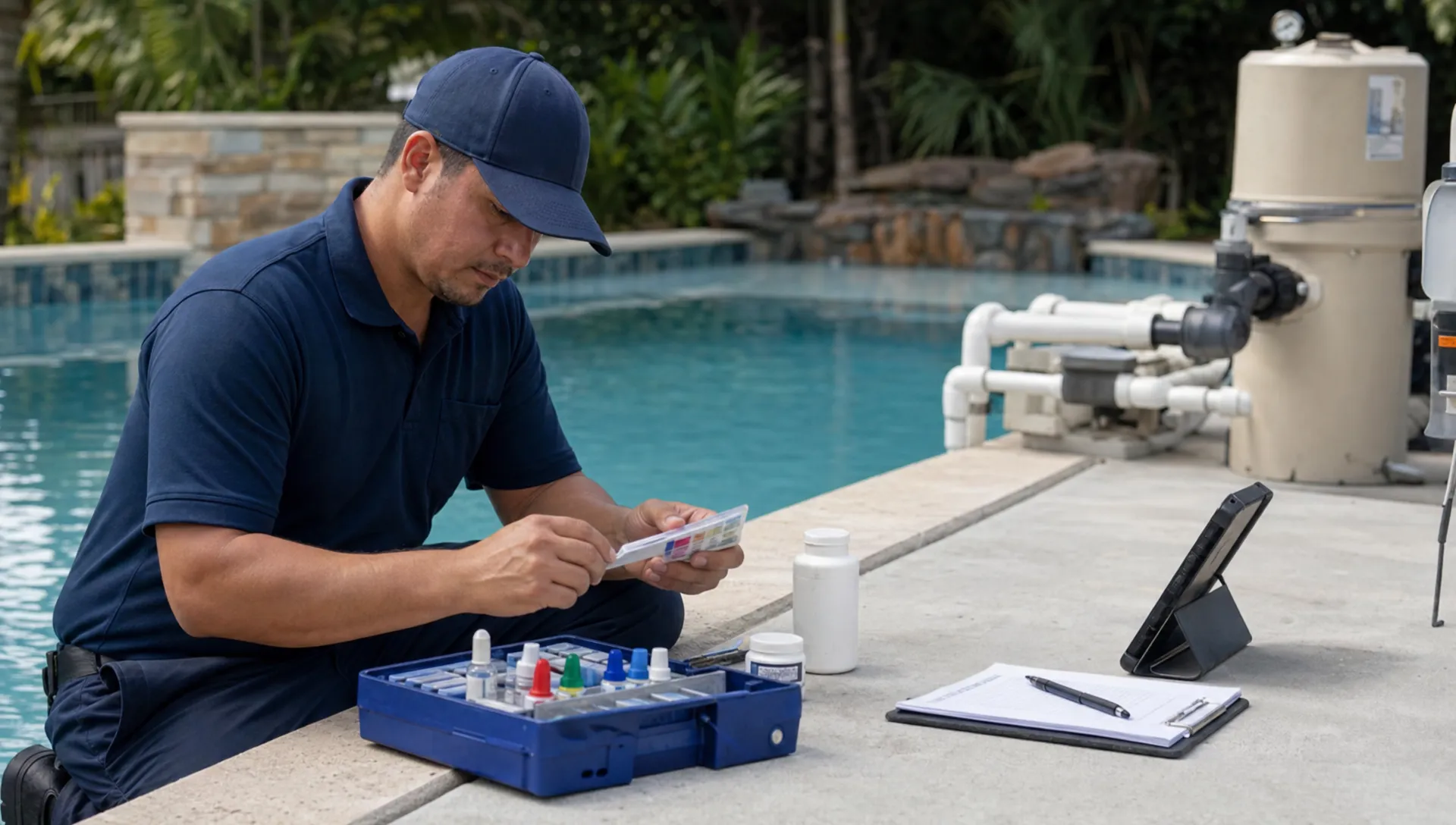
The record does not need to be long. It needs to be specific enough that another person can understand the state of the pool without standing in the backyard. A pool technician should capture the conditions that affect water quality, equipment performance and customer expectations.
| Record category | What to capture | Callback risk reduced |
|---|---|---|
| Water chemistry | Chlorine, pH, alkalinity, stabilizer, salt and other readings relevant to the pool | Cloudy water, algae complaints, chemical imbalance disputes |
| Work performed | Brushing, skimming, vacuuming, basket cleaning, filter cleaning and chemical additions | “Was the pool actually serviced?” questions |
| Equipment status | Pump noise, filter pressure, leaks, automation alerts, heater or salt cell behavior | Emergency calls caused by missed early warnings |
| Photos | Before-and-after condition, unusual debris, broken parts, closed valves or visible stains | Confusion about what changed after the visit |
| Customer notes | Access issues, pets, gate codes, homeowner preferences and requested follow-up | Missed appointments, service delays and communication complaints |
The value comes from consistency. If one tech writes detailed water readings and another writes only “OK,” the office cannot compare visits across the route. Standard fields, required photos and simple checklists help teams collect useful records without turning the stop into paperwork.
Water-quality records catch small problems early
Pool chemistry callbacks often feel sudden, but the warning signs usually appear in the record first. Rising combined chlorine, drifting pH, low stabilizer, high phosphates or a filter that is not keeping up can all point to trouble before the homeowner sees cloudy water.
When a pool technician logs readings at every visit, the company can see trends instead of isolated numbers. A single low chlorine reading might be a one-time demand spike after heavy use. Repeated low readings at the same property suggest a feeder issue, undersized output, excessive debris load or a homeowner usage pattern that needs a different service plan.
This is where records help both quality and accountability. The tech can explain what changed, the office can approve the right follow-up and the homeowner can see why the recommendation is being made. For a deeper look at the operational side of chemistry problems, SplashIQ’s guide to pool water chemistry mistakes that lead to repeat visits covers the common process gaps behind repeat service calls.
Equipment history prevents “mystery” failures
Equipment callbacks are especially frustrating because they often start with subtle symptoms. A pump takes a little longer to prime. Filter pressure climbs from one visit to the next. A heater shows an intermittent error. A salt cell is nearing the end of its useful life, but the note never makes it back to the office.
A pool technician can prevent many of these repeat visits by recording equipment observations in the same place each time. The goal is not to write a repair manual in the field. The goal is to create a trail that shows whether a problem is new, recurring or getting worse.
Strong equipment records should connect the asset, the symptom and the next action. “Filter pressure 28 PSI, up from 20 PSI last visit, recommend filter clean” is far more useful than “filter dirty.” The first note supports scheduling, quoting and homeowner approval. The second note leaves the office guessing.
Homeowner communication records reduce trust issues
Many callbacks are not technical failures. They are expectation failures. The homeowner did not know the tech came by, did not understand why the pool still needed time to clear or did not receive a photo showing that a broken part was already documented.
A quick scan of Reddit posts and comment threads in communities like r/pools shows how often homeowners judge pool service by communication. Common complaints include “they never tell me what they did,” “my pool turned green after service” and “I keep paying but do not know what is being checked.” Reddit is not formal research, but it is useful voice-of-customer material because it captures the exact frustrations customers write when they feel ignored.
For a pool technician, a clear service record gives the office a better way to respond. Instead of sending a defensive message, the company can say, “Your readings were within range on Tuesday, the filter pressure was elevated, and the tech recommended a cleaning. Here are the photos from the visit.” That kind of response is specific, calm and much more likely to preserve trust.
Arrival notifications, service summaries, before-and-after photos and homeowner portal access all support the same goal: make the work visible. When homeowners can see what happened, they are less likely to assume nothing happened.
Better records help service businesses train and scale
Records are also a management tool. Owners cannot improve what they cannot see. If callbacks cluster around certain routes, service types, technicians or properties, the company needs structured data to find the pattern.
A pool technician with strong records gives managers material for coaching without making the conversation personal. Instead of saying “you are getting too many complaints,” the manager can review missed readings, skipped photos, incomplete equipment notes or routes where service time is consistently too short. Technician scorecards work best when they are based on observable actions, not guesswork.
Contractor-focused CRM articles make the same point in a broader trade context. Jobber’s guide to CRM for contractors explains how organized customer information, job history and communication help service businesses manage work as they grow. ServiceTitan’s contractor CRM overview also frames CRM as a way to centralize customer details, scheduling and follow-up rather than letting information live in notebooks, texts and memory.
For pool companies, the lesson is straightforward. Better records help turn individual technician knowledge into company knowledge. That makes training easier, scheduling more reliable and quality control less dependent on who happens to answer the phone.
How to build the record habit without slowing the route
The objection from the field is predictable: “I do not have time to type a report at every stop.” That concern is valid. If recordkeeping adds too much friction, techs will skip it or fill in the bare minimum.
The answer is to design records around the visit flow. A pool technician should be able to log chemistry, check off completed tasks, add photos and flag equipment issues in seconds. Drop-down fields, saved notes, required readings, mobile photo capture and offline access all matter because pool routes often include weak signal areas and tight schedules.
A practical service record system should make these actions easy:
- Capture standard water readings before chemical adjustments are forgotten.
- Attach photos to the correct customer, visit and piece of equipment.
- Flag repair opportunities for office review without a separate text thread.
- Send homeowners a clear visit summary when the work is complete.
- Preserve the history for the next tech assigned to that property.
This is where connected software helps more than spreadsheets or paper. SplashIQ brings CRM, scheduling, water-quality logs, equipment tracking, homeowner communication and payments into one operating system for pool service companies. If your team is also rethinking the whole service flow, the SplashIQ article on smart pool service workflows that reduce callbacks expands on how intake, routing, documentation and follow-up work together.
Better records turn callbacks into preventable patterns
Not every callback can be eliminated. Storms happen. Equipment fails. Homeowners host parties, dogs swim and landscaping crews blow debris into the water. The point is not to pretend every problem is controllable.
The point is to stop treating every repeat visit like a surprise. When records are complete, a pool technician can see what happened last time, the office can make faster decisions and the homeowner can understand why a recommendation matters. Over time, those records reveal which pools need plan changes, which equipment needs proactive repair and which internal processes need tightening.
For more on consistency across routes and visits, SplashIQ’s article on pool maintenance software that helps techs stay consistent explains how standardized checklists and field visibility support reliable service.
Frequently Asked Questions
What records should a pool technician keep to prevent callbacks? A complete visit record should include water readings, chemicals added, cleaning tasks completed, equipment observations, photos, access notes and any recommended follow-up. The most useful records are specific enough for another tech or office manager to understand the account without asking the original technician.
Do photos really reduce pool service callbacks? Photos help reduce confusion because they show the condition of the pool, equipment and surrounding area at the time of service. They are especially useful for storm debris, broken parts, stains, closed valves, low water levels and before-and-after proof of completed work.
How can pool companies get technicians to write better notes? Make notes fast and structured. Use required fields for key readings, simple checklists for completed work, photo prompts and short issue categories instead of open-ended typing for every detail. Field teams are more likely to document well when the system matches the route workflow.
Can CRM software help contractors reduce callbacks? Yes, when the CRM connects customer history, scheduling, communication and job notes. For pool service companies, CRM data becomes more valuable when it is tied to water-quality logs, equipment records, photos and homeowner notifications.
Run cleaner routes with service records your whole team can use
If your company is still relying on paper checklists, scattered texts and memory, callbacks will keep slipping through the cracks. SplashIQ gives pool service teams one place to manage customer records, routes, field notes, water-quality logs, equipment history, homeowner updates and payments.
See how SplashIQ can help your team turn better documentation into fewer repeat visits, clearer communication and more reliable weekly service at SplashIQ.