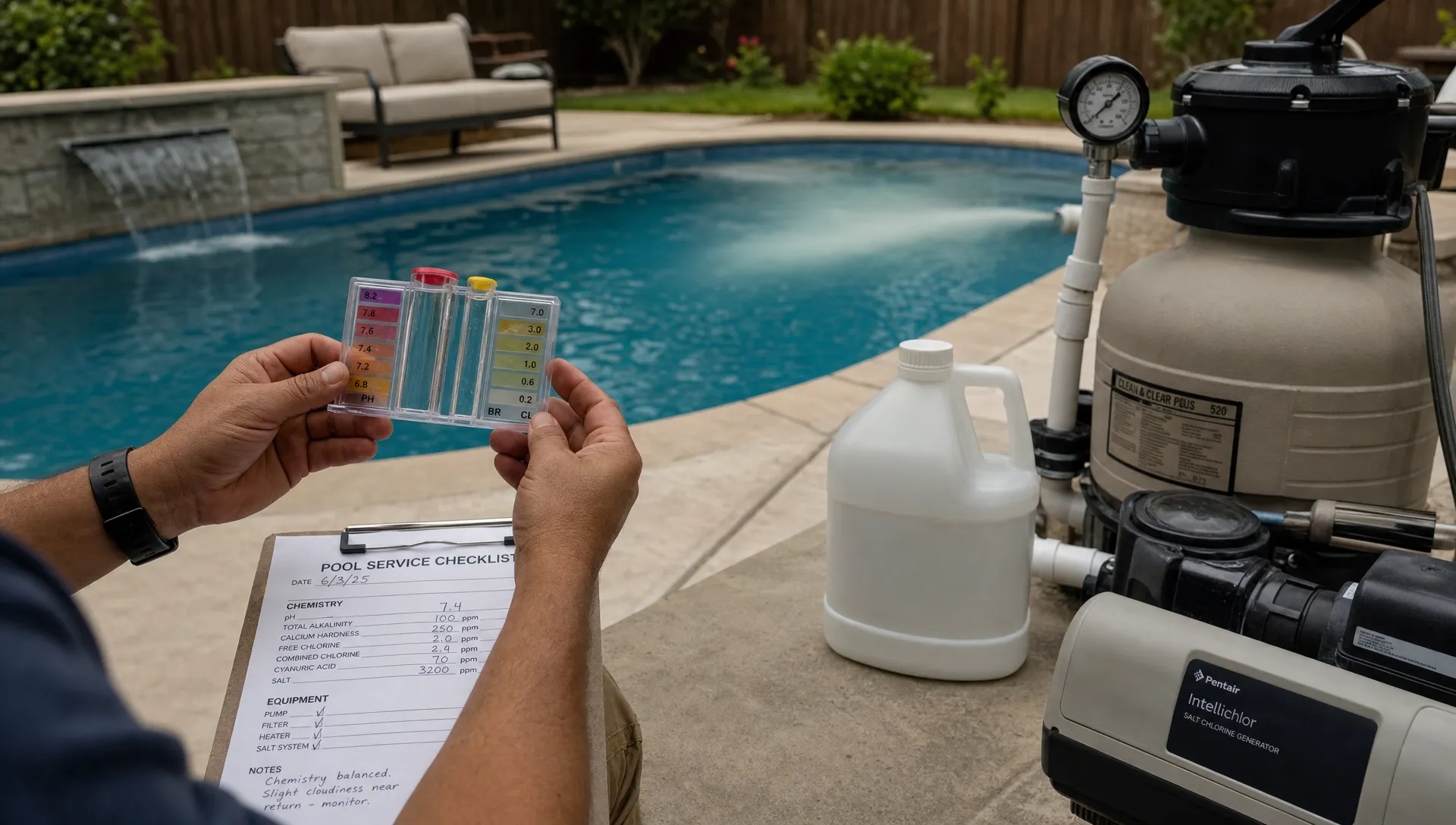
Repeat visits rarely come from one bad test strip or one missed scoop of chemical. They usually come from a weak process around pool water chemistry: unreliable readings, incomplete notes, rushed dosing, poor equipment context, and no clear trigger for follow-up.
For a pool service business, chemistry mistakes are especially expensive because they do not stay in the water. They spill into the route schedule, the office phone, the customer relationship, and the technician’s confidence. A green pool after a routine stop can become an emergency call. Cloudy water after a shock treatment can become a second trip. A pH problem that keeps drifting can become a frustrated homeowner asking why they pay for weekly service.
The goal is not to turn every technician into a chemist. The goal is to make pool water chemistry consistent enough that the team can catch risk early, document what happened, and avoid preventable callbacks.
Why chemistry callbacks are usually process problems
Pool water changes fast. Sunlight, rain, temperature, bather load, landscaping, fill water, equipment run time, and chemical history all affect what a technician sees on arrival. A reading from last week is useful context, but it is not a control point for today.
That is why repeat visits often happen when a company treats chemistry as a one-time task instead of a workflow. The technician tests, adds product, leaves, and hopes the water behaves. If the result is not documented in a way the office can see, nobody knows whether the pool needs a follow-up, a repair estimate, a homeowner message, or a change in the next service plan.
The most reliable companies build a loop: test, interpret, dose, document, communicate, and trigger follow-up when readings fall outside the expected pattern.
Mistake 1: Testing water in a way that creates bad data
Every chemistry decision depends on the sample. If the sample is wrong, the treatment plan is guesswork.
Common testing mistakes include pulling water from the surface, testing next to a return jet, using expired reagents, reading color tests in poor light, and testing too soon after chemicals were added. A tech may think the pool needs more sanitizer, acid, or alkalinity adjustment when the real issue is sample location or timing.
A better standard is simple: collect from elbow depth, away from returns and skimmers, use clean testing supplies, follow the kit instructions, and record the method. If a company uses different test methods across technicians, it should define which readings count as the source of truth.
The CDC’s healthy swimming guidance emphasizes the importance of disinfectant and pH control for swimmer comfort and safety. Commercial and residential service requirements vary, but the lesson for route work is universal: consistent testing matters before any chemical decision is made.
Mistake 2: Treating the symptom instead of the cause
Cloudy water does not always mean the pool needs more chlorine. Green water does not always mean the last dose was too small. Scale does not always mean the surface is failing. A pool can look like a chemistry problem while the root cause is circulation, filtration, debris load, incorrect runtime, high stabilizer, or a homeowner behavior the company has not captured.
When technicians dose based only on the visible symptom, they often create a repeat visit. The water may improve for a day, then return to the same condition because the underlying issue stayed in place.
| Symptom on arrival | Common rushed response | Better question to ask | Callback risk if missed |
|---|---|---|---|
| Cloudy water | Add shock only | Is filtration working long enough and is the filter clean? | Water stays dull or turns cloudy again |
| Low sanitizer | Add more chlorine | Is stabilizer, sunlight, organic load, or dosing history driving demand? | Sanitizer disappears before the next visit |
| High pH | Add acid repeatedly | Is alkalinity high, is aeration present, or is a salt system contributing? | pH rises again within days |
| Algae returning | Brush and shock | Are there dead spots, poor circulation, high phosphates, or missed surfaces? | Green dust or spots return |
| Scaling | Add scale product | Is the water saturation balance drifting because of pH, calcium, alkalinity, or temperature? | Scale continues and homeowner loses trust |
This is also where water chemistry and equipment service overlap. A filter problem can make good chemical work look bad, which is why proactive equipment notes matter. If rising pressure, weak flow, or returning debris is part of the pattern, the issue may belong in a repair workflow, not just another dose. SplashIQ has covered this connection in more detail in its guide to pool filter repairs that help avoid emergency calls.
Mistake 3: Ignoring how chemistry factors interact
Pool water chemistry is not a set of isolated numbers. pH, alkalinity, calcium hardness, cyanuric acid, sanitizer, temperature, and total dissolved solids all influence each other.
A technician who only reacts to one number may miss the actual direction of the water. For example, high pH can reduce sanitizer effectiveness and increase scale risk. High alkalinity can make pH harder to control. Cyanuric acid protects chlorine from sunlight, but too much stabilizer can make it harder to maintain effective active chlorine levels. Calcium hardness may be acceptable in one pool but create scale risk in another when pH and alkalinity are also high.
This is why a visit checklist should avoid vague notes like “chemicals balanced” without the actual readings. Balanced compared to what? A plaster pool, vinyl pool, salt pool, indoor pool, and heavily shaded pool may need different interpretation.
A good chemistry note tells the next technician what is happening, not just what was added.
Mistake 4: Treating every pool like the last pool on the route
Route work encourages shortcuts. If a tech services eight or ten pools in a day, it is easy to develop habits based on what worked at the previous property. But two pools on the same street can behave completely differently.
One may have full sun, a salt chlorine generator, a cartridge filter, high swimmer load, and a spa spillover. Another may be shaded, screened, low-use, and manually chlorinated. The same dose can be too little for one and too aggressive for the other.
This is where property history matters. A technician should be able to see recent readings, previous chemical additions, equipment notes, homeowner complaints, photos, and repairs before making a treatment decision. Without that context, the tech is forced to rely on memory or assumptions.
Reddit is a useful reminder of how homeowners experience these failures. In Reddit posts and threads in communities like r/pools, recurring complaints often sound like “my pool is cloudy after service,” “chlorine disappears overnight,” “pH is high every week,” or “the pool turns green right after it was cleaned.” Those posts are not technical references, but they are valuable voice-of-customer data. They show that homeowners usually judge chemistry by outcomes, not by whether the technician completed a checklist.
Mistake 5: Not documenting readings, doses, and conditions
If a pool needs a repeat visit, the first question should be: what changed since the last stop? Without documented readings and actions, the team has to reconstruct the story from memory.
That creates several problems. The office cannot confidently answer the homeowner. The next technician may duplicate the same treatment. The service manager cannot identify whether the issue is training, equipment, weather, or customer behavior. Over time, the company loses the ability to spot patterns across routes.
Good documentation should capture the essentials:
- Test readings before treatment
- Chemicals added and approximate dosage
- Water appearance and visible issues
- Equipment status, including pump, filter, cleaner, and salt system observations
- Photos when the condition may be disputed or needs follow-up
- Any customer communication or recommended next step
This is where paper forms and spreadsheet notes often break down. They may capture data, but not always in a way the office and field can act on quickly. A platform that standardizes visit records and water-quality logs can help technicians stay consistent across routes. For more on that operational side, see SplashIQ’s article on pool maintenance software that helps techs stay consistent.
Mistake 6: Leaving without a follow-up trigger
Some chemistry situations are not finished when the technician leaves. A pool recovering from algae, a major pH correction, a high chlorine demand event, a drain-and-refill plan, or a suspected equipment issue may need another check before the next normal service day.
The mistake is leaving that decision informal. If the tech thinks “someone should check this tomorrow” but does not create a task, note, or schedule change, the company may not act until the homeowner calls.
Repeat visits are less painful when they are planned. A planned follow-up can be routed efficiently, communicated clearly, and tied to a specific reason. An unplanned callback interrupts the day and often feels like a failure to the customer.
Mistake 7: Overcorrecting to look decisive
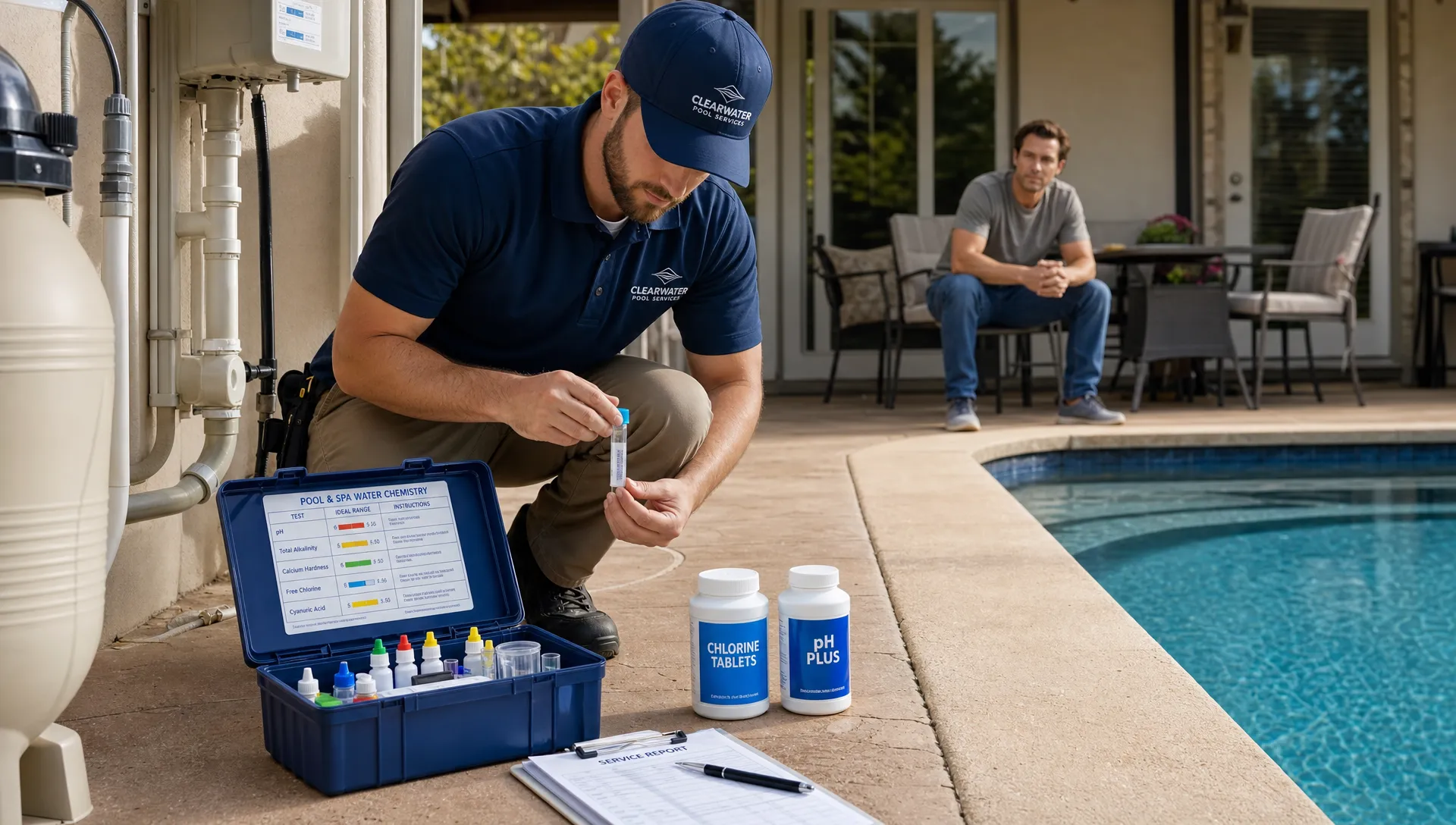
When a homeowner is watching, technicians may feel pressure to fix the problem immediately. That can lead to overcorrection: too much acid, too much shock, too many products added at once, or a treatment that does not account for pool volume and current readings.
Overcorrection can create the next problem. The pool may move from high pH to low pH, from cloudy to irritated, or from mild algae to staining risk if chemicals are applied carelessly. It can also make troubleshooting harder because multiple variables changed at the same time.
A professional response is not always a dramatic dose. Sometimes it is a clear explanation: “This water needs staged correction, and we are scheduling a follow-up because adding everything at once would create more risk.” Homeowners usually respond better when the plan is specific and documented.
Product labels, local requirements, surface manufacturer guidance, and company policy should always guide chemical handling and dosing. A callback avoided by rushing is not a win if the treatment creates damage, safety concerns, or another service issue.
Mistake 8: Separating chemistry from circulation and equipment
Water does not balance in a vacuum. If circulation is poor, sanitizer distribution suffers. If the filter is dirty or damaged, particles remain in the water. If the pump schedule is too short, the pool may not turn over enough for the treatment plan to work. If a salt chlorine generator is underperforming, the numbers may drift between visits.
This is why chemistry notes should be connected to equipment tracking. A recurring low sanitizer reading might point to dosing, but it could also point to cell output, runtime, sunlight, bather load, or stabilizer. A recurring cloudy pool might need a filter cleaning, cartridge replacement, valve inspection, or pump diagnosis.
When chemistry and equipment records live in separate places, the service manager has to connect the dots manually. That slows down decisions and increases the odds of another visit.
Mistake 9: Failing to communicate the plan to the homeowner
Many repeat visits become emotional because the homeowner does not understand what happened. They see a pool that still looks wrong and assume nothing was done.
A short, clear service update can prevent that. The message should explain what was observed, what was tested, what was added or adjusted, and what should happen next. Photos help because they show the condition at the time of service, especially for algae recovery, staining, debris, or cloudy water.
Communication also protects the technician. If a pool was unsafe to swim in, if equipment was not operating, or if a follow-up was recommended, that information should be visible to the homeowner and the office. Silence invites confusion.
Build a pool water chemistry workflow that reduces repeat visits
The best way to reduce chemistry callbacks is to make the workflow repeatable. That does not mean every pool gets the same treatment. It means every pool gets the same quality of assessment.
| Workflow checkpoint | What it prevents | Practical standard |
|---|---|---|
| Reliable test method | Bad dosing decisions | Define sample location, kit type, reagent care, and reading procedure |
| Required readings | Missing context | Capture sanitizer, pH, alkalinity, and other readings required by your service policy |
| Property-specific notes | One-size-fits-all treatment | Record surface, volume estimate, equipment, sun exposure, and known recurring issues |
| Dose documentation | Duplicate or conflicting treatment | Log what was added and why |
| Equipment observations | Chemistry-only troubleshooting | Connect water issues to filter, pump, cleaner, heater, and salt system notes |
| Follow-up rules | Forgotten callbacks | Create triggers for severe readings, algae recovery, unsafe water, or suspected equipment failure |
| Homeowner update | Confusion and complaints | Send clear notes, photos, and next steps after the visit |
The idea is similar to the feedback loops used by growth marketing and innovation teams: observe the signal, test one change, record the outcome, and scale what works. A pool company can use the same discipline on service routes. If a treatment pattern reduces callbacks, standardize it. If a recurring issue keeps appearing, investigate the upstream cause.
How SplashIQ helps make chemistry work visible
SplashIQ is built for pool service companies that want their field work, office follow-up, and customer communication in one operating system. For chemistry-related repeat visits, the most important shift is visibility.
Instead of relying on paper checklists, scattered texts, or memory, teams can use SplashIQ to centralize customer records, route schedules, water-quality logs, equipment tracking, before-and-after photos, and homeowner communication. The offline field app helps technicians keep working when connectivity is limited, while office staff can still manage the broader workflow from lead to invoice.
That matters because repeat visits are rarely solved by one person. The technician sees the water. The office hears the customer. The service manager spots patterns. The homeowner needs clarity. When those pieces are connected, chemistry problems become easier to diagnose and easier to prevent.
If chemistry issues often turn into repair work, approvals, or billing questions, it also helps to connect service notes with the rest of the operation. SplashIQ’s guide to managing pool service and repairs in a more connected way explains how that broader workflow can reduce handoff problems.
Frequently Asked Questions
What pool water chemistry mistake causes the most repeat visits? The most common mistake is dosing before diagnosing. If a technician treats cloudy water, algae, or low sanitizer without checking the full context, the same problem can return because the root cause was not addressed.
How often should pool technicians document chemistry readings? Readings should be documented at every routine service visit and whenever a pool receives corrective treatment. The exact readings required depend on your company policy, pool type, and local requirements, but the record should be detailed enough for another technician to understand what happened.
Can poor filtration look like a chemistry problem? Yes. Weak flow, dirty filters, damaged cartridges, short pump runtime, or circulation dead spots can make water cloudy or allow algae to return even when chemicals were added. Chemistry and equipment notes should be reviewed together.
Why does pH keep rising after service? Recurring pH rise can be related to alkalinity, aeration, salt systems, plaster curing, fill water, chemical choices, or other site-specific factors. Repeated acid additions may be necessary in some cases, but the pattern should be documented and reviewed.
How can pool companies reduce callbacks from green or cloudy pools? Use consistent testing, document readings and doses, connect chemistry notes to equipment observations, create follow-up triggers, and send clear homeowner updates with photos when needed.
Turn chemistry callbacks into a controlled workflow
Repeat visits are not always avoidable, but preventable repeat visits should not be accepted as part of the job. When pool water chemistry is tested consistently, documented clearly, connected to equipment history, and followed by the right communication, service teams can protect their routes and give homeowners more confidence.
If your team is ready to replace scattered notes and paper checklists with one system for scheduling, water-quality logs, equipment tracking, homeowner updates, and payments, explore SplashIQ and see how a connected pool service workflow can reduce the callbacks that slow growth.