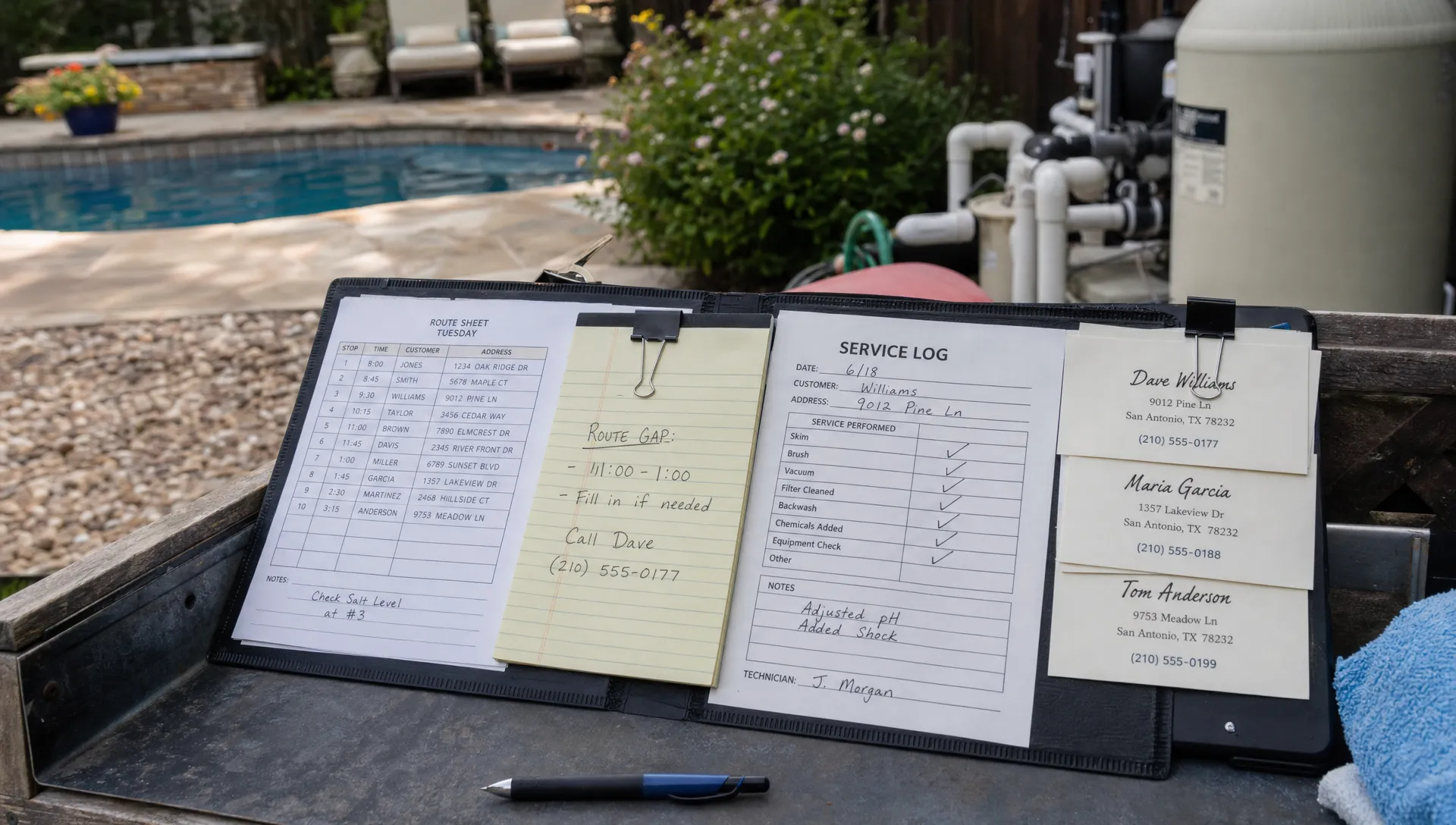
Empty spots in a pool route rarely look dramatic on a calendar. One Tuesday customer cancels, one Friday account pauses for the winter, one estimate never gets a second follow-up. But across a season, those gaps turn into wasted drive time, underused technicians and revenue that should have been captured in neighborhoods you already serve.
That is where CRM marketing becomes useful for pool service companies. Not as a generic email blast tool, but as a practical way to match open route capacity with the right homeowners, on the right streets, at the right time.
The goal is not just “more leads.” The goal is more of the right stops near your existing stops. A full calendar can still be unprofitable if the work is scattered across town. A tighter route with fewer windshield hours, fewer callbacks and better homeowner communication is usually worth more than a bigger route that forces technicians to zigzag all week.
Start by defining what a route gap actually is
A route gap is not only an empty appointment slot. It can be any pocket of unused capacity that prevents a route from producing at its best. For a pool service owner, that might mean a technician has 45 minutes open between two accounts, a route has too few stops in a high-value neighborhood or a newly sold maintenance plan sits far away from the rest of the day’s work.
Contractor-focused CRM articles from companies like Jobber, Housecall Pro and Buildertrend tend to make the same operational point: contractors scale more cleanly when customer history, estimates, scheduling and follow-up live in one system instead of scattered across spreadsheets, notebooks and text messages. For pool service companies, that same principle applies directly to route density.
Reddit can also be useful voice-of-customer research. In r/pools discussions about pool service, homeowners often ask about weekly service value, pricing, green pools, missed visits and whether a provider is doing the right work. In r/smallbusiness CRM discussions, small business owners often talk about outgrowing spreadsheets and losing track of follow-up. Those threads are not formal research, but they reveal the exact language customers and contractors use when service breaks down.
The point of CRM marketing for route gaps is to turn that messy operational reality into targeted actions.
Build a route-gap view inside your CRM
Before running campaigns, you need to know where the gaps are. A list of leads is not enough. Your CRM should connect the homeowner, property, service history and route context so you can see which opportunities actually improve the route.
At minimum, track these fields consistently:
- Property address, neighborhood and ZIP code
- Current route day or preferred service day
- Service type, such as weekly maintenance, filter clean, repair or seasonal opening
- Pool type, equipment notes and access details
- Lead source and first inquiry date
- Estimate status, lost reason and last follow-up date
- Customer status, such as active, paused, canceled, one-time or past customer
This is why pool companies often need a property-focused CRM strategy, not just a contact database. If you are still building that foundation, SplashIQ’s guide to a practical CRM strategy for growing pool service companies explains how to organize records around real service workflows.
Once the data is in place, route gaps become campaign targets.
| Route gap | CRM signal to watch | Best campaign angle |
|---|---|---|
| Open stop near a dense route | Active route has unused capacity in a neighborhood | Neighbor offer or referral request |
| Seasonal slowdown | Customers paused or closed for the season | Pre-season restart campaign |
| Lost estimate in a target area | Estimate marked “not now” or no response | Route-day availability follow-up |
| One-time job completed nearby | Green-to-clean, filter clean or repair marked complete | Maintenance plan conversion |
| Recent cancellation | Customer canceled for price, moving or timing | Win-back or replacement campaign |
| Short-notice opening | Technician has same-week capacity | Standby list message |
A CRM marketing plan for route gaps should start with this kind of table, not with a discount.
Tactic 1: Target neighbors around profitable stops
The fastest way to fill a route gap is often sitting next door to a customer you already serve. If a technician is already on a street every Thursday, every additional account nearby improves route density more than a random lead across town.
Use your CRM to create micro-segments around existing profitable clusters. For example, you might tag all properties within a certain neighborhood, gate community or ZIP code where you already have multiple weekly maintenance accounts. Then run homeowner outreach that references local availability without sounding spammy.
Good messaging is specific:
“We service pools in [Neighborhood] every Thursday and have a limited number of weekly maintenance openings nearby.”
That is stronger than “We are accepting new customers” because it tells the homeowner you are already operating in their area. It also helps your office avoid selling a new stop on the wrong day.
Referral campaigns work especially well here. After a successful service visit, send a simple message to satisfied homeowners asking whether any nearby neighbors need reliable weekly maintenance. If your CRM stores before and after photos, water-quality logs and service notes, your team can use real proof in the follow-up instead of vague claims.
For a deeper look at this approach, SplashIQ’s article on customer segmentation software for denser pool routes covers the segments that matter most for pool service companies.
Tactic 2: Reactivate cold leads by route day
Many pool companies have a hidden backlog of route-filling opportunities in old estimates. These are homeowners who already raised their hand, asked for pricing, sent photos or talked to someone in the office. If they are located near existing routes, they should not sit forgotten in a spreadsheet.
Segment old leads by geography and route day, then send a practical availability message. The best version does not guilt the homeowner or push a generic promotion. It connects their original need to a current route opening.
For example:
“We have a technician in [Area] on Tuesdays and can add a small number of weekly pool service accounts this month. Do you still need help with maintenance?”
Speed matters too. The well-known Harvard Business Review article “The Short Life of Online Sales Leads” reported that companies responding to online leads within an hour were far more likely to have meaningful conversations with decision-makers than those that waited longer. Pool service is local and practical, but the lesson still applies: homeowners often hire the company that replies clearly while the problem is still urgent.
If leads are slipping through the cracks before they even become route opportunities, review SplashIQ’s CRM lead management tips to stop leaks in your pipeline. Strong lead capture makes later route-gap campaigns much easier.
Tactic 3: Win back the right canceled customers
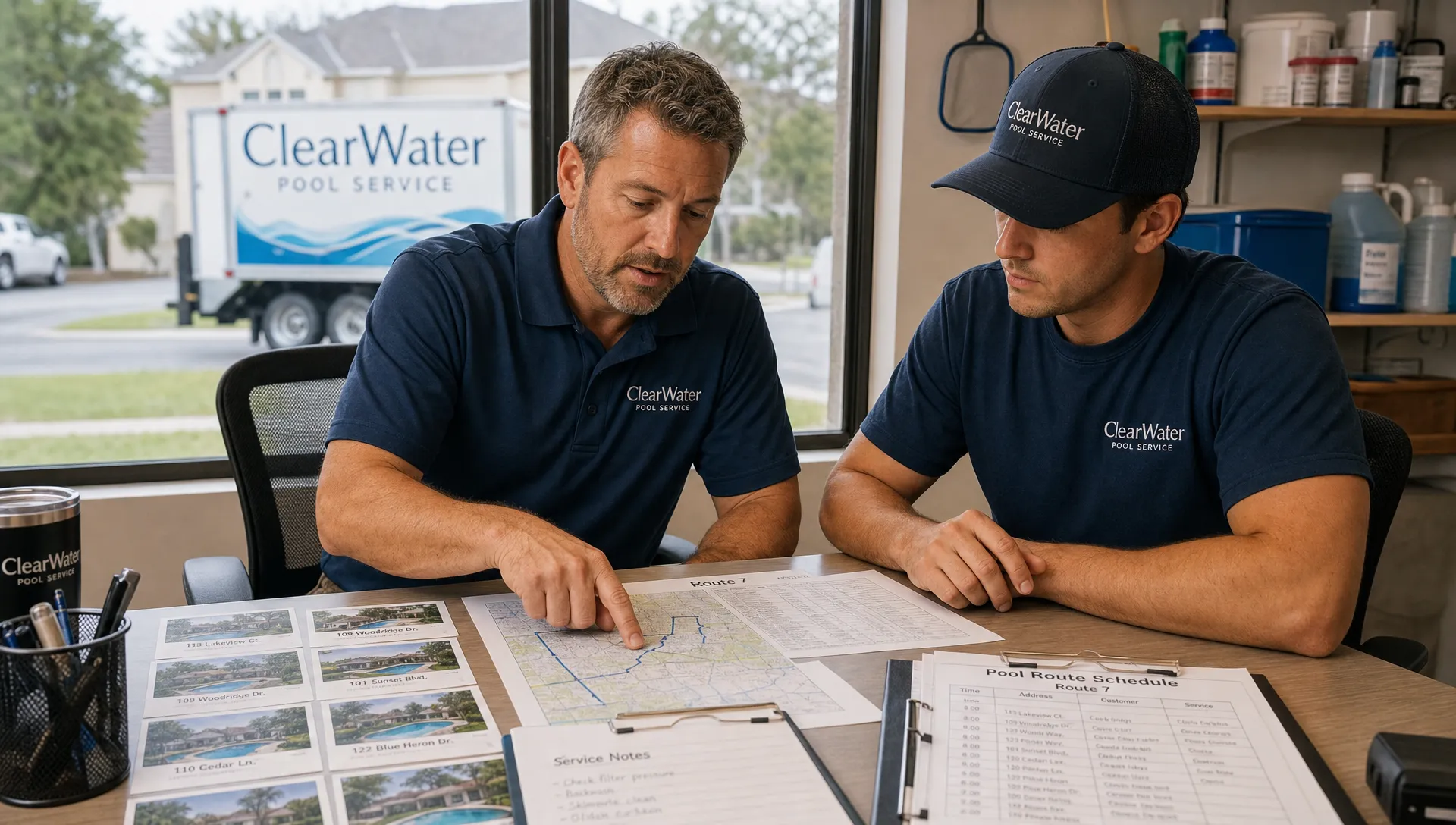
Win-back campaigns can be profitable, but only if you target the right accounts. Some canceled customers are not worth recovering. If a customer was chronically late on payments, refused needed repairs or generated repeated callbacks, replacing that account may be better than winning it back.
Use CRM tags to separate canceled customers by reason. Good candidates for win-back include homeowners who canceled because they were traveling, paused during construction, tried to do service themselves or moved into seasonal use. Poor candidates include accounts with unresolved disputes or repeated access problems.
A strong win-back message should acknowledge context:
“Last season you paused weekly service while work was being done on the backyard. We now have availability on our Friday route in [Area] if you would like to restart maintenance.”
This is where CRM marketing beats a generic email platform. The message is based on route fit, customer history and timing. It feels relevant because it is relevant.
You can also create a replacement campaign when a customer leaves. If a Wednesday stop in a gated community cancels, immediately search for old leads, neighbors, past one-time jobs and referral prospects in the same community. The sooner you start that replacement process, the less revenue the gap costs you.
Tactic 4: Convert one-time jobs into recurring maintenance
Many homeowners first call a pool company for a specific problem: algae, cloudy water, a filter issue, a vacation visit, an inspection after buying a home or an equipment repair. Once the job is complete, the account often disappears unless someone follows up.
A route-gap campaign turns those completed jobs into maintenance opportunities. The key is timing. Send the offer after the homeowner has seen the quality of the work, not months later when they barely remember your company.
Good follow-up angles include:
- After a green-to-clean: “We can help keep the pool clear with weekly maintenance on our existing [Area] route.”
- After a filter clean: “Your system is in good shape now. Weekly service helps catch chemistry and equipment issues earlier.”
- After a home purchase inspection: “We service several pools nearby and can help you get familiar with the equipment.”
- After a repair: “If you want us to monitor the system during weekly visits, we have a route opening on [Day].”
This tactic works best when technicians document the visit clearly. Water-quality logs, equipment tracking and before and after photos give the office a better reason to follow up. Instead of selling from memory, the team can reference what actually happened at the property.
Tactic 5: Create a standby list for short-notice openings
Cancellations are unavoidable. The question is whether your office has a way to fill them without panic.
A standby list is a segment of homeowners who are interested in service but flexible on timing. This can include past customers, one-time job customers, repair customers waiting on maintenance availability and leads who said they were not ready yet. When a technician has an opening, the office can send a targeted message to the right area.
The message should be simple and honest:
“We have a service opening in [Area] this Thursday. If you want a one-time pool check or would like to start weekly service, reply and we can confirm availability.”
Avoid training customers to wait for discounts. The value is availability, proximity and reliability. If you must use an incentive, keep it tied to the behavior you want, such as signing up for recurring service or approving online payment before the first visit.
This is a natural fit for CRM marketing because the list changes constantly. A homeowner who was cold in April may be urgent in July. A repair customer in May may become a maintenance customer after one algae bloom. Your CRM should make it easy to update those statuses as the relationship changes.
Tactic 6: Use service proof in every route-gap campaign
Homeowners are not only buying a clean pool. They are buying trust that someone will show up, handle chemicals correctly, notice equipment problems and communicate clearly.
Reddit pool discussions make this obvious. Homeowners complain about unclear service, surprise charges, missed details and not knowing what was actually done. Your marketing can answer those concerns before the homeowner asks.
Instead of leading with a generic “professional pool service” message, use proof points that match the job:
- Arrival and service notifications
- Water-quality logs after visits
- Before and after photos for visible work
- Equipment notes that carry from visit to visit
- Online payments that make billing easier
- Homeowner communication tied to the property record
This is not about overloading the homeowner with details. It is about making reliability visible. When your CRM, field app and homeowner communication work together, every completed visit gives your marketing team more trust-building material.
Tactic 7: Watch the numbers that reveal route health
Route-gap marketing should be measured differently from broad lead generation. A campaign that brings in ten leads across ten ZIP codes may look good in a marketing report, but it may be weak for route profitability. A campaign that adds three weekly accounts to an existing Tuesday cluster may be far more valuable.
Track metrics that connect marketing to operations.
| Metric | What it tells you | Why it matters |
|---|---|---|
| Open capacity by route day | Where technicians have room | Helps marketing promote the right areas |
| Lead-to-route conversion | Which leads become scheduled stops | Shows whether campaigns attract workable customers |
| New accounts by neighborhood | Where density is improving | Reveals profitable growth pockets |
| Drive time per route | Whether density is actually improving | Prevents scattered growth |
| Reactivation rate | How many cold leads or past customers return | Measures value in the existing database |
| Churn by neighborhood | Where gaps are forming | Helps replace lost stops quickly |
Review these numbers weekly during the busy season. In slower months, a monthly review may be enough. The important thing is that marketing and scheduling look at the same reality. If the office is selling Monday availability in neighborhoods where Monday is already overloaded, the campaign is working against operations.
How SplashIQ supports route-gap marketing
SplashIQ is built for pool service companies that need the office, technicians and homeowners working from one operating system. For route-gap campaigns, that matters because the useful data is spread across the full workflow: leads, customers, schedules, field notes, water quality, equipment, photos, billing and communication.
With SplashIQ, pool companies can manage customer CRM records, homeowner outreach, smart route scheduling, water-quality logs, equipment tracking, before and after photos, online payments and technician performance in one connected workflow. That makes CRM marketing more operationally useful because campaigns can be tied to real service capacity, not just contact lists.
If you already have demand but your routes still feel thin, scattered or hard to manage, the issue may not be lead volume. It may be that your marketing system and route schedule are not working together.
Frequently Asked Questions
What is CRM marketing for pool service companies? CRM marketing means using customer, lead, property and service data to send more relevant outreach. For pool companies, it can help target homeowners near existing routes, reactivate old estimates, win back good past customers and convert one-time jobs into recurring service.
How do I find gaps in my pool routes? Start by reviewing open capacity by technician, route day, neighborhood and service type. Then compare that capacity with cold leads, canceled customers, one-time jobs and referral opportunities in the same areas.
Should I discount service to fill route gaps? Usually, availability and local route presence are stronger selling points than discounts. If you use an incentive, connect it to recurring service, online payment setup or a limited route opening rather than lowering your standard value.
Which homeowners should get route-gap campaigns? The best targets are neighbors of existing customers, old estimates in dense service areas, past customers with good history, one-time job customers and homeowners who asked to be contacted when availability opened.
How often should I run route-gap campaigns? During peak season, review route gaps weekly and run small targeted campaigns as openings appear. During slower months, monthly reactivation, pre-season and win-back campaigns can help build a stronger schedule before demand spikes.
Fill the gaps before they become lost revenue
Pool route gaps are easiest to fix when your team can see them early. A connected CRM, schedule and field workflow lets you act before a canceled stop turns into weeks of unused capacity.
If you want to replace spreadsheets, paper checklists and disconnected follow-up, SplashIQ gives pool service companies one app for managing leads, routes, field operations, homeowner communication and payments.