Opening a second branch tests whether your contracting business runs on a repeatable process or on the owner remembering every detail. CRM technology helps make that process repeatable by connecting customer records, lead follow-up, scheduling and service history across locations. But installing software is not the same as building a branch-ready operation.
For pool service companies, the challenge is specific: a new territory needs enough route density to support technicians, consistent water-quality records and a clear path from completed visit to payment. Meanwhile, customers at the original branch still expect reliable service.
The goal is not simply to give another office access to your customer list. It is to establish who owns each customer, how work moves between teams and how you will know whether the new location is becoming sustainable.
What changes when you open a second branch?
At one location, informal coordination can hide process gaps. A dispatcher knows which technician handles a difficult equipment setup. The owner remembers why a customer received a discount. Someone catches an incomplete invoice before it goes out.
A second branch stretches those informal controls. Different teams may contact the same prospect, promise conflicting appointment windows or maintain separate versions of a property’s service history.
A branch-ready CRM should make the next action clear without requiring the owner to explain it. A new lead needs an accountable person. A service visit needs a complete property record. A billing exception needs someone authorized to resolve it.
Software does not replace expansion planning. The U.S. Small Business Administration’s guidance on expanding to new locations also addresses market research and the legal requirements that can accompany a new location. Treat those as a separate workstream alongside operational preparation.
How CRM technology makes a second branch repeatable
The value comes from establishing shared records and consistent handoffs, not from copying every habit at your original location. Start with the workflows that would otherwise depend on phone calls, texts or someone’s memory.
Keep one customer history without blurring branch ownership
Your team should be able to identify the customer, the serviced property and the responsible branch without opening competing spreadsheets. For customers with multiple properties, ownership may need to be assigned at the property level rather than only at the contact level.
For pool contractors, useful records include equipment details, access instructions, service agreements, water-quality logs, photos and unresolved issues. Sensitive information, such as gate codes, should be restricted to people who need it.
Decide how transfers work before the first one happens. If a property changes territories, its service history should remain available, along with a clear record of who is now responsible.
A branch label alone does not establish accountability. Verify whether your chosen system supports the ownership rules, visibility controls and transfer process you need. Do not assume that a filter provides the same protection as an access permission.
Separate local decisions from company-wide standards
CRM technology supports delegation when employees know which decisions they can make and which require approval. Otherwise, every exception still travels back to the owner.
A practical starting point is to document responsibilities like these:
| Decision | Suggested accountable role | Rule to establish before launch |
|---|---|---|
| Assign a new inquiry | Central intake or designated branch coordinator | Territory boundaries and backup coverage |
| Change tomorrow’s route | Local dispatcher | Capacity limits and customer notification requirements |
| Approve a discount | Authorized manager | Approval threshold and documented reason |
| Resolve a service complaint | Branch manager | Escalation criteria and follow-up deadline |
| Transfer a property | Designated operations lead | Effective date and open-work handoff |
These are operating choices, not assumed software capabilities. Test whether the platform can enforce them, record them or at least make exceptions visible.
Match new sales to actual service capacity
A second branch can generate revenue while creating unprofitable driving. Track prospects by service location and distinguish between an attractive account and an account that fits an efficient route.
Before promising a start date, the sales team needs to know whether the branch has technician time available, whether the property is inside the launch territory and whether the requested service requires special skills.
Define a handoff from accepted proposal to scheduled service. Someone should confirm the service scope, property information, billing arrangement and first appointment before the account reaches a technician’s route.
Marketing should follow those boundaries. Concentrating outreach in neighborhoods the branch can serve efficiently is usually more operationally useful than collecting inquiries across a broad area that the team cannot yet cover reliably.
Make service standards portable
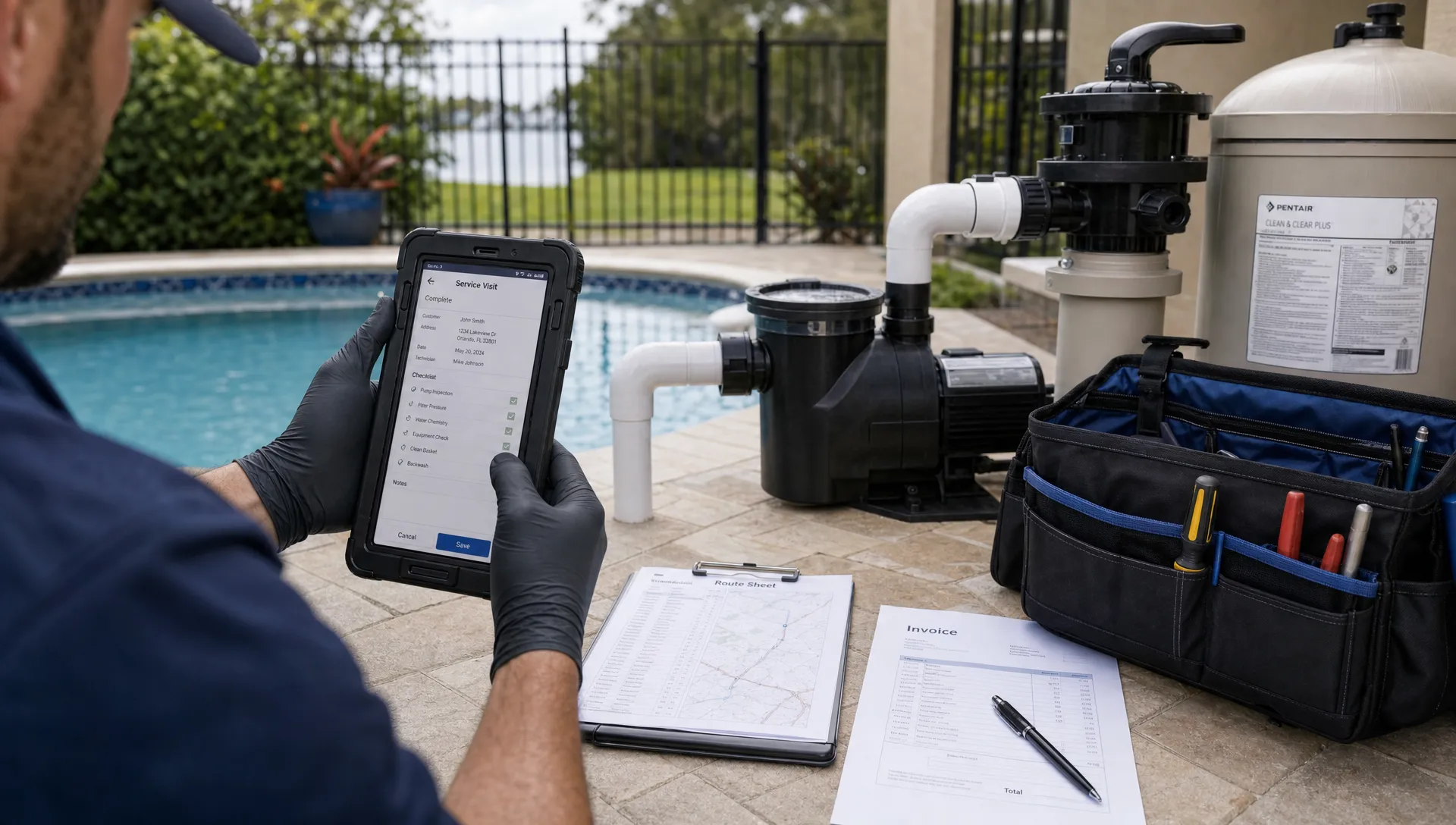
Consistent field documentation is where CRM technology becomes more than a sales tool. A technician at the new branch should know what must be completed and recorded without calling the original location.
For recurring pool service, define the required visit record: water readings, treatment details, equipment concerns, service notes and photos where relevant. Also establish what happens when access is blocked, equipment is unsafe or the visit cannot be completed.
An offline field app can help where connectivity is unreliable, but test the actual workflow. Confirm what technicians can access offline, what they can record and how updates synchronize afterward.
Keep documentation proportionate. Require information that supports safe service, customer communication and billing, rather than adding fields nobody uses. Review a sample of completed visits for accuracy, not just whether every box has been checked.
Use branch numbers that reveal operational problems
Company-wide revenue can hide a struggling new location. CRM technology is more useful for expansion when operational records can be grouped reliably by branch, territory or another consistent location identifier.
Start with a small set of measures and agree on their definitions before launch:
| Measure | Working definition | What it helps you investigate |
|---|---|---|
| Active recurring accounts | Properties with an active recurring service agreement assigned to the branch | Whether the recurring customer base is growing |
| Travel time per completed visit | Recorded route travel time divided by completed visits | Whether geographic expansion is weakening route efficiency |
| Unplanned return-visit rate | Unplanned return visits divided by completed visits for the same period | Possible service-quality or diagnostic problems |
| Completion-to-invoice time | Time between completed billable work and invoice issuance | Delays in documentation or billing handoffs |
| Past-due receivables | Unpaid invoice balances beyond their payment terms | Collection problems or unresolved disputes |
Not every CRM calculates these measures natively. Ask whether the required data is captured and whether reports, exports or a connected system can produce them.
Financial review still belongs alongside these operational measures. Branch contribution after direct service costs is not the same as branch profit after rent, management and other overhead. Confirm cost allocation with your bookkeeper or accountant rather than treating a CRM revenue report as a complete financial statement.
Check readiness before committing to the launch
Before expanding, use CRM technology to test whether the original branch can operate without constant owner intervention. A second location is unlikely to fix an unclear process at the first one.
Customer records should be dependable. Audit a sample of active accounts for service scope, contact information, property details and billing arrangements. Resolve duplicate records and missing instructions before copying those problems into a new territory.
Exceptions should have owners. Run through a missed visit, a failed payment, an equipment concern and a customer complaint. Each scenario should have a documented next step and an accountable role.
Managers should be able to explain performance. Ask the branch lead to explain overdue work, open customer issues and billing delays using shared records rather than a private spreadsheet.
A useful rehearsal is to have the owner step away from routine dispatch and customer follow-up for a defined period. Record every interruption that still requires the owner’s knowledge. Those interruptions identify the procedures, permissions or training that need attention before expansion.
Roll out the second branch in controlled stages
A staged launch reduces the number of unfamiliar workflows introduced at once. The following 90-day outline is a planning example, not a promise that every branch can launch on that schedule.
Days 1 to 30: establish the operating rules
Define the initial territory, branch ownership rules, service standards and escalation responsibilities. Clean the customer data that will move into the new operation, preserving service history and open issues.
Test CRM technology with realistic scenarios rather than a polished demonstration alone. Assign a lead near a territory boundary. Reschedule an appointment. Record an incomplete visit. Transfer a property with an unpaid invoice. Each test should reveal who acts next and what information they receive.
Document the minimum workflow that everyone must follow. Avoid redesigning the entire company while preparing one branch.
Days 31 to 60: pilot with limited complexity
Begin with a manageable service area and workload. Where possible, avoid launching several unfamiliar service types at the same time.
Review scheduling exceptions, incomplete visit records, customer questions and billing delays frequently during the pilot. Look for repeated causes rather than treating every incident as an isolated technician mistake.
If a required field is consistently skipped, investigate whether the problem is training, device usability or an unnecessary requirement. If customers receive conflicting messages, clarify which team owns communication before adding more automation.
Days 61 to 90: expand against agreed criteria
Increase the workload only when the pilot demonstrates dependable execution. Set your own acceptance criteria for documentation, unresolved complaints, billing timeliness and staffing coverage before reviewing the results.
At this stage, CRM technology should help a branch manager spot exceptions without inspecting every customer record individually. If that visibility requires manual reporting, include the reporting effort in the operating plan.
When a criterion is missed, pause the affected part of the rollout and address its cause. Continuing to add customers to an unstable workflow makes the eventual cleanup harder.
What contractor growth articles and Reddit can teach you
Articles about contractors scaling with CRM software are useful for identifying workflows to investigate. SplashIQ’s guide to CRM tools for contractors scaling without chaos covers lead capture, scheduling and documentation. For a second branch, translate those topics into specific tests of ownership, handoffs and visibility.
Its article on Reddit’s CRM lessons for contractors scaling service teams focuses on adoption, mobile field workflows and jobsite-centered records. You can also use Reddit’s contractor CRM search in r/smallbusiness to find owner discussions worth investigating.
Treat community posts as anecdotes, not verified performance evidence. Likewise, a vendor’s growth story does not establish that software alone caused expansion. Ask for references from contractors with similar service models and multiple locations, then discuss implementation effort, administrative workload and what still happens outside the system.
Evaluate SplashIQ against a real branch workflow
For pool service companies, SplashIQ brings together customer CRM, smart route scheduling, water-quality logs, equipment tracking and an offline field app. It also supports homeowner arrival and service notifications, before-and-after photos, a homeowner portal and online payments.
Those capabilities address work that must stay connected as a company grows. The second-branch decision, however, requires more specific validation than a feature checklist.
When evaluating CRM technology, ask the provider to walk through a lead becoming a customer, receiving service and paying an invoice under your proposed branch structure. Confirm location-based visibility, ownership rules, permissions and reporting rather than assuming that any of them are included.
Also test the exceptions: a technician covering another territory, a property changing branches and a disputed charge that requires service photos. A platform’s suitability becomes clearer when it must handle the awkward cases, not just the standard visit.
Frequently asked questions
Do contractors need a separate CRM for each branch? Not necessarily. A shared system can preserve customer history and common standards, provided it supports the ownership, permissions and reporting the business needs. Separate systems require a deliberate plan for transfers, duplicate records and consolidated oversight.
Can a CRM show whether a second branch is profitable? It can provide useful customer, service and revenue data, but profitability also requires complete cost information. Use accounting records to assess labor, vehicles, materials, occupancy and overhead alongside operational reports.
What should contractors standardize before opening another location? Start with customer records, lead ownership, service documentation, exception handling and the handoff to billing. Establish which decisions belong to branch managers and which require company-level approval.
How do you know whether the team will use the software? Pilot real work with the people who will perform it. Check whether technicians can complete records in field conditions and whether office staff can resolve issues without maintaining a parallel spreadsheet.
Test your second-branch workflow before expanding
Before committing to another location, map one customer’s journey from inquiry to payment and assign ownership at every handoff. Then test that workflow with your actual branch scenarios. Explore SplashIQ’s pool service platform to assess how its office, field and homeowner tools fit that operating plan, and confirm the location-specific controls your expansion requires.