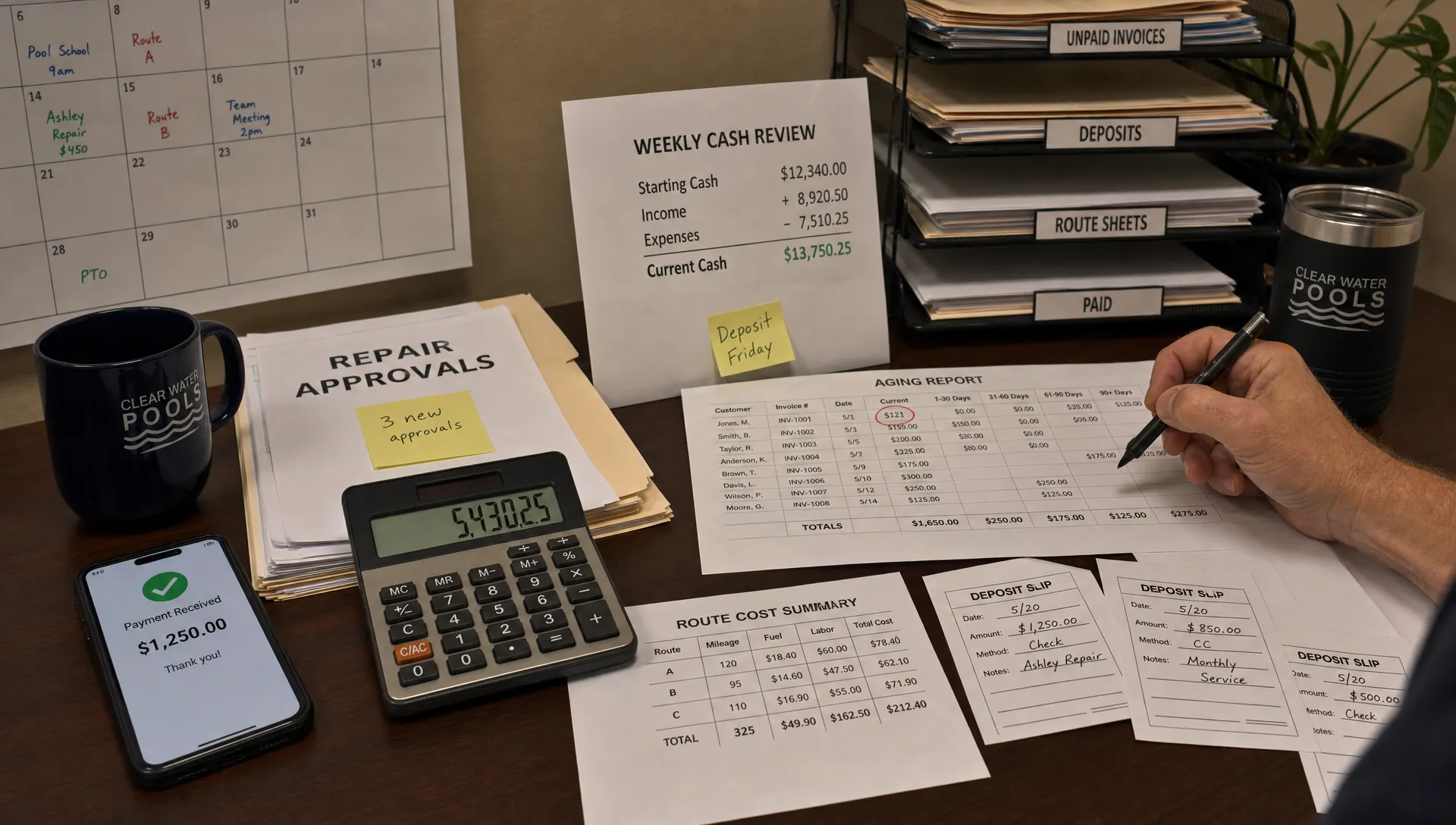
Cash flow problems in a pool business rarely start with one catastrophic mistake. They usually come from small leaks: a repair not billed for three weeks, chemicals priced from last season, a homeowner who never approved a part, a technician note that never made it back to the office or a route that looks full but loses money after drive time.
That is why good pool contractor accounting is not just bookkeeping after the fact. It is a set of habits that connects the field, the office and the customer before cash gets tight.
For pool service companies, this matters even more than it does in many trades. You have recurring service revenue, seasonal spikes, emergency repairs, chemical costs, equipment purchases, warranty work, route density and homeowner billing all moving at once. If the accounting process only catches up at month end, the business owner is already reacting late.
The goal is not to turn every pool contractor into a CPA. The goal is to build a rhythm where invoices go out faster, job costs are visible sooner and cash decisions are based on current information instead of gut feel.
Treat accounting as part of the job, not cleanup after the job
Many pool companies separate “the work” from “the paperwork.” The technician handles the pool, the office handles the invoice and the owner handles the bank balance when something feels off. That split creates gaps.
A better habit is to treat accounting data as something created during the job. The visit note, water-quality log, chemical use, equipment condition, repair recommendation, photo and customer approval all become source material for billing and margin tracking.
This is where field operations and accounting overlap. If a technician replaces a seal, adds extra chemicals or identifies a failing pump but the information stays in a text thread, it may never become billable revenue. If the office does not know whether the homeowner approved the work, billing gets delayed. If the owner cannot see which routes consume the most labor and material, pricing decisions lag behind reality.
Reddit is useful here because owners speak plainly. In r/smallbusiness, r/Entrepreneur and contractor-related discussions, recurring complaints are not usually about accounting theory. They are about late invoices, forgotten follow-ups, customers disputing vague bills and owners realizing that a busy schedule does not always mean positive cash flow. Those posts mirror what many pool operators feel during peak season: work is everywhere, but cash is harder to pin down.
The fix starts with making every service visit easier to document in a consistent way. SplashIQ supports that operating layer with scheduling, water-quality logs, equipment tracking, before and after photos, homeowner communication and billing workflows. Your accounting system still records the books, but cleaner field data means cleaner invoices.
Invoice while the value is still fresh
Same-day invoicing is one of the simplest pool contractor accounting habits, and one of the easiest to break. When invoices wait until Friday, next week or the end of the month, several things happen: details fade, disputed charges are harder to explain and cash arrives later than it should.
A homeowner is most likely to understand and accept a charge when the service is fresh. If the invoice includes what was done, what was found and any photos or readings that support the work, it feels tied to a real visit instead of appearing as a surprise line item weeks later.
For recurring maintenance, same-day billing may not mean charging after every visit. Many companies bill monthly. The habit still applies: visit records should be complete the same day so the invoice cycle is not slowed by missing information.
For repairs, the bar should be higher. If a repair is completed today, the invoice should be ready today unless there is a specific reason to wait. Larger repairs may require deposits, staged payments or financing discussions before the work starts, but the accounting habit is the same: do not let completed work sit unbilled.
If route scheduling and billing are currently disconnected, the delay often hides in handoffs. One person knows the work was done, another person creates the invoice and a third person follows up on payment. Connecting those steps is one reason many service companies move away from spreadsheets. SplashIQ’s guide to pool service software for teams that need routes and billing goes deeper into how route-heavy businesses can reduce that friction.
Separate maintenance revenue from repair revenue
A pool business can look healthy in total revenue while hiding two very different cash-flow stories.
Recurring maintenance usually brings predictable revenue, but margins can shrink quietly when chemical prices rise, routes spread out or visit times increase. Repair work can produce strong revenue, but it often requires upfront parts, homeowner approvals and more administrative coordination.
When everything lands in one broad income bucket, the owner loses visibility. You may know total sales, but not whether routine service is carrying the business or repairs are masking underpriced maintenance.
At a minimum, track revenue and direct costs by category:
| Category | What to track | Why it protects cash flow |
|---|---|---|
| Recurring service | Monthly fee, visit frequency, labor time, chemical use | Shows whether routes are priced for real operating cost |
| One-time cleanups | Labor hours, chemicals, disposal or extra supplies | Prevents high-effort jobs from being priced like normal maintenance |
| Equipment repairs | Parts, labor, warranty status, approvals | Reduces missed billing and protects margin on parts |
| Equipment replacements | Deposit, equipment cost, labor, permit or subcontract cost if applicable | Keeps the company from financing expensive jobs with its own cash |
| Specialty services | Green pool recovery, filter cleanings, inspections | Helps identify profitable add-ons and underpriced work |
This does not require a complicated chart of accounts on day one. It does require discipline. Every invoice should be classified clearly enough that you can answer basic questions: Which work produces the most cash? Which work consumes cash before it pays? Which services are busy but weak on margin?
For pricing strategy, accounting and estimating need to talk to each other. If the books show that chemical costs or drive time are eroding profit, the pricing model needs to change. A useful next step is to review pool service pricing models that protect your margins and compare them against your actual job-cost data.
Use deposits to avoid becoming the bank
Pool contractors can get into cash trouble when they pay for parts and equipment before the homeowner pays them. Pumps, heaters, automation systems, filters and specialty parts can create a cash squeeze even when the job is profitable on paper.
A deposit policy protects the business from funding customer projects out of operating cash. It also filters out homeowners who are not ready to commit.
The right deposit amount depends on local rules, project size, contract language and your business model, so this is an area where your CPA, attorney or state contractor licensing guidance matters. The habit, though, is straightforward: do not order expensive materials for non-emergency work until the payment terms are clear and accepted.
For larger jobs, staged payments may be better than one final payment. For example, a company might collect an initial deposit before ordering equipment, a progress payment when installation begins and the balance at completion. The exact structure should match your local requirements and customer agreement.
Clarity matters as much as the amount. Service businesses outside the pool industry often do this well by making terms visible before the customer books. For example, the Aqua Blue electric cart rental page in Les Saintes clearly presents booking details, rates, conditions and FAQs, which is the same kind of upfront clarity pool homeowners need before approving a repair, replacement or recurring service agreement.
Make weekly cash review a non-negotiable routine
Monthly financial statements are useful, but pool operators need a faster pulse. A weekly cash review gives the owner time to act before a small issue becomes a payroll problem.
This review does not need to be long. In fact, if it takes two hours, it probably will not happen consistently. Aim for a repeatable 20 to 30 minute routine that looks at the same numbers every week.
A practical weekly review should cover:
- Cash in bank, after accounting for payroll and known withdrawals
- Accounts receivable, especially invoices older than your normal terms
- Unbilled completed work from the prior week
- Deposits collected for upcoming equipment jobs
- Parts or chemical purchases expected in the next two weeks
- Failed payments, expired cards or payment plans needing follow-up
- Jobs completed without enough documentation to invoice confidently
The most important line is often unbilled completed work. Many owners focus on receivables because invoices are visible. Unbilled work is more dangerous because it can hide in technician notes, texts, memory or incomplete job records. It is work you already paid labor for, but have not yet converted into a customer balance.

Reconcile payments before small errors become expensive
Payment reconciliation is not glamorous, but it protects cash flow in several ways. It catches failed payments, duplicate charges, missing deposits, merchant fee surprises and invoices marked paid by mistake.
Pool businesses that accept online payments need a habit for matching invoices, deposits and bank payouts. Merchant processors often batch transactions, deduct fees and settle payments on a delay. If nobody checks the flow weekly, the books may say cash is coming while the bank balance tells a different story.
The reconciliation habit should answer three questions:
| Question | What it catches | Why it matters |
|---|---|---|
| Did every paid invoice deposit correctly? | Failed payments, processing delays, incorrect payment status | Prevents false confidence in cash balance |
| Did every bank deposit match expected payments? | Batch differences, fees, refunds, chargebacks | Keeps books aligned with reality |
| Did every completed job become an invoice? | Missed repair charges, incomplete visit records | Converts operational work into cash |
This is also where customer communication matters. If a card fails, a homeowner disputes a charge or a payment link goes unopened, the follow-up should be fast and professional. The longer a balance sits, the more awkward it becomes for both sides.
Track job costs by route, property and technician
Cash flow improves when you know where profit is produced. For pool service companies, that means looking beyond company-wide profit and loss.
A route can be full but inefficient. A customer can pay on time but consume too many chemicals. A technician can complete many stops but miss repair opportunities or create callbacks. A property can look like a normal maintenance account but require extra brushing, chemical correction or equipment attention every week.
Job costing does not need to become complicated. Start with the numbers that shape cash most directly: labor time, drive time, chemicals, parts and callbacks. Over time, this creates a clearer picture of which accounts should be repriced, which routes should be tightened and which service types deserve more focus.
Technician scorecards can support this if they are used carefully. The point is not to punish techs for difficult pools. The point is to see patterns that affect cash: incomplete notes, recurring callbacks, missed photos, skipped readings or repair recommendations that never get written up clearly enough for homeowner approval.
This is also where articles about contractors using CRM software to scale tend to land on the same lesson. The software is not valuable because it stores names and phone numbers. It is valuable because it creates a shared operating record that lets the owner delegate without losing control. For pool companies, a practical CRM strategy should connect the property, homeowner, equipment, route history, service notes, approvals and billing context. SplashIQ’s article on a practical CRM strategy for growing pool service companies explains that shift in more detail.
Build a collections rhythm that does not feel desperate
Collections get uncomfortable when they are inconsistent. If a homeowner hears nothing for 45 days and then receives an urgent message, the company looks disorganized. A steady process feels more professional and usually performs better.
Set a clear sequence for overdue invoices. The tone can stay friendly, but the timing should not depend on the owner remembering to follow up.
For example, the first reminder can confirm the invoice was received. The second can restate the service date, amount and payment link. A later reminder can explain that service may be paused if the account is not brought current. Policies should be written into your service agreement and applied consistently.
The strongest collections process starts before anything is overdue. Use clear service agreements, store current payment methods when appropriate, send arrival and completion notifications and make invoices easy to understand. Homeowners are less likely to delay payment when the service record is clear and the payment experience is simple.
Keep tax money separate from operating cash
One common cash-flow trap is treating all bank cash as spendable cash. It is not. Some of it belongs to payroll taxes, income taxes, sales tax where applicable or future obligations.
Pool companies should work with a qualified bookkeeper or CPA to set aside tax reserves based on their structure and local requirements. The accounting habit is to separate those funds before they blend into operating cash.
A separate tax savings account can help. So can a weekly or monthly transfer based on revenue, profit or estimated liability. The exact formula should come from your advisor, but the behavioral goal is simple: avoid discovering at tax time that the business used government money to cover parts, fuel or payroll.
This habit becomes more important as the company grows. A solo operator may be able to keep obligations in their head for a while. A team with multiple routes, technicians, card payments, financing options, repair deposits and seasonal swings needs a system.
Watch leading indicators, not just bank balance
The bank balance is a lagging indicator. It tells you what happened after invoices, collections, payroll, purchases and customer behavior have already affected cash.
Leading indicators give you earlier warning. They show whether cash is likely to tighten before the bank account proves it.
Good cash-flow indicators for pool contractors include:
| Indicator | Healthy sign | Warning sign |
|---|---|---|
| Unbilled completed work | Reviewed and invoiced weekly | Growing after busy service days |
| Average invoice age | Most customers pay within normal terms | More balances moving past 30 days |
| Repair approval time | Homeowners approve quickly with clear photos and notes | Quotes sit unanswered while equipment worsens |
| Chemical cost per route | Stable or explained by seasonality | Rising without pricing review |
| Callback rate | Low and traceable | Repeat visits eat labor without new revenue |
| Deposit coverage | Large parts ordered after deposit | Company cash used to fund customer equipment |
These indicators are easier to track when the office and field team use the same source of truth. If approvals are in one inbox, technician photos are on phones, invoices are in a separate system and route notes are on paper, cash-flow visibility will always arrive late.
Use accounting habits to support growth, not just survival
Good accounting habits are not only defensive. They help a pool contractor grow with more confidence.
When invoices go out quickly, cash comes in sooner. When deposits cover expensive materials, growth does not starve the bank account. When maintenance and repair revenue are separated, pricing decisions get sharper. When job costs are visible by route and property, the owner can decide which customers, neighborhoods and service types to pursue.
This is why CRM and operations software matter to scaling contractors. Growth creates more handoffs: more homeowners, more visits, more equipment records, more approvals, more technicians and more exceptions. If the business depends on the owner remembering every detail, growth adds stress faster than profit.
Pool contractor accounting works best when it is supported by clean operational habits. The office should not have to chase every technician note. The technician should not have to guess what was approved. The homeowner should not have to wonder what was done. The owner should not have to wait until the end of the month to know whether cash is healthy.
Frequently Asked Questions
What is the most important pool contractor accounting habit for cash flow? Same-day documentation and fast invoicing usually create the fastest improvement. If completed work is recorded clearly and billed quickly, the company reduces delays, disputes and forgotten charges.
Should pool contractors require deposits for equipment repairs? For larger repairs or replacements, deposits often help protect cash flow because the contractor may need to buy parts before collecting final payment. Deposit policies should follow local rules and be clearly stated in the customer agreement.
How often should a pool service company review cash flow? A weekly review is practical for most operators. It should cover cash on hand, overdue invoices, unbilled work, upcoming payroll, expected parts purchases and deposits for scheduled repair jobs.
Is pool service software the same as accounting software? No. Accounting software records financial transactions and produces financial reports. Pool service software supports the operating workflow that creates clean billing data, including scheduling, field notes, photos, equipment records, homeowner communication and payments.
How can a pool contractor know which accounts are hurting cash flow? Track labor time, chemical use, callbacks, repair history and payment behavior by property. Accounts that require extra effort, pay late or create repeated callbacks may need repricing, a service change or a different customer conversation.
Turn service work into cleaner cash flow
Cash flow improves when the business captures what happened in the field, communicates it clearly to the homeowner and turns it into an invoice without delay.
SplashIQ helps pool service companies replace scattered spreadsheets, paper checklists and disconnected messages with one operating system for scheduling, field operations, homeowner communication, billing and payments. If your team is growing and your cash-flow process still depends on memory, now is the time to tighten the workflow.
Explore how SplashIQ helps pool service businesses run cleaner routes, document better service and get paid with less friction.