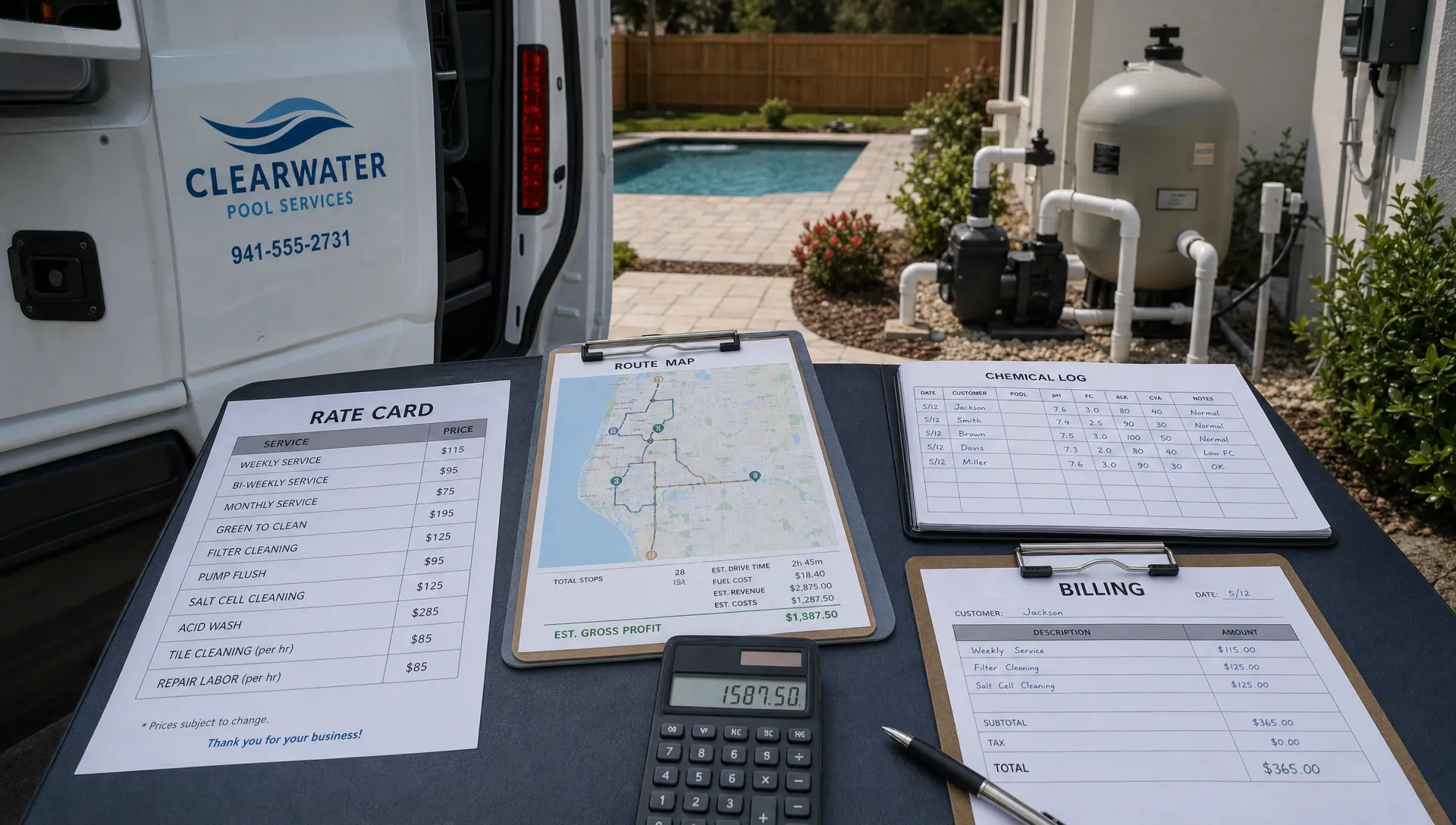
Pool service pricing is easy to copy and hard to get right. A competitor says weekly service is $X per month, a homeowner asks for a “simple cleaning,” and suddenly your price has to cover technician time, fuel, chemicals, billing, callbacks, customer communication, and profit.
That is why strong pool service pricing is not just a rate card. It is a margin system.
The best pricing model for your company should answer three questions:
- Does this account still make money after drive time, chemicals, admin, and payment costs?
- Does the price change when the work changes?
- Can your team explain the value clearly enough that homeowners understand what they are buying?
If the answer is no, revenue can grow while profit quietly disappears. Let’s break down pricing models that help pool service companies protect margins without turning every proposal into a custom spreadsheet.
What pool service pricing has to cover
A pool service visit looks simple from the homeowner’s perspective. The tech arrives, tests water, brushes, nets, checks equipment, adds chemicals, documents the visit, and leaves. For the business, that visit carries several cost layers.
The most obvious cost is technician labor. But the full cost also includes windshield time, vehicle wear, fuel, chemicals, test supplies, software, office labor, callbacks, insurance, credit card fees, and owner profit. If your pricing only reflects “time at the pool,” you are underpricing the job.
A healthy pricing model accounts for hidden cost drivers before the customer is onboarded.
| Cost driver | How it hides in the business | Pricing move that protects margin |
|---|---|---|
| Drive time | Long gaps between stops reduce visits per day | Price by service zone or set route minimums |
| Chemicals | Heavy bather load, sun exposure, and poor circulation increase usage | Use chemical allowances, surcharges, or tiered plans |
| Pool complexity | Spas, water features, screens, trees, and large pools add time | Classify pools before quoting |
| Admin time | Calls, billing questions, rescheduling, and approvals consume office hours | Build admin cost into recurring plans |
| Callback risk | Poor access, unclear expectations, and bad equipment cause unpaid returns | Define service scope and document visits |
| Payment friction | Late payments and card fees reduce realized revenue | Encourage online payments and clear billing terms |
The point is not to make pricing complicated. The point is to stop treating different accounts as if they cost the same to serve.
Start with your break-even visit cost
Before choosing a pricing model, calculate your break-even cost per visit. This gives you a price floor. You may charge more based on value, market positioning, seasonality, or urgency, but you should know the minimum number that keeps the account from losing money.
A simple break-even formula looks like this:
Break-even visit cost = loaded labor per visit + chemicals and supplies + vehicle and route cost + overhead per visit + payment and admin cost
Then add your target profit margin.
For illustration only, here is a simplified example. Do not copy these numbers blindly. Your labor rates, overhead, chemical costs, market, and service density will be different.
| Input | Example assumption | Example cost per visit |
|---|---|---|
| Loaded technician cost | $32 per hour, 35 minutes total service and route time | $18.67 |
| Chemicals and supplies | Average across normal maintenance visits | $7.00 |
| Vehicle and fuel allocation | Based on route miles and maintenance | $4.50 |
| Office and fixed overhead | Monthly overhead divided by completed visits | $12.50 |
| Payment and billing cost | Processing, invoicing, reminders | $2.25 |
| Total estimated cost | Before profit | $44.92 |
If you want a 40% gross margin on that visit, you would not price it at $45. You would divide cost by the inverse of margin:
Price = cost ÷ (1 - target margin)
In this example, $44.92 ÷ 0.60 = $74.87 per visit.
That does not mean every visit should be priced at $75. It means that if your real cost structure looked like the example above, pricing below that level would make it difficult to hit a 40% margin. The math is the guardrail.
Pricing models that protect your margins
There is no single best model for every pool service company. The right choice depends on route density, seasonality, customer expectations, chemical volatility, and how much repair work you perform. Many successful companies use a hybrid approach.
Flat monthly recurring pricing
Flat monthly pricing is common because homeowners like predictable bills and pool companies like predictable revenue. Instead of charging per visit, you charge the same monthly amount for routine service.
This model works best when you have strong route density, consistent service scope, and a clear definition of what is included. It can also smooth cash flow during months with fewer service days, depending on your market and contract terms.
The risk is underestimating high-cost accounts. A shaded pool with heavy leaves, poor circulation, and frequent chemical demand should not be priced like a clean screened pool with modern equipment. If your flat monthly plan ignores pool complexity, your best accounts subsidize your worst accounts.
To protect margins, use flat monthly pricing with account classifications. For example, you might classify accounts by pool size, screen enclosure, spa, tree coverage, service frequency, equipment condition, and access difficulty. The homeowner still sees a simple monthly price, but your internal quoting process reflects real costs.
Per-visit pricing
Per-visit pricing is straightforward: each completed service visit creates a charge. This model is useful for seasonal service, vacation homes, rental turnovers, one-time cleanups, and markets where service frequency changes throughout the year.
The margin advantage is that revenue tracks activity. If you visit more, you bill more. The challenge is that customers may focus on each individual charge, which can create more billing questions. It can also make revenue less predictable if weather, cancellations, or seasonality change visit counts.
Per-visit pricing protects margins when you set minimums. A visit across town should not carry the same price as a stop on a dense route. If you serve a wide territory, zone-based minimums are essential. Route density changes your effective hourly rate, which is why smart scheduling tactics that cut drive time are directly connected to pricing.
Tiered maintenance packages
Tiered packages help homeowners choose a service level while helping you avoid scope creep. Instead of one generic “pool service” offer, you create clear tiers such as basic chemical service, standard maintenance, and premium full-service care.
The names and inclusions should match your market, but the logic is consistent. Each tier should have a defined scope, a defined frequency, and a defined boundary between routine maintenance and billable extras.
A tiered structure often works well when customers have different expectations. Some homeowners want the lowest-cost option and are willing to handle more tasks themselves. Others want a worry-free plan with more documentation, more frequent checks, or more support.
The key is to avoid creating a premium tier that includes unlimited labor. “Full service” should not mean “anything the homeowner asks for.” It should mean a specific, well-documented bundle of recurring maintenance tasks.
Hybrid membership plus billable repairs
A hybrid model combines recurring maintenance revenue with separate repair pricing. This is often the cleanest model for growing companies because it separates predictable service from variable technical work.
Under this model, the homeowner pays a recurring amount for maintenance. Repairs, parts, major cleanups, filter breakdowns, green-to-clean work, equipment upgrades, and leak investigations are quoted separately.
This protects margins because maintenance plans are not forced to absorb unpredictable repair labor. It also makes it easier to communicate value. The homeowner understands that weekly care keeps the pool operating, while repairs address specific equipment or system failures.
The challenge is operational. Your field team must document repair opportunities clearly, and your office must turn those findings into approvals quickly. When repairs are managed in disconnected notes, texts, or spreadsheets, profitable work slips through the cracks. A connected workflow for routes, visit details, and billing can help, especially for teams using pool service software for routes and billing to reduce manual follow-up.
Time-and-materials for unpredictable work
Time-and-materials pricing is best for work that cannot be scoped accurately in advance. Examples include diagnostic visits, complex equipment troubleshooting, severe cleanups, plumbing surprises, and older systems with unknown conditions.
This model protects the company from eating unknown labor. However, homeowners may feel uneasy if they do not understand the range of possible costs. To reduce friction, set expectations before work begins. Explain the diagnostic fee, hourly rate, material markup, and approval threshold.
Time-and-materials pricing should not be a substitute for poor estimating. Use it when uncertainty is real, not when the team simply has not built a repeatable estimating process.

Choosing the right pricing model by job type
Most pool companies need more than one pricing model. Routine service, green pools, repairs, and new customer onboarding do not carry the same risk.
| Job type | Best-fit pricing model | Why it protects margin |
|---|---|---|
| Weekly residential maintenance | Flat monthly or tiered recurring | Predictable revenue and clear scope |
| Seasonal or vacation home service | Per-visit or monthly seasonal plan | Matches billing to service frequency |
| Green pool cleanup | Fixed starting price plus time-and-materials | Accounts for uncertain severity |
| Equipment diagnostics | Diagnostic fee plus quoted repair | Separates expertise from parts and labor |
| Filter cleaning or one-time maintenance | Fixed price by filter type or job class | Easy to sell and repeat |
| Large repairs or upgrades | Quote with labor, parts, and approval terms | Protects against scope and parts cost changes |
| Commercial pools | Contract pricing with defined frequency and compliance requirements | Reflects higher documentation and reliability expectations |
A useful rule: the more predictable the work, the more confidently you can package it. The more uncertain the work, the more your pricing should include diagnostic fees, ranges, exclusions, or approval checkpoints.
Margin leaks to fix before raising prices
Raising prices can be necessary, especially when labor, insurance, fuel, and chemical costs rise. But price increases work best when your operations are clean. Otherwise, higher prices can mask inefficient routes, inconsistent service, or missed billing.
Route inefficiency
If technicians spend too much of the day driving, the price per account has to carry that dead time. This is one of the biggest reasons two accounts with the same monthly fee can produce very different margins.
Track revenue per route, visits per day, average drive time, and callbacks by route. If a faraway account pays the same as a dense-route account, it may need a zone surcharge, a higher minimum, or a planned exit.
Scope creep
Scope creep happens when the customer buys one thing but receives another. A routine maintenance plan slowly becomes leaf removal, extra brushing, chemical recovery, equipment troubleshooting, trash cleanup, and free education after every visit.
The solution is not to be less helpful. It is to define the plan. Your proposal should say what is included, what is excluded, and what triggers an additional charge.
Chemical cost volatility
Chemical costs can shift quickly, and usage varies dramatically by pool. If you include all chemicals in one monthly price, you are carrying that risk. Some companies prefer this because it is simple for the homeowner. Others use chemical surcharges, allowances, or separate billing.
There is no universal answer. The margin-safe approach is to know your average chemical cost by account type and create a policy before costs spike.
Unbilled repairs
Technicians often notice failing pumps, worn o-rings, leaking filters, noisy motors, cracked lids, and cloudy water patterns before the homeowner does. If those findings stay in a paper note or a text thread, you lose revenue and the customer loses a chance to prevent a bigger issue.
Before changing your pricing, make sure repair recommendations are documented with photos, equipment details, and a clear approval path. This turns field expertise into approved work instead of unpaid advice.
Discounting weak leads
Not every new customer is worth winning. If a lead is outside your route, price shopping aggressively, asking for exceptions before signing, or refusing normal billing terms, a discount may lock in a bad account.
Reddit threads in communities such as r/pools and r/swimmingpools often show how homeowners compare quotes: they ask whether a monthly price is “too high” without listing pool size, location, visit frequency, chemical inclusion, equipment condition, or service scope. Those conversations are a useful reminder that many buyers do not know how to compare pool service pricing accurately.
Your sales process should educate without apologizing. Explain what affects price and why your service costs what it costs.
How to raise prices without losing your best customers
A price increase should feel organized, not reactive. Homeowners are more likely to accept an increase when the message is clear, the timing is reasonable, and the value is visible.
Start by segmenting accounts. Do not apply the same increase to every customer unless your costs truly changed equally across the board. Low-margin accounts may need a larger correction. Highly profitable, easy-route accounts may need a smaller adjustment or no change at all.
Next, communicate before the new price appears on an invoice. Explain the reason in plain language: labor, chemicals, insurance, fuel, expanded documentation, or improved service reliability. Keep the message specific but concise.
For higher-value customer segments or neighborhoods where you want to grow route density, direct mail can still be useful. Renewal letters, neighborhood postcards, and win-back campaigns can reinforce your value outside the inbox, especially when paired with tracking. If you use offline campaigns, an all-in-one platform for direct mail automation and attribution can help keep those efforts measurable.
Finally, give customers a clear next step. If they have questions, tell them how to reach you. If they want to change service levels, explain the options. If the new rate starts on a specific date, make that date easy to find.
A practical pricing framework for pool service companies
If your pricing has grown organically over years, do not try to rebuild everything overnight. Start with a repeatable framework.
- Define your account classes: Group pools by size, complexity, screen enclosure, spa, tree exposure, equipment condition, service frequency, and access difficulty.
- Calculate your route economics: Review revenue per route, visits per day, drive time, callback rate, and technician capacity.
- Set price floors: Establish minimum acceptable pricing by account class and service zone.
- Separate maintenance from repairs: Keep recurring service predictable and quote repairs based on labor, parts, urgency, and complexity.
- Document exclusions: Make it clear when green pools, storm cleanup, heavy debris, phosphate treatments, filter breakdowns, and equipment repairs are billed separately.
- Review quarterly: Compare quoted assumptions against actual visit time, chemical usage, callbacks, and payment performance.
This framework gives you pricing discipline without making every quote feel custom. The homeowner gets clarity. Your office gets consistency. Your technicians know what is included. Your margins become easier to defend.
What to include in your pricing terms
Clear pricing terms reduce conflict. They also train customers to understand the difference between maintenance and additional work.
Your proposal or service agreement should address service frequency, billing schedule, chemical policy, access requirements, weather policy, skipped visit policy, repair approval process, payment terms, and cancellation terms. Keep the language understandable. A homeowner should not need a lawyer to understand how pool service works.
Here is a simple example of margin-protecting language:
Routine service includes scheduled water testing, chemical balancing within normal maintenance conditions, brushing, skimming, basket cleaning, and visual equipment checks. Repairs, parts, green pool recovery, excessive debris removal, storm cleanup, and services caused by restricted access or equipment failure may be quoted separately.
Your exact language should match your services and local requirements, but the principle is universal: define the routine, then define what falls outside it.
Use software to make pricing enforceable
Pricing only protects margins if your team can execute it consistently. If the office quotes one thing, the technician performs another, and billing happens from memory, margin control breaks down.
A pool service operating system helps by connecting customer records, scheduling, field notes, water-quality logs, equipment details, photos, billing, and payments. For example, SplashIQ is built for pool service companies that want to replace spreadsheets and paper checklists with one workflow for the office, technicians, and homeowners.
This matters because pricing decisions depend on real operating data. Which pools use the most chemicals? Which routes generate the most drive time? Which accounts create the most callbacks? Which repairs were recommended but never approved? When those answers are visible, your pricing becomes less emotional and more profitable.
Frequently Asked Questions
What is the best pool service pricing model? The best model depends on your market and cost structure. Many companies use flat monthly or tiered recurring pricing for routine maintenance, then bill repairs, cleanups, diagnostics, and parts separately.
Should pool service companies include chemicals in the monthly price? Including chemicals is simple for homeowners, but it shifts cost risk to the service company. If you include chemicals, track average usage by account type and consider allowances or surcharges for unusual demand.
How often should I review my pool service pricing? Review pricing at least quarterly. Labor, fuel, chemical costs, route density, callback rates, and payment performance can change quickly, and old prices often stop reflecting current costs.
How do I raise prices without losing customers? Segment accounts, explain the reason clearly, give advance notice, and connect the increase to service quality and reliability. Avoid apologizing for a necessary correction, but make the communication professional and easy to understand.
Why are some pool accounts unprofitable even at the same monthly rate? Two accounts with the same price can have different margins because of drive time, pool size, debris load, chemical usage, access problems, equipment condition, and customer communication demands.
Build pricing around the work you actually perform
Profitable pool service pricing is not about charging the highest possible rate. It is about matching price to cost, complexity, and value.
When your routes, service notes, water-quality logs, equipment records, approvals, billing, and payments live in one system, it becomes much easier to see which accounts protect your margins and which ones need attention. SplashIQ helps pool service businesses run that workflow in one place, so pricing decisions are backed by the work your team actually performs.