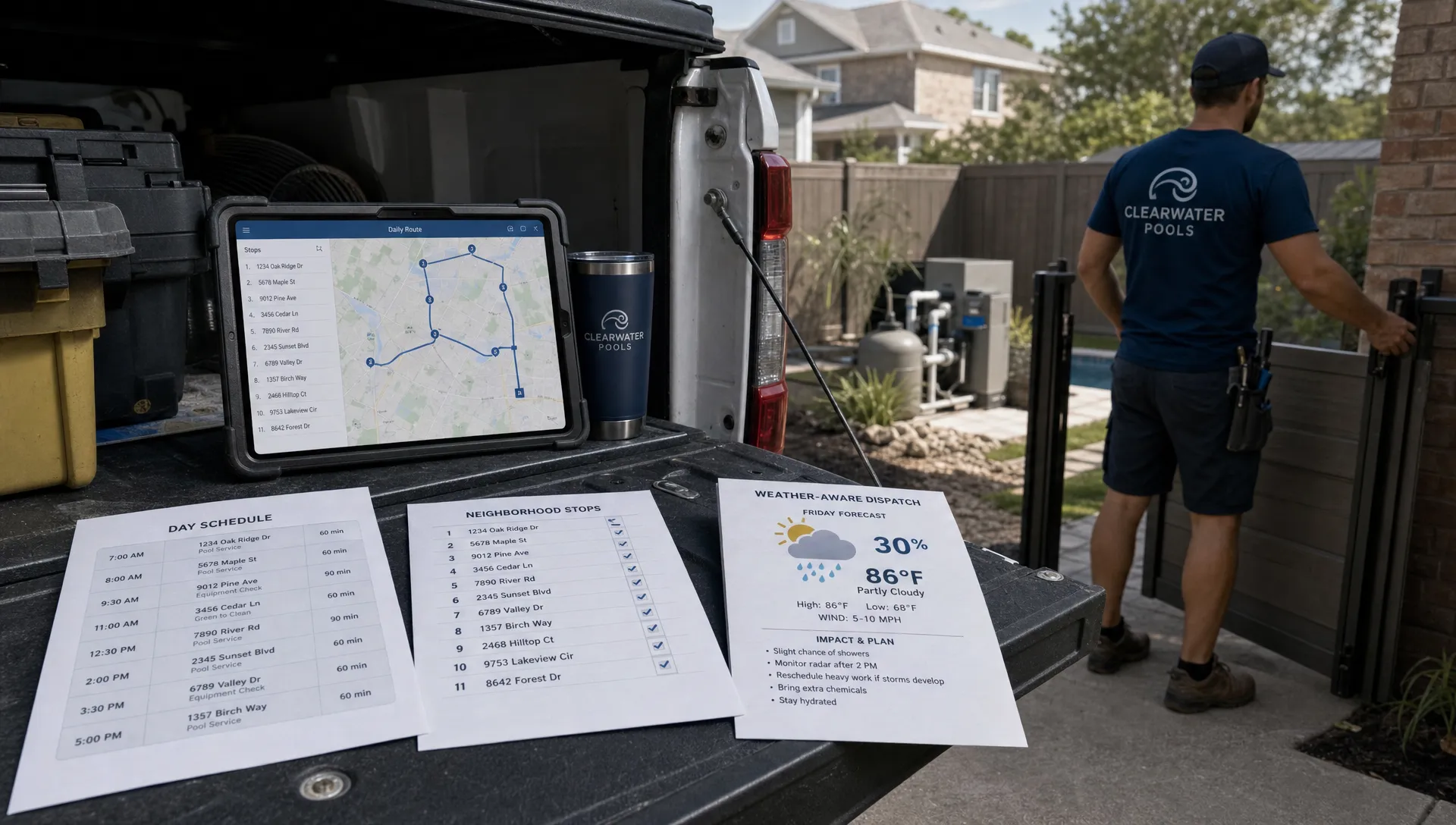
By 2026, the pool service industry is being reshaped less by one dramatic technology shift and more by daily operational pressure. Homeowners expect clearer communication. Technicians need cleaner routes and better property history. Owners need to protect margins while managing repairs, recurring service, billing and customer expectations without adding another layer of office work.
For growing pool service companies, the question is no longer whether operations should move beyond paper routes, spreadsheets and memory. The question is how quickly the company can turn its workflow into a repeatable system that supports more stops, better service quality and fewer preventable mistakes.
The following trends are the ones most likely to shape pool service operations in 2026.
Homeowner expectations are becoming an operational standard
Homeowners have become used to real-time updates from food delivery, rideshare apps, package tracking and home-service marketplaces. That expectation now follows them into pool maintenance. They want to know when a technician is arriving, what was done, what was found and whether anything needs approval.
This is not just a customer service issue. It affects call volume, review quality, payment speed and technician trust. When the homeowner has no visibility into the visit, the office often becomes the default help desk. A missing gate code, a cloudy pool after a storm or a question about chemicals can turn into multiple calls, texts and follow-ups.
Reddit is a useful place to see this expectation in plain language. Threads in r/pools often revolve around uncertainty: what caused cloudy water, whether the service company added the right chemicals, why equipment is not working or whether a quote sounds fair. In r/HomeImprovement, homeowners regularly discuss contractor communication, missed appointments and trust signals. Reddit is not a scientific sample, but it is a live record of how customers talk when they feel uninformed.
In 2026, strong pool operators will treat communication as part of the job, not as an afterthought. Arrival notifications, service summaries, water readings, before/after photos and simple next-step recommendations all reduce friction. They also create a record that protects the company when there is confusion later.
Route density is becoming a direct margin lever
Route efficiency has always mattered in pool service, but 2026 puts more pressure on route-heavy businesses. Labor costs, drive time, fuel, traffic and technician retention all make wasted windshield time expensive. A route that looks acceptable on a spreadsheet can still quietly drain profit if the stops are scattered or if repairs are scheduled without regard for location.
Smart route scheduling is not only about arranging stops on a map. It is about building density over time. That means understanding which neighborhoods are profitable, which customers create excessive service friction and which days are overloaded. It also means connecting route planning with billing, customer records and technician availability instead of treating scheduling as a separate task.
For companies that are feeling the strain of route growth, the operational challenge is often workflow fragmentation. The schedule lives in one place, billing in another and technician notes somewhere else. That is why route-heavy teams often benefit from connecting scheduling and invoicing in a single operating flow, as discussed in SplashIQ’s guide to pool service software for teams that need routes and billing.
| 2026 trend | Operational pressure | Practical response |
|---|---|---|
| Higher homeowner expectations | More calls, texts and follow-ups when service is unclear | Send arrival alerts, service summaries, photos and next steps |
| Tighter route economics | Drive time eats into recurring service margins | Build denser routes and schedule repairs by geography when possible |
| More complex equipment | Technicians need property history at the job site | Track equipment, past repairs, photos and notes by property |
| Faster payment expectations | Delayed billing slows cash flow | Use online payments and cleaner invoice workflows |
| Labor and training pressure | Inconsistent service quality becomes harder to hide | Standardize checklists, logs and technician coaching |
CRM is moving from contact list to operating system
In many pool companies, CRM has historically meant a list of names, phone numbers and maybe a few notes. That is no longer enough. The useful version of CRM in 2026 is property-centered: who owns the pool, where it is, what equipment is installed, what has been quoted, what has been approved, which gate code works, which technician last visited and which issues keep recurring.
This mirrors a broader shift across contracting businesses. Contractor CRM articles from platforms like Buildertrend and Jobber both emphasize the same scaling lesson: as a service business grows, the owner cannot be the only person who knows the customer history, job status and follow-up plan. Growth requires shared information, consistent processes and fewer details trapped in someone’s phone.
For pool service companies, that shift matters because every property has its own operational context. A residential pool with a salt system, heater and automation panel is not the same as a basic chlorine pool. A commercial pool adds another layer of documentation and accountability. A CRM that only stores customer contact details misses the point.
A practical CRM strategy should support the full customer lifecycle, from lead capture and estimate follow-up to recurring service, repairs, billing and retention. SplashIQ’s article on a practical CRM strategy for growing pool service companies goes deeper into how pool businesses can organize records around properties instead of scattered notes.
Water-quality logs are becoming proof of service
Water testing has always been part of the work. What is changing is the importance of the record. A verbal update or handwritten checklist may be enough for a very small route, but it becomes fragile as soon as the company adds technicians, commercial accounts or higher-value homeowners.
In 2026, water-quality logs serve several operational purposes. They help technicians see trends over time, not just a single reading. They help managers spot inconsistent service. They give homeowners confidence that the visit happened and that the technician did more than skim leaves. For commercial and public aquatic facilities, documentation can also support more formal health and safety expectations.
The CDC Model Aquatic Health Code is aimed at public aquatic venues, not the average backyard pool, but it reflects a larger principle: water quality is operationally important because it affects safety, consistency and accountability. Residential pool companies can borrow the same mindset without overcomplicating the job. Log the readings, attach them to the visit and make the information easy to review later.
The companies that do this well will not treat water chemistry data as a box to check. They will use it to coach technicians, catch patterns before customers complain and explain service recommendations with evidence.
Equipment tracking is becoming a revenue and retention advantage
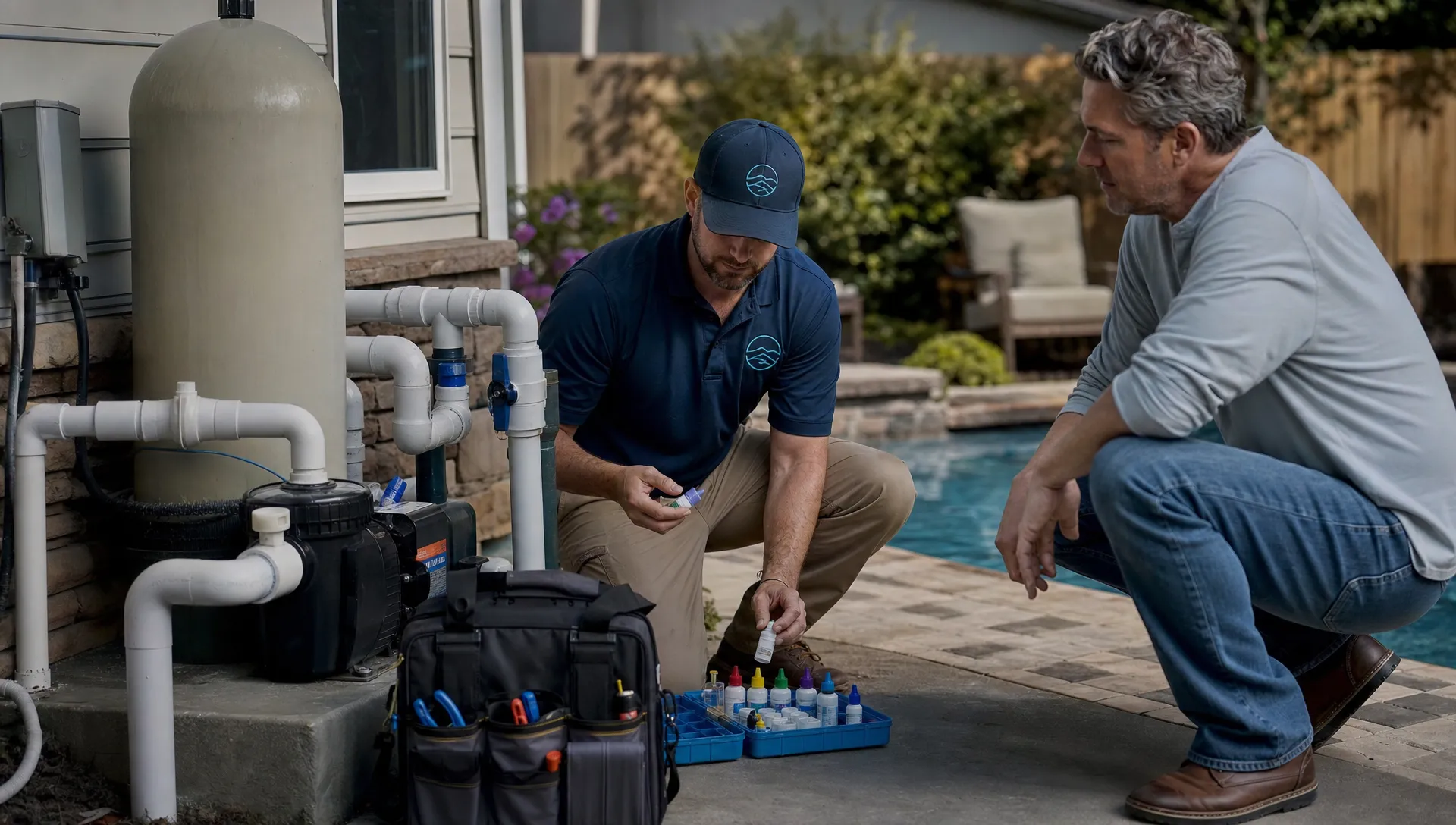
Pool equipment is more complex than it used to be. Variable-speed pumps, automation systems, heaters, salt cells, lights, valves and connected controllers create more opportunity for repair revenue, but they also create more room for mistakes. If a technician does not know what is installed, how old it is or what was repaired last season, the company wastes time rediscovering the same information.
Equipment tracking turns the property record into a working asset. It helps the office quote faster, helps technicians arrive prepared and helps owners identify replacement opportunities before an emergency call. It also supports better homeowner conversations because the recommendation can be tied to an actual equipment history.
This is especially important as repair work becomes a bigger part of the profit mix. Recurring cleaning routes can create stability, but repairs, upgrades and equipment replacements often determine whether growth is truly profitable. The challenge is making sure repair opportunities do not get lost in text messages, memory or handwritten notes.
Pricing discipline is becoming harder to avoid
The pool service industry has many owners who are excellent technicians but reluctant price analysts. That becomes risky when chemical costs, labor, insurance, drive time and callbacks all keep pressure on margins. In 2026, companies that price from habit will feel more pain than companies that price from cost structure.
A monthly service price has to cover more than the time spent at the pool. It has to account for travel, chemicals, office coordination, customer communication, billing, bad debt, callbacks and profit. If the company does not know the true cost of a stop, route growth can create the illusion of success while profit stays thin.
This is where operations and pricing connect. Better records make better pricing possible. If you can see how long different types of pools take, which customers need extra communication, which routes carry too much drive time and which equipment issues repeat, you can make more defensible pricing decisions. SplashIQ’s article on pool service pricing models that protect your margins explains how to think about pricing beyond a simple monthly rate.
Pricing discipline also affects sales. A well-run company does not have to win every lead. It needs the right customers at the right price, especially when technician capacity is limited.
Online payments and financing are becoming part of the service experience
Homeowners increasingly expect payment to be simple. If an invoice requires a mailed check, a phone call or a manual reminder, friction increases. That friction slows cash flow and adds work for the office.
Online payments are now a baseline operational improvement for many service businesses. The bigger 2026 shift is the connection between payments, approvals and repairs. When a homeowner can review a service note, approve a repair and pay online, the company shortens the distance between recommendation and revenue.
Financing also matters for larger repairs and replacements. A homeowner may understand that a heater, pump or automation upgrade is needed but hesitate because of the upfront cost. When financing is available as part of the workflow, the conversation can move from whether the homeowner can pay today to which option fits the situation.
Pool companies should still be careful not to use payment tools as a substitute for trust. Clear diagnostics, photos, equipment history and transparent recommendations are what make online approval feel comfortable.
AI and automation are entering through practical back-office tasks
AI in the pool service industry does not need to look futuristic to be useful. The most valuable use cases are often ordinary tasks that consume administrative time: organizing leads, standardizing responses, surfacing missing information, suggesting follow-up steps, helping plan routes or turning field notes into cleaner customer-facing summaries.
The risk is treating AI as a magic layer on top of messy operations. Automation works best when the underlying workflow is already defined. If the company has inconsistent service categories, incomplete customer records and technicians using different note formats, automation can make the mess move faster.
In 2026, the more realistic path is structured automation. Pool companies can standardize the inputs first, then automate pieces of the workflow where consistency matters. Examples include homeowner notifications, service reminders, quote follow-up, recurring billing prompts and internal alerts when a visit is missing key information.
The practical question for owners is not whether AI will replace the office. It is which repetitive tasks should no longer require manual chasing.
Offline field access is becoming a serious requirement
Pool routes do not always happen in perfect connectivity. Technicians work in backyards, rural service areas, gated communities, equipment rooms and neighborhoods where mobile signal is unreliable. If the field app depends on constant connectivity, the technician may be forced back into screenshots, paper notes or delayed updates.
Offline access matters because field data is most accurate when captured at the job site. Water readings, photos, completed tasks, equipment observations and repair notes lose value when they are reconstructed hours later. The delay also creates gaps for the office, especially if a homeowner calls before the visit record is complete.
For 2026 operations, offline capability is not a bonus feature. It is part of data quality. The best system is the one technicians can actually use at every stop, including the inconvenient ones.
Technician scorecards are shifting from surveillance to coaching
Labor remains one of the hardest parts of scaling a pool service company. Hiring is difficult, training takes time and inconsistent field work can damage the brand quickly. Technician scorecards are becoming more common because owners need visibility into performance across routes.
The companies that get scorecards right will use them for coaching, not just pressure. A useful scorecard should help answer practical questions. Are visits being completed on time? Are water-quality logs complete? Are photos being captured when needed? Are callbacks clustered around specific technicians, route types or equipment categories? Are repair opportunities being documented clearly?
Numbers alone can be misleading if they are not tied to context. A technician with slower completion times may be handling older pools, more complex equipment or a less dense route. A fair scorecard combines measurable activity with manager judgment and field realities.
Used well, scorecards make training more specific. Instead of telling a technician to do better, a manager can coach on exactly what is missing from the workflow.
What pool service operators should prioritize in 2026
The pool service companies that perform best in 2026 will not be the ones with the most software tabs open. They will be the ones with the clearest operating system for the work they already do.
A practical priority list looks like this:
- Centralize customer, property, equipment and billing records so the office and field team work from the same information.
- Standardize service visits with water-quality logs, photos and clear completion notes.
- Improve route density before adding more customers in scattered areas.
- Connect repair recommendations to equipment history, approvals and payments.
- Use technician scorecards to coach consistency, not just monitor activity.
- Automate homeowner communication where it reduces confusion and saves office time.
This does not require changing everything at once. The best starting point is usually the part of the operation creating the most daily friction. For some companies, that is scheduling. For others, it is billing, field notes, repair follow-up or customer communication.
Frequently Asked Questions
What is the biggest pool service industry trend in 2026? The biggest trend is the move toward connected operations. Scheduling, CRM, field notes, water-quality logs, equipment tracking, communication and payments are becoming part of one workflow instead of separate tasks managed through spreadsheets, texts and paper.
How are homeowner expectations changing pool service operations? Homeowners want clearer communication before, during and after service. Arrival notifications, service summaries, photos, water readings and easy payment options help reduce confusion and make the company look more professional.
Do small pool service companies need CRM software? A very small owner-operator may survive with simple tools for a while, but CRM becomes more valuable as soon as leads, recurring customers, repairs and technician coordination increase. The goal is not just storing contacts. It is preserving property history and follow-up details so growth does not depend on memory.
Will AI replace pool service office staff? AI is more likely to reduce repetitive administrative work than replace the office. The near-term value is in cleaner follow-up, better organization, faster summaries, smarter scheduling support and fewer manual reminders.
What should pool service owners track more closely in 2026? Owners should track route density, service completion quality, water-log consistency, callbacks, repair conversion, payment speed and technician performance. These metrics reveal whether growth is improving the business or just adding work.
Build operations that can keep up with the 2026 pool service industry
The direction of the pool service industry is clear: homeowners want better visibility, technicians need better information and owners need tighter control over routes, billing, repairs and margins.
SplashIQ is built for pool service companies that want one operating system for that work. It brings together CRM, scheduling, homeowner communication, water-quality logging, equipment tracking, an offline field app, before/after photos, online payments, homeowner financing and technician scorecards.
If your company is outgrowing spreadsheets, paper checklists or disconnected tools, 2026 is the right time to build a cleaner operating rhythm before the next layer of growth makes the old system harder to fix.