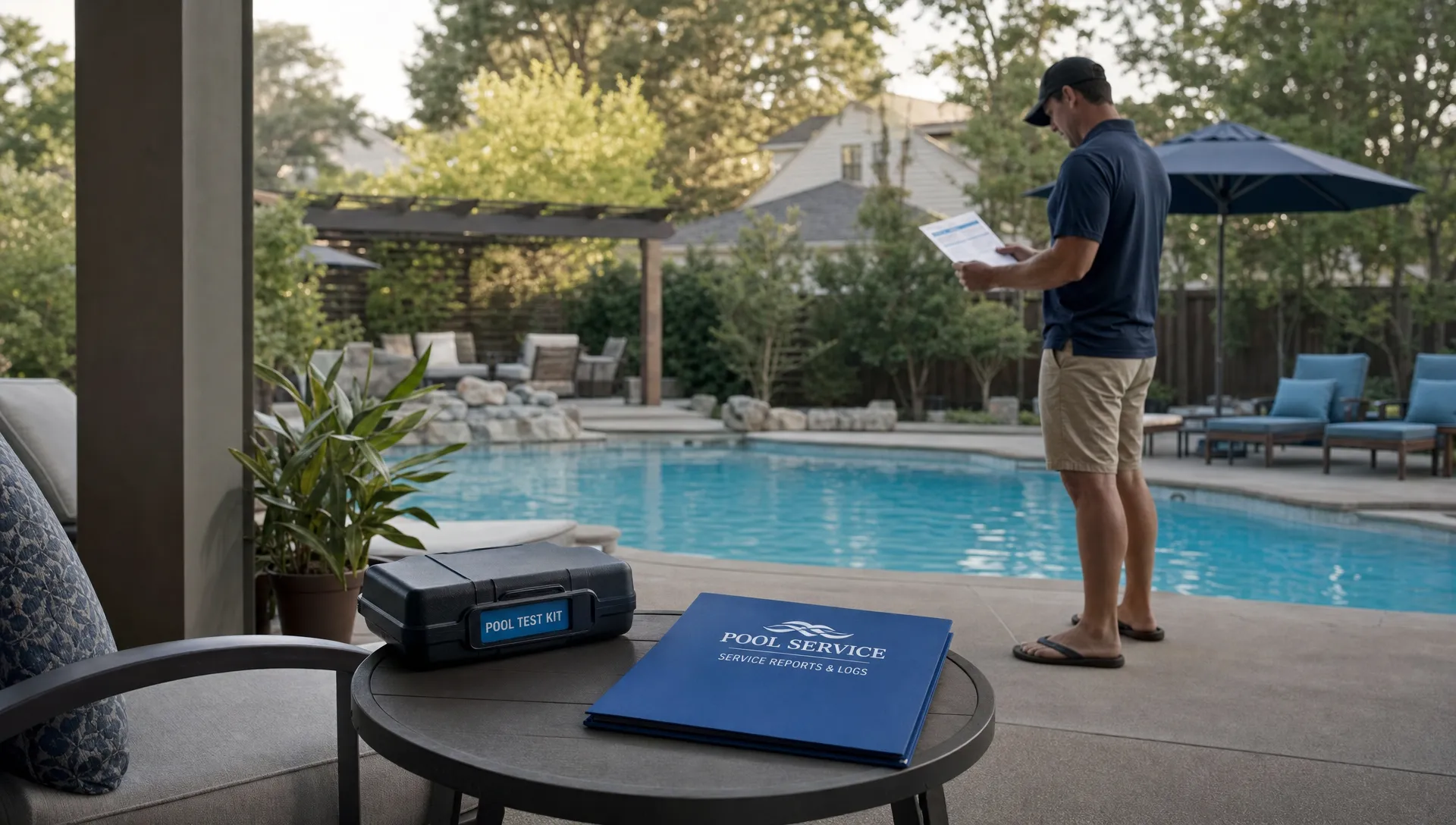
A water log can look complete and still be wrong. A reading may belong to the wrong pool, a blank field may have become a zero or a treatment may be mistaken for a follow-up test. Pool testing software should help protect the accuracy of the record, not simply replace the paper form.
For pool service companies comparing tools, the useful question is what happens between taking a measurement and someone relying on it later. This guide focuses on that chain: capturing results, preserving corrections, handling offline work and keeping the office and field crew aligned.
Accuracy starts at the test kit
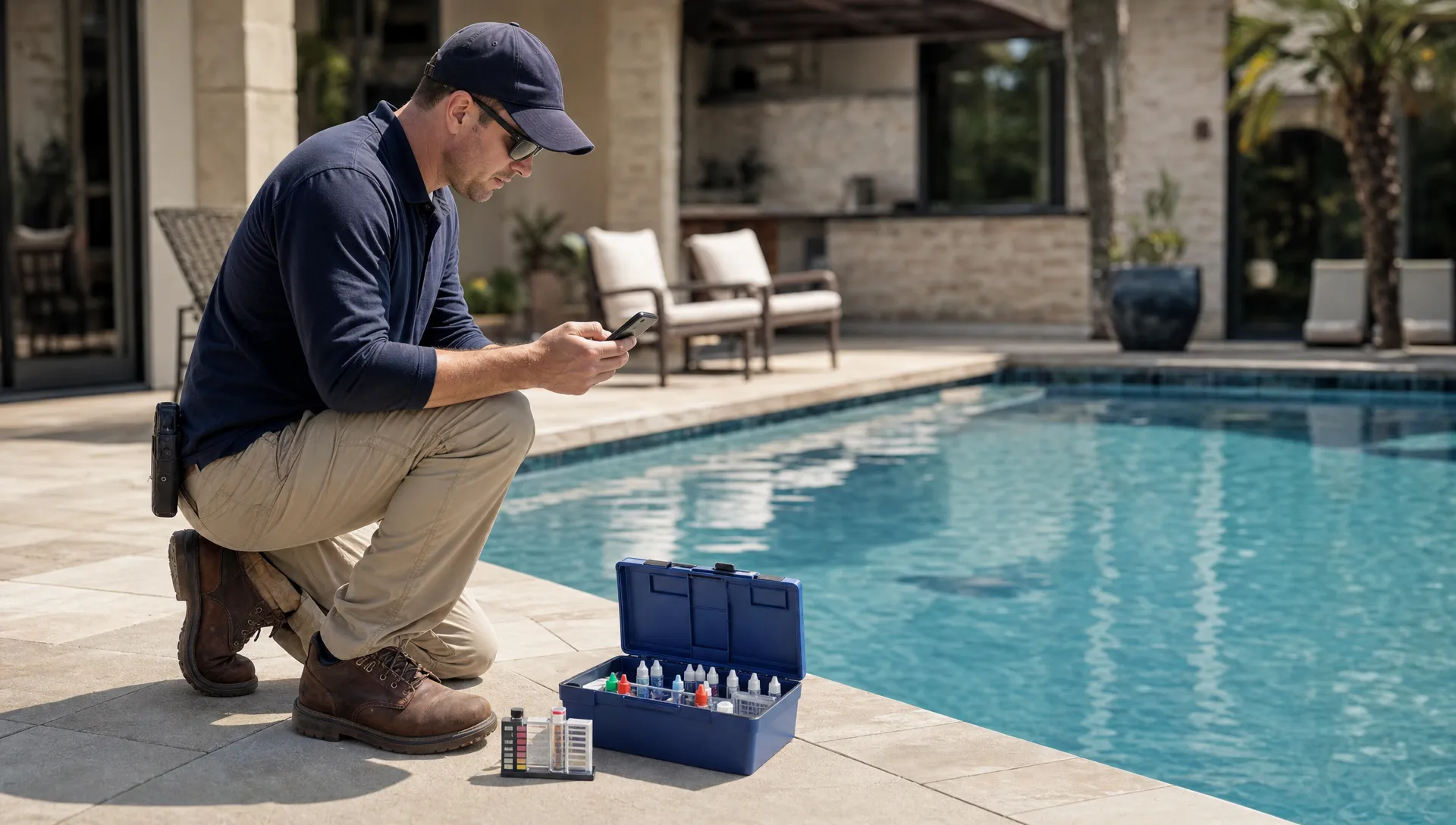
Software cannot repair an unreliable sample or an incorrectly performed test. Technicians still need to follow the test-kit manufacturer’s instructions for sampling, reagent handling, timing and interpretation. A digital field with two decimal places does not make a measurement more precise than the test method allows.
Start by standardizing the testing process across your team. If technicians use different methods, identify the method in the record so a supervisor can interpret a change without assuming every result is directly comparable.
The entry workflow should also distinguish between a measured value and a technician’s observation. “Water looks clear” is useful context, but it is not a sanitizer reading. A photo documents conditions at the visit; it does not prove the chemistry was acceptable.
Pool testing software is most useful when it preserves those distinctions instead of collapsing everything into a single service note.
For public and commercial accounts, build your workflow around applicable local requirements. The CDC’s Model Aquatic Health Code provides a model framework for public aquatic facilities, but it is not a substitute for the rules adopted in your jurisdiction.
Before evaluating vendors, agree on what your team considers a valid test record. Otherwise, each technician may digitize a different version of the same process.
How pool testing software should structure water logs
A reliable record needs enough structure to prevent ambiguity without making poolside entry unnecessarily slow. The goal is not to require every possible measurement on every visit. It is to make required readings identifiable and missing information explicit.
| Record element | Accuracy problem to prevent | What to check in a demo |
|---|---|---|
| Pool and service visit | A reading attached to the wrong property or body of water | Results remain associated with the specific pool and visit |
| Measurement name | Free chlorine confused with total chlorine | Separate, clearly labeled fields |
| Units | A number loses meaning when units are missing | Units appear beside the value and remain visible in reports |
| Test status | An unperformed test appears as zero | Blank, not tested and measured zero are distinguishable |
| Measurement time | Entry time is mistaken for sampling time | The workflow explains which timestamp is being recorded |
| Test method | Results from different methods appear interchangeable | A method or contextual note can be retained |
For chlorine readings, ppm is commonly used; pH does not use ppm. That sounds basic, but a generic numeric form can hide these differences.
Pool testing software should make the meaning of each entry clear to both the technician entering it and the next person reviewing it.
Keep measurements separate from chemical additions. A pre-treatment result, an amount added and an actual retest are three different events. Recording a treatment should not imply that the water was retested afterward.
If you need a broader foundation for what belongs in a service history, SplashIQ’s guide to pool water test records covers that context. During software selection, focus on whether the system preserves it reliably.
Preserve corrections without hiding the original reading
People make entry mistakes, especially on a busy route. The important distinction is between correcting a record and silently replacing its history.
Suppose a technician enters a pH result against the wrong pool. The correction should leave enough context for the office to understand what happened. Otherwise, a later review may show a chemistry change that never actually occurred.
Ask vendors to demonstrate how an existing reading is corrected. Look for the original value, the corrected value, the person making the change and the time of the correction. A reason for the edit is also useful when the change could affect a treatment decision or homeowner communication.
Pool testing software should make a corrected typo distinguishable from a new measurement taken later in the visit.
These are evaluation criteria, not features you should assume every product includes. Some systems allow unrestricted editing; others offer a detailed change history. Have the vendor show the actual behavior rather than describe it broadly as “tracking.”
Also check the relationship between corrected records and already-sent reports. If a homeowner received an incorrect result, does changing the internal record update anything they can see? Is a separate clarification needed?
A simple office policy helps: correct the record, document why and determine whether the change requires follow-up. Do not rely on an internal edit to automatically communicate the correction.
Test the offline workflow before committing
An offline field app can keep technicians working where reception is weak. That does not, by itself, tell you how records behave when connectivity returns.
Run a controlled trial using test accounts, not live records that could confuse customers. Enter results offline, reconnect and inspect the final history from both the technician and office views.
Include realistic interruptions in the trial:
- Save a reading offline, close the app and reopen it before reconnecting.
- Enter two separate measurements during the same test visit and check that both remain identifiable.
- Have the office and technician change the same test record while disconnected.
- Attempt to finish a visit with a required reading missing and observe the result.
Ask the vendor how its system handles conflicts, failed uploads and duplicate submissions. Do not assume that the most recent edit is always the correct one or that a saved screen means the office has received the record.
For pool testing software, the offline acceptance test is straightforward: can your team explain what was captured, what remains pending and what ultimately became part of the service history?
Document unexpected behavior during the pilot. A small sync problem is easier to investigate with one technician and a few test properties than after the whole route team depends on the app.
Evaluate the whole workflow, not just the entry screen
A fast entry screen is useful, but the record also needs to survive office review, technician handoffs and homeowner communication.
Ask a dispatcher or service manager to find the previous visit’s readings without help from the person who entered them. Then have another technician explain which numbers were measurements, which entries were treatments and whether any follow-up was still needed.
This reveals problems that a polished product demonstration can miss. A log may be easy to complete but difficult to interpret. A report may show numbers while omitting the units or context that made them useful.
Pool testing software should preserve the meaning of the record as it moves between people, not merely display the same numbers on another screen.
SplashIQ includes water-quality logs, an offline field app, equipment tracking and before/after photos within its pool service platform. Its Pool Care app for technicians also supports water-test tracking, chemical calculations, treatment planning and visit reports.
Those capabilities provide a relevant starting point for evaluation. For requirements such as correction history, field validation, export formats or conflict handling, request a demonstration of the specific workflow rather than assuming how it works.
Keep chemical calculations separate from measurement accuracy in your assessment. A calculation depends on correct inputs, including pool volume and product details where applicable. A well-organized log does not independently validate those inputs or certify that water is safe.
Connect water logs to the CRM as your routes grow
As a company adds accounts and technicians, accurate records become a coordination issue. The office needs to know which pool was serviced, what happened and whether the visit created a follow-up task or customer question.
HubSpot’s article on construction CRM software offers a useful adjacent perspective on how contractors can organize customer relationships as their businesses grow. For pool companies, the practical connection is between the customer record and the service history, not simply maintaining a larger contact list.
Pool testing software should keep each result attached to the correct service location and body of water, even when one customer manages multiple properties or pools.
Test what happens when a technician changes routes, a property receives a new contact or an account becomes inactive. Historical measurements should remain understandable after those administrative changes.
SplashIQ combines customer CRM, smart route scheduling, water-quality logs, homeowner communication and payments. When evaluating that connected workflow, check whether the right people can find the relevant service record without retyping it into another system.
Use community discussions to build better trial scenarios
Reddit’s r/pools discussions about test results can provide practical questions to explore during a software trial. Use individual threads as prompts for situations such as conflicting readings, unclear treatment histories or confusion over which test was performed.
Treat Reddit posts as anecdotal discussion, not validated testing guidance. For measurement procedures and operating requirements, use manufacturer instructions and applicable local rules.
A useful exercise is to take one troubleshooting question and ask whether your proposed record structure would preserve enough information to investigate it. That tests the workflow without treating an online reply as a chemistry standard.
Frequently asked questions
Does pool testing software automatically test the water? Not necessarily. Many tools record results entered by a technician. Digital testing-device connections and automatic imports are separate capabilities that need to be confirmed for the specific product and equipment.
Should an unusual reading be blocked? A warning can help catch a typo, but an unusual result may be genuine. Ask how the software allows technicians to verify a reading and retain relevant context. A validation rule should not encourage someone to replace a real result merely to finish the form.
Can digital water logs replace required commercial-pool records? That depends on local requirements and whether the digital record meets them. Confirm required fields, retention periods, accessibility and any reporting format with the relevant authority before replacing an existing process.
What should we measure during a pilot? Track missing required readings, wrong-pool entries, duplicate records, corrections and offline upload problems. Also measure how long it takes the office to reconstruct a visit. These observations are more useful than relying only on how quickly a technician can fill out the form.
Choose a system your team can verify
Before rolling out a platform, run several representative visits through it and review the records from the field, office and homeowner perspectives. Write down which accuracy requirements passed, which failed and which still need clarification.
If you want water-quality logging connected to the rest of your service operation, explore SplashIQ and use these scenarios to guide your evaluation. The goal is a service history your team can trust when the next decision depends on it.