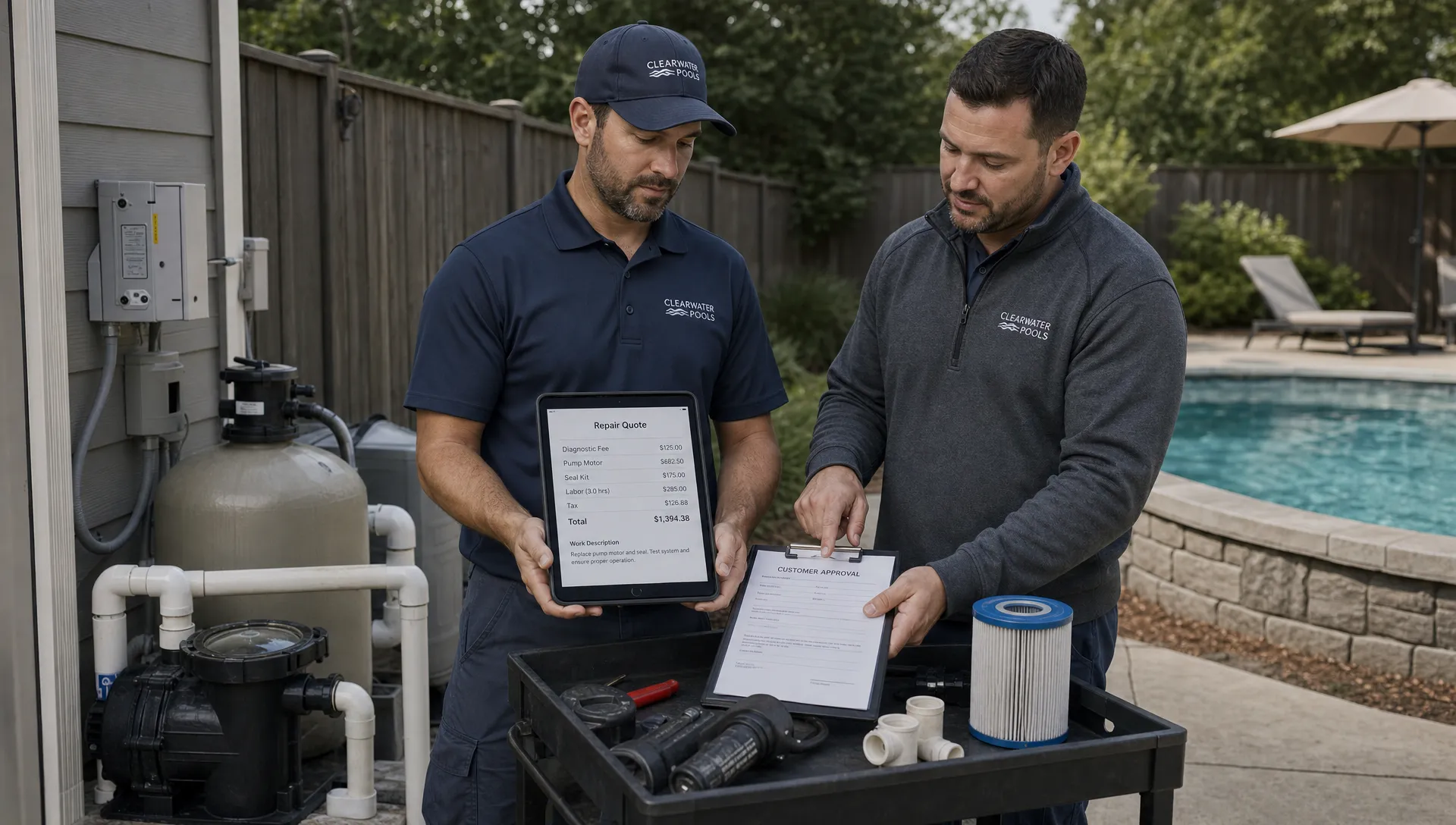
A CRM for sales team discount approvals should help your pool service business answer three questions before a repair quote goes out: Who can reduce the price, how much can they offer and will the job still meet your margin target? Without those rules, a small concession on a pump replacement can become a larger loss once labor, parts and additional visits are counted.
The solution is not a blanket ban on discounts. It is a documented pricing policy that connects estimated costs, approval authority and the final invoice.
Calculate the Repair’s Minimum Selling Price First
Start with the job’s economics, not a percentage that feels reasonable. A 5% discount can be affordable on one repair and erase most of the profit on another.
For each estimate, establish the expected direct cost using parts, loaded field labor, subcontractor charges and other job-specific costs. Define these categories consistently with your accountant so your team compares margins on the same basis.
Consider this illustrative example, not an industry benchmark:
| Item | Amount |
|---|---|
| Original repair price, before tax | $1,500 |
| Estimated direct job cost | $1,050 |
| Original gross profit | $450 |
| Original gross margin | 30% |
| Required gross margin floor | 25% |
Calculate the minimum selling price as:
Minimum price = estimated direct cost ÷ (1 − required margin)
Here, $1,050 ÷ 0.75 = $1,400. The largest discount that preserves the floor is therefore $100, approximately 6.7% of the original price.
In a CRM for sales team pricing decisions, that cost-based limit should take precedence over a generic discount allowance. A 10% reduction would bring the selling price to $1,350 and reduce the gross margin to approximately 22.2%.
Gross margin is not markup. Margin divides gross profit by selling price; markup divides it by cost. Confusing them produces the wrong price floor.
Assign Discount Authority by Role
Once the price floor is established, decide who may authorize a concession. Use both a percentage cap and a dollar cap, with the lower amount controlling the decision.
The following matrix is a starting example to adapt, not a recommendation that every pool company use these limits:
| Role | Illustrative authority | Required condition |
|---|---|---|
| Sales representative | Lower of 3% or $75 | Approved cost estimate and margin floor preserved |
| Sales manager | Lower of 8% or $200 | Documented reason and margin floor preserved |
| Owner or designated executive | Case-by-case exception | Written justification for exceeding standard limits |
On the $1,500 example, the representative’s percentage cap allows $45. The manager’s percentage cap allows $120, but the margin floor restricts the actual discount to $100.
A CRM for sales team approvals should evaluate these conditions together rather than treating manager permission as permission to ignore job costs.
Specify who covers approvals when the manager is unavailable. Otherwise, representatives may delay quotes or seek approval through informal texts that never reach the customer record. Below-floor exceptions should have a named approver, an explicit business reason and a budget owner.
Define Exactly What Counts Toward the Limit
A discount is not always a percentage entered into an estimate. Waived diagnostic fees, free installation labor, promotional coupons and post-sale credits can all reduce what the company earns.
When configuring a CRM for sales team concessions, define the limit against the combined economic effect, not just the field labeled “discount.” Otherwise, several individually acceptable adjustments can exceed the policy together.
For example, a $75 price reduction plus a $50 waived fee creates a $125 concession. If the authorization limit is $100, the combination needs escalation.
Your written policy should distinguish these situations:
- Negotiated discount: A voluntary reduction to win or retain business.
- Promotional offer: A published offer with defined eligibility and combination rules.
- Warranty work: An obligation evaluated under warranty terms, not ordinary sales discretion.
- Service recovery credit: Compensation for a documented service problem with separate authorization.
- Scope revision: A real change in work that requires updated costs, pricing and customer acceptance.
Measure concessions against a clearly defined, pre-tax baseline. Do not let representatives inflate the starting price to make a discount appear compliant. Track payment-processing or financing costs consistently as well, even if they sit outside the sales discount calculation.
Configure a CRM for Sales Team Approval Workflows
Translate the policy into a repeatable sequence: prepare the estimate, calculate the available concession, request approval when necessary and release the approved version to the homeowner.
Ask your software provider which controls are native, which require integration and which need a documented manual process. Customer records and estimate storage alone do not establish enforceable discount limits.
Record the Inputs Behind the Decision
Each approval record should identify the original price, estimated direct cost, proposed adjustment, resulting margin, reason and approving person. Connect it to the specific quote version rather than only to the customer account.
Capture enough context for a manager to make a decision without a second round of questions. For a pool equipment replacement, that might include the model, supplier cost, expected installation time and any site conditions affecting labor.
A CRM for sales team approvals becomes more useful when the request explains the commercial reason too. “Homeowner requested a lower price” is less actionable than “Customer has a comparable written proposal; requested concession is $80 and margin remains above the floor.”
Prevent Unapproved Quotes From Being Sent
If supported, restrict sending, acceptance or conversion of a quote while approval is pending. Limit who can change cost inputs and who can override a price floor.
Without native enforcement, use a controlled fallback: an authorized manager releases the customer-facing estimate, and the approval is attached to that version. Do not describe a reminder or an editable note as a hard control.
Any material change to scope, cost, price or concessions should trigger a fresh review. An approval for one pump model should not silently carry over to a different model with a higher supplier cost.
Close the Common Workarounds
Test whether the policy can be bypassed before relying on it. Common gaps include splitting one repair into multiple estimates, changing line-item quantities, adding free accessories or issuing an invoice credit after the quote has been approved.
The control should follow the repair opportunity and its related adjustments, not just one line item. Legitimately separate repairs can remain separate, but dividing the same job must not reset the discount allowance.
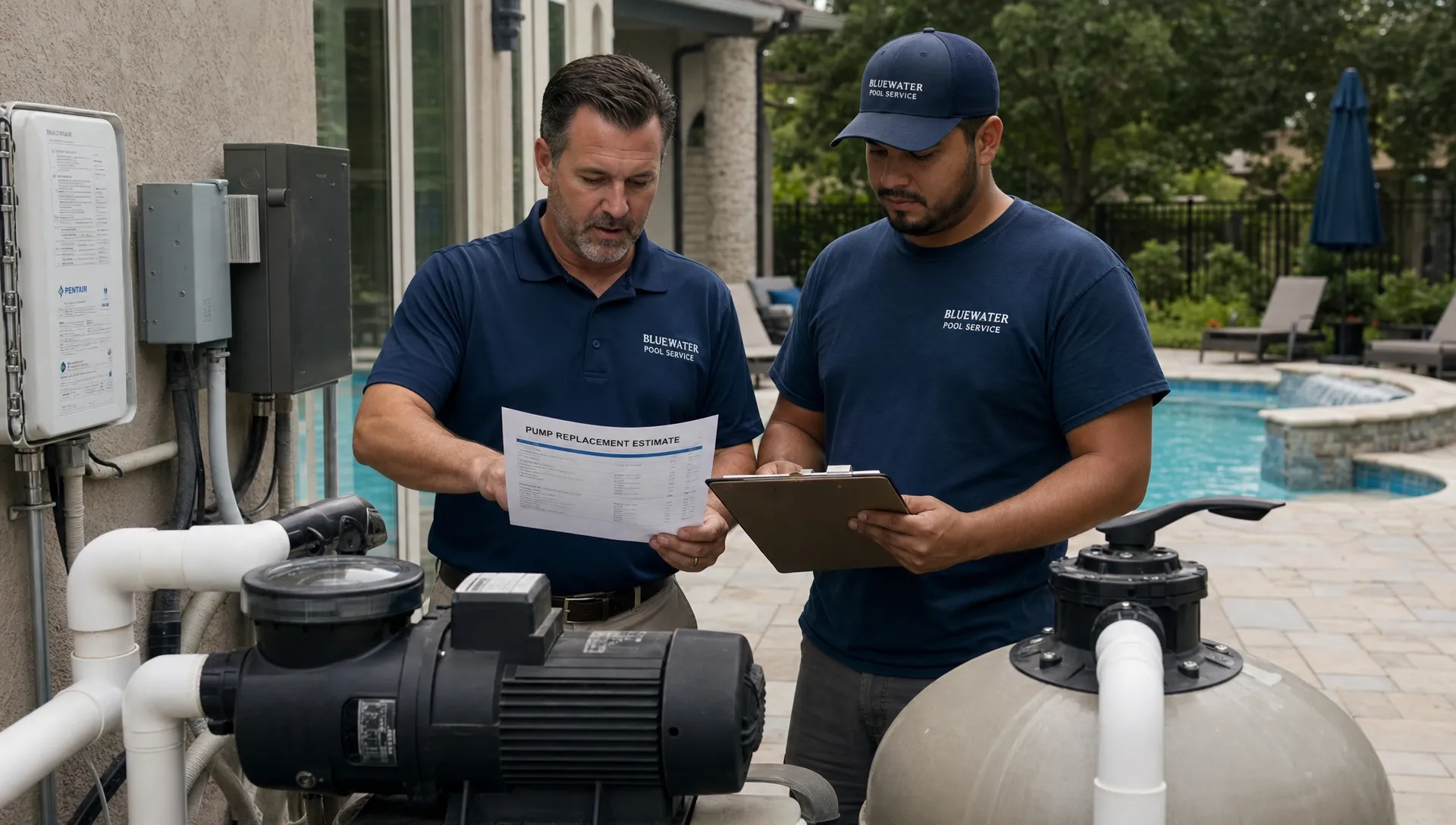
Also define how approvals work in the field. If a technician is offline or cannot reach a manager, the fallback should be a standard-price quote or a pending request, not an undocumented promise to the homeowner.
Run test cases for a routine concession, stacked offers, an outdated cost estimate, a below-floor request and a post-approval revision. Confirm not only that the system warns someone, but that the intended person cannot release an unauthorized price.
Carry the Approved Price Through to the Invoice
The office and field team need the same commercial record. A homeowner should not receive an approved estimate from sales, a different verbal promise from the technician and an unexplained total on the invoice.
In a CRM for sales team handoffs, preserve the accepted scope, approved concession, approval reference and customer-facing total alongside the job. Where the system supports it, compare the invoice against the accepted quote and flag unexplained differences.
If the technician discovers additional work, document a change order rather than absorbing the new scope into the old discounted price. Record the added cost, revised selling price and customer acceptance before proceeding, except where a separately defined emergency procedure applies.
Keep homeowner communication straightforward. The customer needs the final price, included work, exclusions and applicable terms. Internal approval thresholds and cost calculations generally belong in the internal record, not in the sales conversation.
Finally, restrict post-sale credits appropriately. A tightly controlled estimate process offers little protection if anyone can later reduce the invoice without a reason or review.
Measure Margin Retention, Not Just Close Rate
Discount policies need a review cycle. Start with a monthly review of approved concessions, exceptions, completed-job costs and final collected revenue.
Useful measures include discount dollars by reason, quote acceptance by discount band, approval turnaround time and estimated versus actual job margin. Look at comparable repair types together; a mix of small valve repairs and major equipment replacements can distort averages.
A CRM for sales team performance reviews should help distinguish productive concessions from habitual price cutting. If one representative discounts nearly every quote, examine estimating accuracy, sales conversations and approval behavior before assuming that lower prices are necessary.
Include the cost of additional visits and other overruns when reviewing completed work. A quote that met the floor at approval may finish below it because the labor estimate was wrong.
Your pool repair revenue forecast should also reflect approved net selling prices rather than undiscounted quote totals. Keep quoted revenue, invoiced revenue and collected cash distinct.
If commissions depend on revenue or gross profit, document how approved discounts and later credits affect compensation. Review changes against applicable employment requirements before implementation.
Check the Policy Against Contractor Workflows
Discount governance works best inside a connected operating process. SplashIQ’s article on CRM tools that help contractors scale without chaos provides broader context on connecting lead capture, scheduling and job documentation as a business grows. Discount limits add a specific financial control to that workflow.
For additional operator perspectives, browse Reddit’s r/smallbusiness discussions about contractor CRMs. Look for practical questions about approval delays, technician adoption and duplicate data entry. Treat individual posts as anecdotes and questions to investigate, not proof that a vendor supports a particular control.
Ask representatives and technicians to walk through realistic repair scenarios before rollout. Their feedback can reveal unclear rules without giving them authority to bypass those rules.
Frequently Asked Questions
What is a reasonable maximum repair discount? There is no universal percentage. In a CRM for sales team discount management, the maximum should be the lowest amount allowed by the role’s percentage cap, dollar cap and job-specific margin floor. Use your costs and business targets to set those limits.
Should technicians be allowed to offer discounts? Only within explicitly assigned authority. A technician who identifies the repair does not automatically need permission to change its price. Give field staff a clear approval route and a customer-facing response when authorization is pending.
Should warranty work count against a sales discount allowance? Usually it should have a separate classification and approval process. Warranty obligations, sales concessions and goodwill credits serve different purposes. Separating them makes costs and performance easier to interpret.
What if our CRM cannot block an unauthorized discount? Use manager-controlled quote release, versioned estimates and attached written approvals as an interim process. Audit invoices and credits too. Recognize that a manual review is less enforceable than a properly configured system restriction.
Evaluate the Workflow Before Choosing the Software
When evaluating a CRM for sales team pricing controls, bring a sample repair estimate and ask the provider to demonstrate the approval process from proposed concession through final invoice.
SplashIQ connects customer CRM, equipment tracking, before/after photos, scheduling and online payments for pool service businesses. Confirm discount approval rules, pricing permissions, margin calculations and audit-history capabilities directly with the team rather than assuming they are included.
Start with one written policy and a few realistic test jobs. The goal is a process that lets authorized people make timely decisions while keeping every concession visible and accountable.