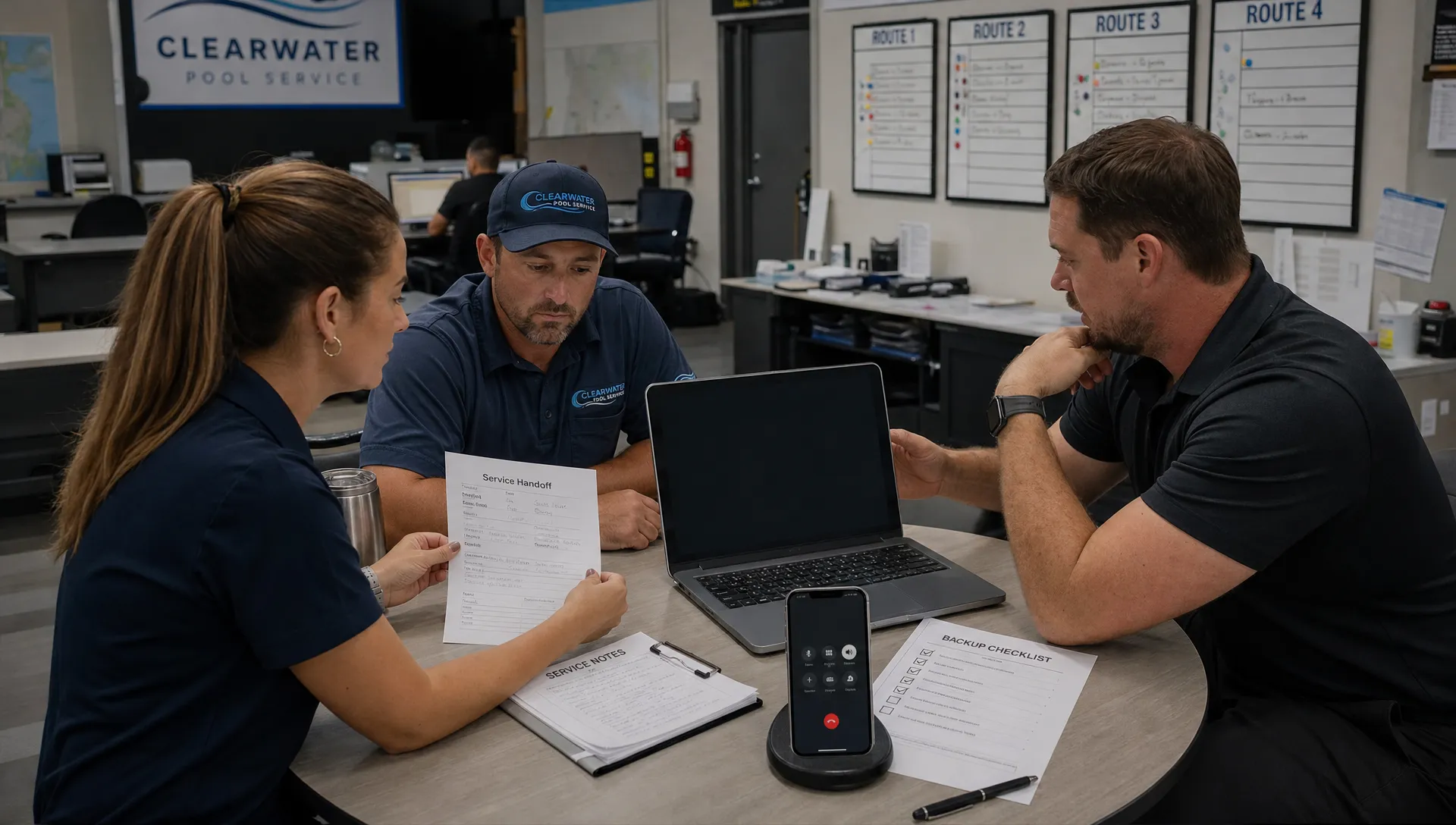
When a pool company chooses open source CRM software, someone still has to keep it running. The project’s developers maintain the shared codebase. Your business, an employee or a contracted provider must maintain your installation, integrations, backups and daily workflows.
That distinction matters when a technician cannot retrieve gate instructions at 7 a.m. or yesterday’s service records fail to reach billing. A community forum may explain the problem, but it does not automatically provide someone authorized to fix your system.
Before comparing features, answer one question: Who owns the next failure, and what have they agreed to do?
Separate the software project from your installation
An open-source project and your company’s working CRM are different things. Project maintainers can publish a security fix without installing it on your server. A hosting company can keep a server online while your customer notifications remain broken.
A practical responsibility map looks like this:
| Responsibility | Potential owner | What to confirm |
|---|---|---|
| Shared application code | Upstream project maintainers | Release process and security reporting channel |
| Hosting and operating system | Internal IT or hosting provider | Which infrastructure updates are included |
| CRM updates and extensions | Application administrator or implementation partner | Testing, deployment and rollback responsibilities |
| Records and workflow rules | Pool company operations lead | Approval authority and data-quality checks |
| Backups and recovery | Named technical provider | Backup scope and demonstrated restoration |
| Incident coordination | One designated business owner | Escalation contacts and decision-making authority |
For open source CRM software, assign one accountable person inside the company even when outside providers perform the technical work. Otherwise, a host, developer and office manager can each reasonably believe that somebody else owns the failure.
Free access to code does not mean free operations
Open source describes licensing rights, not a maintenance service. The Open Source Initiative’s definition addresses rights such as redistribution and access to source code. It does not promise hosting, implementation or a support response.
A free hosted CRM tier is different. It may offer no source-code rights and impose limits on users, storage or features. Conversely, an open-source application can have paid hosting, commercial extensions and paid support.
Check the exact edition and each extension’s license. A vendor can distribute a community edition alongside a differently licensed commercial product. Access to a repository alone does not establish that every component you need is open source.
The practical benefit of open source CRM software is the ability to inspect and adapt qualifying code under its license. That flexibility becomes valuable when you have a workable maintenance arrangement, not simply because downloading the application costs nothing.
Divide ongoing maintenance into three jobs
Keep the infrastructure healthy
Someone must manage the server, database, certificates, storage and scheduled background jobs. Depending on the setup, that includes monitoring failed processes, applying operating-system updates and checking that email services remain connected.
“Managed hosting” needs a written definition. Some providers maintain the operating system but exclude the CRM application, custom code and third-party integrations. Others offer a broader service for an additional fee.
Ask who receives alerts when storage fills overnight. Then ask who can act on them before the first route leaves. A monitoring dashboard is not a response plan.
With open source CRM software, infrastructure ownership also includes maintaining an inventory of dependencies and supported versions. An application can appear functional while an underlying database or runtime has passed its supported life. Your agreement should identify who tracks those deadlines and plans the necessary upgrades.
Keep the application compatible and secure
Application maintenance covers CRM releases, extensions, customizations and connections to other systems. A working update process includes a separate test environment, representative records and a rollback method.
For a pool company, test more than whether users can log in. Check a recurring service visit, a customer with multiple properties, an equipment record and the transition from completed service to billing.
Security responsibilities also need an owner. That includes removing departed employees, reviewing permissions, protecting administrator accounts and controlling integration credentials. Gate codes and homeowner contact information deserve restricted access, not unrestricted company-wide visibility.
Maintaining open source CRM software means checking whether a security advisory applies to your installed version and extensions, then deploying the appropriate fix. Reading release announcements is only the first step. Someone must be authorized to make the change and verify that service still works afterward.
Keep field workflows accurate
Technical availability does not guarantee operational reliability. An office employee might change a service template without realizing that technicians use its fields to document water readings or equipment problems.
Assign an operations owner to approve changes to property records, required fields, visit statuses and billing handoffs. Keep a short change log explaining what changed, who approved it and how it was tested.
Mobile work adds another responsibility: understanding what happens when connectivity disappears. If your chosen CRM requires a separate field application, identify who maintains that connection and resolves synchronization conflicts.
For open source CRM software used on pool routes, define how a technician reports a failed upload, missing photo or duplicated visit. Avoid storing unverified workarounds in personal texts. A shared issue log helps distinguish training problems from software defects and gives the maintainer reproducible examples.
What does open source CRM software cost to maintain?
Compare complete operating costs rather than subscription prices alone. Include setup, migration, hosting, administration, upgrades, integrations, training and the eventual cost of leaving.
The following worksheet is illustrative planning math, not a market-price estimate or vendor quote:
| Cost item | Hypothetical assumption | Monthly equivalent |
|---|---|---|
| Hosting | Assumed monthly allocation | $80 |
| Backup storage and monitoring | Assumed monthly allocation | $40 |
| Routine administration | 4 hours at $100 | $400 |
| Workflow and integration support | 2 hours at $100 | $200 |
| Upgrade testing reserve | 12 hours annually at $100, divided by 12 | $100 |
| Total | Excludes initial implementation | $820 |
Under these assumptions, annual operating cost is $9,840. An additional 30-hour implementation at $100 per hour brings the first-year total to $12,840. Substitute actual quotes and internal labor costs before using the calculation.
Ownership costs for open source CRM software can also include paid extensions, messaging charges and payment-processing fees. Do not count employee time as free simply because it does not produce a separate invoice.
If extensive customization drives the budget, the comparison between custom CRM development and buying pool service software can help separate essential requirements from avoidable development work.
Assess project health before hiring an implementer
A capable contractor cannot eliminate the risks of an abandoned dependency or an unsupported extension. Inspect the project and your proposed configuration separately.
Useful starting points include SuiteCRM’s repository, ERPNext’s repository and Odoo’s community codebase. These are examples to investigate, not a ranking or assurance that they fit pool operations. Edition and extension licensing still require review.
When assessing open source CRM software, look beyond repository popularity:
- Release history: Are releases documented, with clear upgrade instructions?
- Security process: Is there a private vulnerability-reporting channel and a way to identify affected versions?
- Maintainer participation: Are substantive issues reviewed by people who can approve changes?
- Extension compatibility: Does each critical add-on support the version you plan to deploy?
- Documentation: Can another administrator reproduce installation, backup and recovery without the original developer?
A high commit count alone is not proof of stability. Frequent changes can reflect productive development or significant churn. Review unresolved issues that resemble your requirements, especially mobile access, scheduled jobs and upgrades.
Also ask your implementation partner which versions they support and what happens when the upstream project introduces a breaking change. That answer belongs in the maintenance scope.
Test the failures that could interrupt a pool route
Use a realistic scenario before committing: a technician finishes service without connectivity, the office changes tomorrow’s schedule and the homeowner updates a billing contact.
Have the proposed maintainer demonstrate what happens when those changes reach the system. Confirm which record takes precedence, whether anything duplicates and who investigates exceptions.
The evaluation of open source CRM software should include interrupted workflows, not just a polished sales demonstration. Ask the team to test a failed notification, expired integration credential and unavailable server.
During an outage, technicians need an approved way to access the minimum information required for work. Do not assume an open-source CRM includes offline service records, route tools or secure device storage. Those capabilities may require additional applications or development.
Keep a fallback procedure that protects customer information and explains how completed visits will be reconciled later. Avoid automatically repeating charges or homeowner notifications when integrations reconnect. Payment status should be verified in the payment system before anyone retries a transaction.

Choose a support arrangement your business can sustain
Three arrangements are practical: an internal administrator, a contracted application partner or a managed application service. A combination can work, provided responsibilities do not overlap ambiguously.
An internal administrator offers direct operational knowledge but creates continuity risk if nobody else understands the system. A general IT provider may handle infrastructure well while lacking experience with CRM extensions. An implementation partner may know the application but offer no out-of-hours incident coverage.
Before signing support for open source CRM software, document coverage hours, escalation contacts, included tasks and exclusions. Distinguish an initial response commitment from a restoration commitment. “We will acknowledge your ticket” does not mean tomorrow’s route will be available.
The agreement should also cover access to source repositories, configuration files, backups and deployment instructions. Keep company-controlled credentials for essential accounts rather than relying entirely on a contractor’s accounts.
Deciding which CRM services pool contractors should outsource is easier once routine administration is separated from business decisions. A provider can execute a permission change, for example, while your operations lead decides who should see homeowner access details.
Plan migration and recovery before launch
Move a representative sample first
Start with an inventory of customers, properties, equipment, service history, documents, balances and integration identifiers. Define where each record belongs in the new system and who approves the mapping.
Test several difficult examples: one homeowner with multiple properties, a property with a new owner and an inactive customer with unpaid invoices. Contact counts alone will not reveal broken relationships between records.
When migrating to open source CRM software, compare source and destination totals, then inspect individual records with the office staff who use them. Verify attachments, dates, permissions and property associations rather than accepting a successful import message.
Schedule a cutover window and define when the old system becomes read-only. Preserve an accessible export subject to your retention obligations. Name the person who decides whether to proceed or roll back, and document what happens to work entered during the transition.
Prove that a backup can be restored
A useful backup plan covers the database, uploaded files, configuration, custom code and information needed to rebuild the environment. Protect credentials separately and restrict access to backup copies.
Set two business requirements: how much recent work you can afford to lose and how long operations can function without the system. These are commonly called the recovery point objective and recovery time objective.
For open source CRM software, require a restoration test into an isolated environment before launch and after significant changes. Record the recovery duration and verify that sample properties, photos and service histories are usable.
Before returning a restored system to production, reconcile work completed since the backup. Review pending notifications, synchronization queues and payment events so that recovery does not resend messages or duplicate transactions. A backup success email cannot prove that these steps will work.
Use Reddit and contractor growth articles carefully
For peer experience, search Reddit’s r/smallbusiness CRM discussions. Look for posts that identify the software edition, hosting arrangement, business size and who performed maintenance. A recommendation without those details is difficult to apply to your pool company.
For articles about contractors using CRM and field-service software to scale, explore ServiceTitan’s contractor blog. Treat vendor-published growth stories as examples to investigate, not independent proof of typical results. Look for named contractors and specific process changes rather than revenue headlines alone.
When researching open source CRM software, separate evidence about business workflows from evidence about technical ownership. A contractor may improve follow-up or dispatch with a CRM without self-hosting anything. That story supports the value of a connected process, not the claim that maintaining your own installation will be inexpensive.
Run an ownership audit before the first live route
Ask the proposed administrator to walk through a short handoff meeting with your office lead and a technician. The goal is not to demonstrate every feature. It is to establish that a second person can understand and operate the setup.
Require clear answers to five questions:
- Who installs an urgent security fix, and who approves downtime?
- Who investigates a missing service record or failed billing handoff?
- Where are backups stored, and who has successfully restored them?
- Who maintains custom fields, extensions and integration credentials?
- How does another provider take over if the current maintainer becomes unavailable?
An open source CRM software proposal is incomplete if these answers depend on finding a volunteer after something breaks. Assign names, contact methods and decision rights before launch.
Keep the resulting responsibility sheet somewhere accessible outside the CRM. During an outage, instructions stored only inside the unavailable application provide little help. Review the sheet when staff, vendors or major integrations change, and make sure the backup contact still has working access.
Frequently asked questions
Does the open-source community maintain my company’s CRM? Usually not. Community maintainers work on shared project code. Your company or contracted provider remains responsible for deploying updates, configuring access, protecting data and maintaining your particular installation unless a service agreement assigns those tasks elsewhere.
Can a pool company run a CRM without an internal developer? Yes, if a capable external provider handles the required technical work. Keep an internal operations owner who approves workflows, verifies records and coordinates incidents. Outsourcing execution does not remove the need for business oversight.
Can ChatGPT build and maintain the CRM? AI can help draft code, explain errors and prepare tests. It does not replace accountable technical review, secure deployment or incident response. Someone must validate changes and remain responsible when generated code fails or exposes information.
Is open source CRM software completely free? The applicable license may permit use without a license fee, but hosting, implementation, support and maintenance still consume resources. Some editions or extensions also have commercial charges. Compare the specific configuration you need, not the price of downloading the base application.
Who should own customer data and system accounts? Your business should retain appropriate control over its records, exports and essential accounts. Define access, retention, handoff and deletion requirements in provider agreements, including what happens when the relationship ends.
Compare maintenance ownership, not just features
If your priority is running pool routes rather than maintaining a general-purpose CRM, include purpose-built software in the comparison. SplashIQ offers customer CRM, smart route scheduling, water-quality logs, equipment tracking, an offline field app, homeowner notifications and online payments.
Evaluate SplashIQ’s pool service CRM against the same property records and service scenarios used in your open-source assessment. Ask about support scope, exports, implementation responsibilities and the integrations your company needs.
The right choice gives your team a workable service process and a clear maintenance arrangement. Before committing, make sure every recurring task and foreseeable failure has an owner.