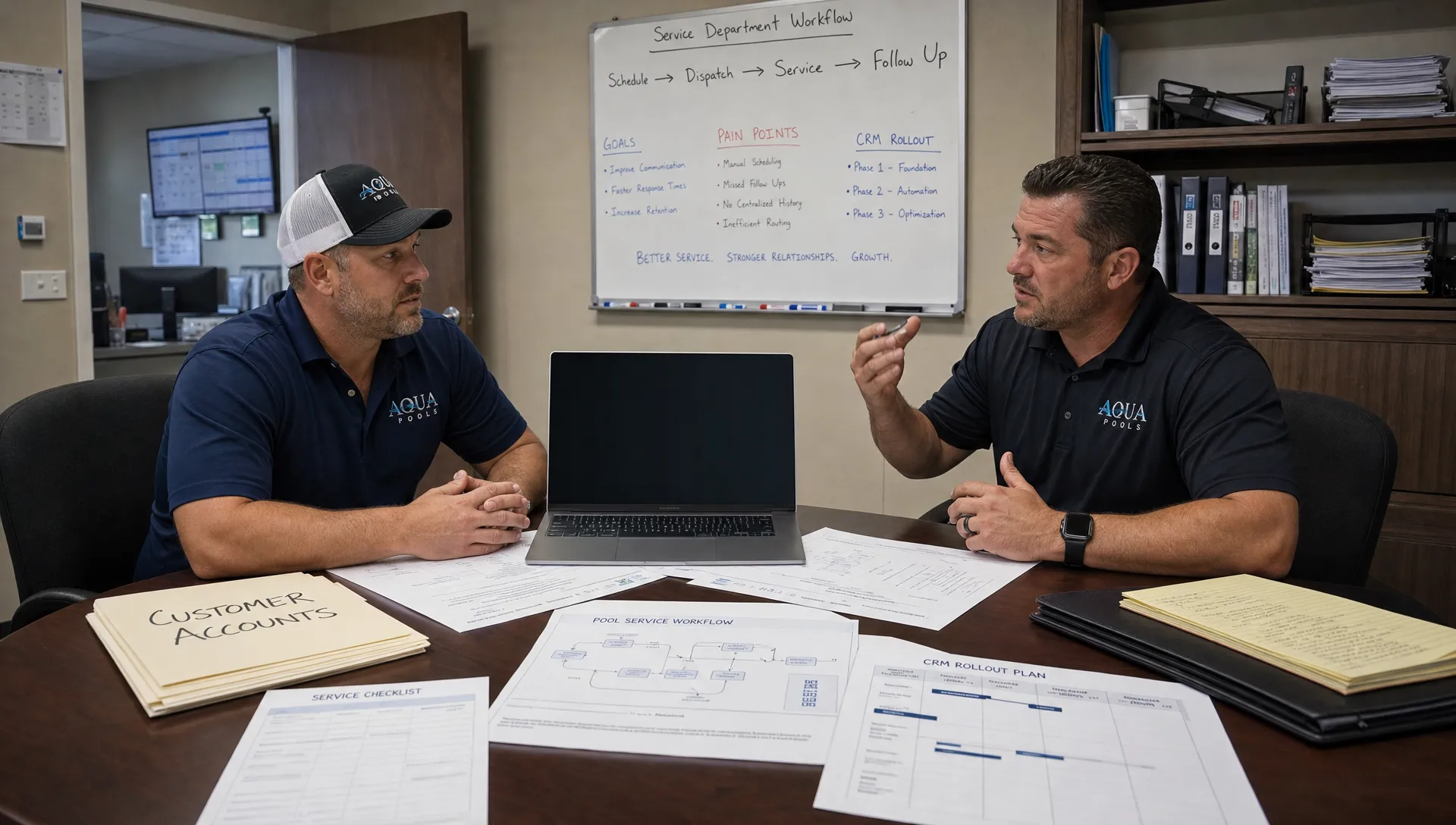
Custom CRM development can give a pool service company exactly the system it wants, but it also makes that company responsible for keeping software working. Buying purpose-built software shifts much of that responsibility to a vendor, with trade-offs around customization, subscription costs and control.
For most growing pool businesses, the decision comes down to one question: Does your competitive advantage require unique software, or do you need reliable execution of familiar service workflows? Here is how to compare the options without underestimating either one.
The Short Answer: Buy Standard Workflows, Build Proven Exceptions
Buying pool service software is usually the stronger starting point when your needs center on customer records, recurring routes, technician documentation, homeowner communication and billing. Those workflows matter enormously, but they rarely need to be invented from scratch.
Building becomes more defensible when a valuable, unusual process cannot be supported through configuration or a workable integration.
| Your situation | Stronger starting point |
|---|---|
| Customer information lives across spreadsheets, texts and paper | Buy a shared operating platform |
| Adding technicians creates scheduling and billing backlogs | Evaluate purpose-built pool service software |
| Your workflow differs mainly in fields, labels or service packages | Investigate configuration before building |
| A proprietary process creates measurable value and existing tools cannot support it | Evaluate a narrowly scoped custom solution |
| Nobody can own software decisions after launch | Avoid a full custom build |
Company size alone does not settle the question. A larger operator may still benefit from standardized software, while a smaller specialist might have one genuinely unusual requirement.
What CRM Development Actually Makes You Responsible For
A CRM manages customer relationships and the information supporting them. For a pool service company, that information connects to properties, equipment, visits, water-quality readings and invoices. A contact database alone does not run the operation.
You Need More Than Customer Screens
A custom system must define how records relate to one another. One homeowner might manage several properties. A property might contain multiple bodies of water, each with equipment and service history. A technician change should not break that history.
You also need rules for permissions, duplicate records, failed notifications and corrections. If a technician edits a visit without connectivity, what happens when the office changes the same record before synchronization?
These questions are solvable. They are also development work, even when the initial prototype looks simple.
Ownership Continues After Launch
Someone must manage hosting, backups, security updates, testing and support. That person also needs authority to decide which requested changes deserve engineering time.
Paying an agency to build the application does not automatically transfer those ongoing responsibilities. Contracts should specify source-code rights, documentation, infrastructure access and support arrangements if the original developer leaves.
Before commissioning anything, distinguish a genuinely unique requirement from a configurable workflow. Our guide to how a customizable CRM fits pool service operations explores that distinction without assuming every business needs its own application.
Compare Total Cost, Not a Build Quote Against a Subscription
A useful CRM development budget covers the software’s operating life, not just its launch. Comparing an agency’s initial estimate with one year of subscription fees gives you an incomplete answer.
Use the same evaluation period for both options, such as three years, and document the assumptions behind each line.
| Cost category | Custom build | Purchased software |
|---|---|---|
| Discovery and setup | Requirements, process design and technical architecture | Evaluation, configuration and onboarding |
| Data migration | Import tools, cleanup and validation | Cleanup, mapping and any migration charges |
| Implementation | Design, engineering, testing and deployment | Workflow setup and any contracted customization |
| Recurring costs | Hosting, monitoring, maintenance and support | Subscription fees and applicable usage charges |
| Change requests | Engineering and regression testing | Configuration, plan changes or integration work |
| Internal labor | Product ownership, testing and vendor management | Administration, training and vendor coordination |
| Exit costs | Technical handover or rebuilding unsupported components | Export, migration and replacement setup |
Ask vendors which charges vary with technician count, customer count, payment volume or additional locations. Ask developers what maintenance includes and how new work is priced.
Put a Value on the Delay
Time spent waiting for software has a cost, too. As an illustrative calculation, ten hours of avoidable administrative work per week at a loaded labor cost of $30 per hour equals $15,600 annually. That is not a promised saving or a market benchmark; it shows how to value a bottleneck using your own figures.
Do not count all those hours as recoverable until a pilot demonstrates the improvement. Similarly, do not assume a custom application will eliminate every manual step simply because the specification says it should.
Test the Pool-Service Workflows That Break Generic CRMs
The practical test for CRM development is not whether someone can create a customer record. It is whether the complete service cycle works under field conditions.
Follow One Visit From Scheduling to Payment
Use a real, anonymized customer scenario. Schedule a recurring visit, assign a technician, record service details, communicate completion and move the work into billing. Then change the appointment and check what happens downstream.
During a buying evaluation, require a demonstration rather than accepting a feature-list answer. During a build evaluation, turn the same scenario into written acceptance criteria.
Pay particular attention to the connection between a customer and a property. Staff should not need to reconstruct equipment history from unrelated notes whenever a different technician takes over.
Test Exceptions, Not Just the Happy Path
Consider a locked gate, a skipped visit, an equipment issue requiring follow-up and an invoice disputed by a homeowner. Check how the office sees unresolved work and who owns the next action.
For offline use, ask what technicians can access and save without connectivity, how synchronization works and how conflicting edits are handled. An “offline” label does not answer all three questions.
Also test permissions around access instructions and customer information. Technicians need relevant service details, but that does not mean every user should see every financial or administrative record.
When Building Your Own System Is Justified
Custom CRM development makes sense when you can identify a specific capability that creates enough value to justify building and maintaining it.
A credible business case explains the requirement, the alternatives already tested and the measurable consequence of leaving the problem unsolved. “Our process is different” is not enough. “No evaluated platform can support this contractual approval sequence, and the resulting manual work costs us this amount” is much stronger.
You also need an accountable internal owner. That person must resolve conflicting requests from dispatch, technicians and finance rather than passing every preference directly to a developer.
Start With the Smallest Valuable Scope
Do not begin by recreating scheduling, messaging, payments and a homeowner portal unless the business case requires all of them. A limited application supporting one unusual process may offer better economics than replacing the entire operating system.
Before approving the project, define acceptance tests, a support arrangement and an exit plan. Confirm that you can access the code, infrastructure and documentation needed to continue operating if the development relationship ends.
A low-code platform can reduce some implementation effort, but it does not remove data design, permissions, maintenance or platform dependency.
Buying Does Not Mean Accepting Every Default
Before choosing CRM development, ask whether configuration can solve the problem adequately. Changing service categories, record structures or handoff rules is different from maintaining a separate software product.
Integrations may also bridge a narrow gap, provided the products involved actually support the required connection. Verify available interfaces, data access, error handling and responsibility for support. Do not assume an integration exists because two vendors both use the word “connected.”
Be equally disciplined about changing your own processes. A workaround created years ago for a spreadsheet may not deserve preservation in a new system.
Keep custom work focused on a demonstrated constraint. Every additional application or connection introduces another place where records can diverge and staff may need to troubleshoot.
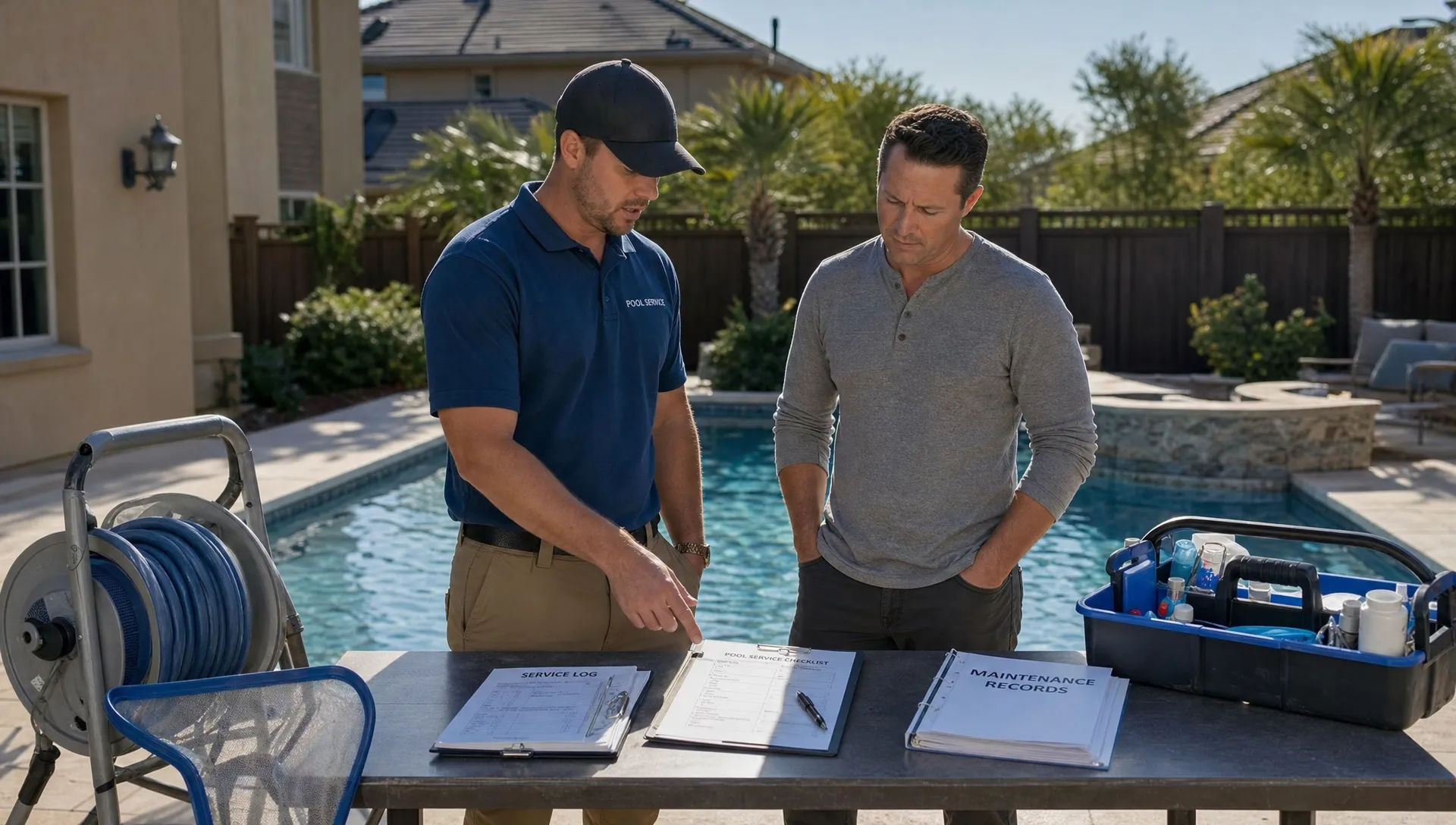
Use Contractor Growth Articles and Reddit as Research, Not Proof
Contractor growth articles can help you identify processes worth improving. For adjacent-trade context, ServiceTitan’s guide to growing an HVAC business offers a vendor-written perspective on scaling a service operation. The trade differs, but the evaluation question transfers: can customer management and field software support more work without creating proportional administrative overhead?
When reading articles about contractors using CRM software to scale, separate the reported business result from the software’s contribution. Additional marketing spend, acquisitions, hiring and price changes may also explain growth. A compelling customer story is not a forecast for your pool company.
For peer perspectives, Reddit discussions about contractor CRM software can surface questions about adoption, support and switching systems. This is a discussion search, not a verified case study or a representative survey.
Before treating a recommendation as relevant, check the commenter’s trade, team size and workflow. A sales-focused remodeler and a recurring pool maintenance operator may need very different systems.
Use those sources to develop questions for your own pilot. CRM development should solve a demonstrated operating constraint, not simply offer an escape from frustrations reported by an unrelated business.
Run a Decision Pilot Before Signing Either Contract
A structured pilot turns opinions into evidence. It should test whether the proposed system supports the business, not whether a polished demonstration looks convincing.
Establish a Baseline
Measure a small set of current outcomes before making changes. Useful examples include administrative time per completed visit, missing service records, completed visits awaiting invoicing and homeowner inquiries about service status.
Define each metric consistently. For example, distinguish invoices delayed by missing technician information from invoices intentionally held for an agreed billing cycle. Otherwise, the comparison will be misleading.
Write Observable Acceptance Criteria
For purchased software, test a representative group of properties, technicians and service exceptions. For CRM development, require a working prototype of the riskiest workflow before authorizing the full scope.
Replace “easy to use” with observable tasks: a new technician can find the correct property, record service and flag a follow-up without a dispatcher re-entering the same information.
Include the office team in testing. A fast technician workflow is not an improvement if it creates reconciliation work for billing.
Check Portability and Support
Request a sample export before committing. Verify which records, attachments and histories it includes and whether relationships between records remain understandable. Ownership of data is less useful if the exported files cannot support a future migration.
Clarify support hours, escalation procedures and responsibility for restoring service. For a custom build, include technical handover requirements. For a subscription, review the applicable contract rather than assuming every support or security commitment is included.
Finally, agree on a decision rule before the pilot begins. The CRM software comparison for contractors ready to scale can help structure the broader comparison, while your pilot supplies evidence specific to your operation.
Frequently Asked Questions
Can I develop my own CRM? Yes. You can use internal developers, an agency or a low-code platform. The harder question is whether you can own requirements, testing, security and ongoing maintenance. CRM development is a continuing operational commitment, not just an initial project.
Is Excel a CRM tool? Excel can hold customer records and support a simple tracking process. It does not, by itself, provide the connected scheduling, permissions, service history and customer communication workflows a growing pool operation may need. Judge it by the work surrounding the spreadsheet, not just the information stored inside it.
Is CRM software hard for technicians to learn? That depends on the product and the workflow. Test common field tasks with actual technicians, including someone unfamiliar with the system. Measure completion, errors and requests for help rather than relying on an interface demonstration.
Is custom software always more expensive? No universal rule applies. A narrowly scoped tool may be economical, while a full operating platform carries broader responsibilities. Compare implementation, recurring costs, internal labor and switching costs over the same period. Use written quotes and tested assumptions rather than generic price ranges.
When should we reconsider buying versus building? Revisit the decision when a significant requirement changes, such as a new service model or a repeatedly demonstrated limitation. Growing customer count alone is not proof that you need custom software.
Evaluate SplashIQ Against Your Actual Service Day
Before committing to CRM development, test whether a purpose-built platform already covers the work you need to standardize. SplashIQ supports customer CRM, smart route scheduling, water-quality logs, equipment tracking, an offline field app, homeowner notifications and online payments, among its capabilities.
Use your pilot scenarios to evaluate SplashIQ’s pool service operating platform, then confirm fit, pricing and contractual details directly. Build only where a valuable requirement remains unmet and your business is prepared to own the software behind it.