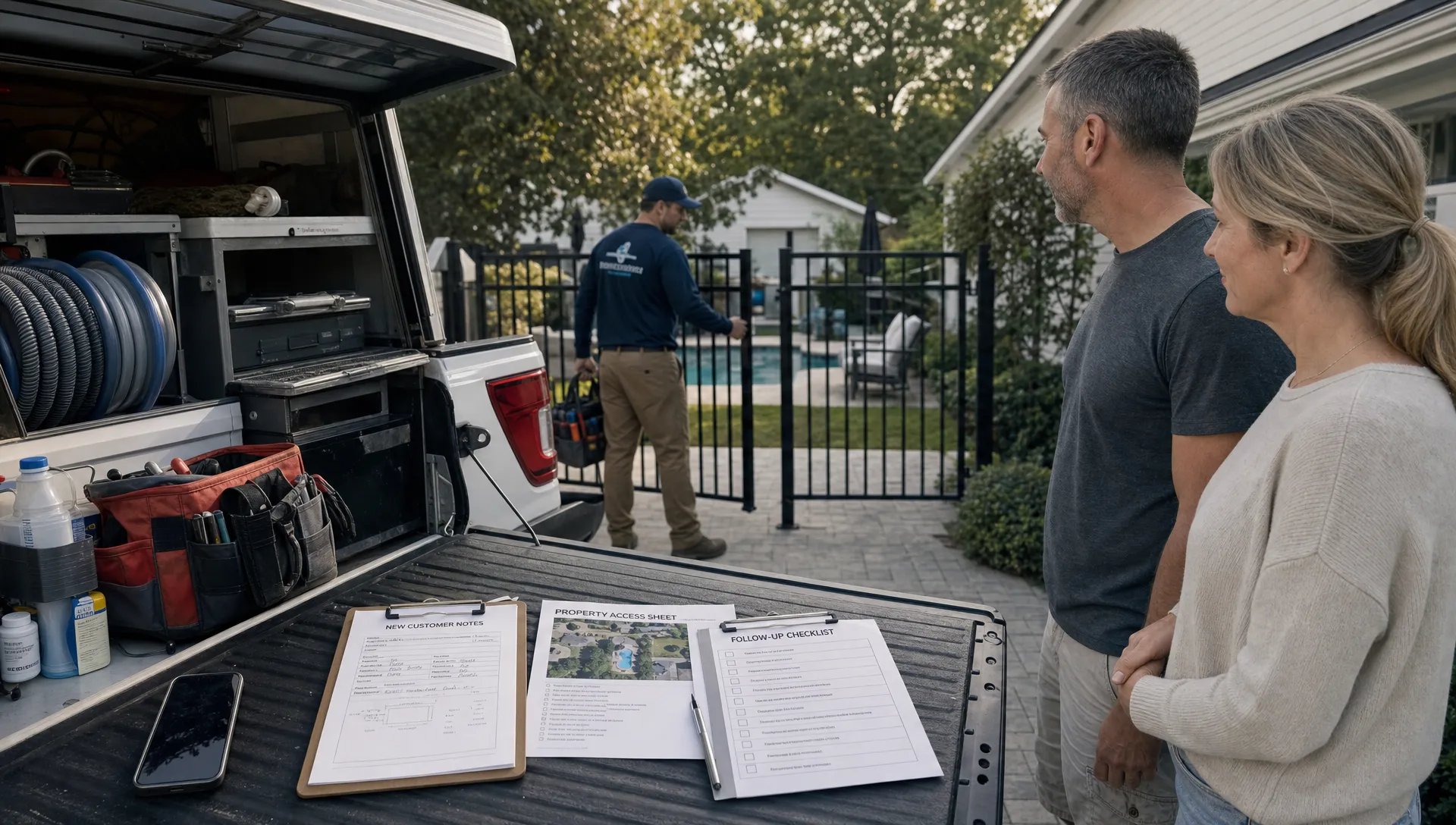
Peak season does not create operational problems for a pool company. It exposes the ones that were already there.
When the phones get busy, every weak handoff becomes expensive: a lead goes unanswered, a route gets built around whoever shouted last, a tech forgets to photograph a green-to-clean recovery, a repair opportunity disappears into a text thread or a homeowner disputes an invoice because they never saw what was done.
That is why the best time to improve operations is before the rush. A growing pool company needs systems that make the ordinary work repeatable, not heroic. The owner should not be the only person who knows which customer has a locked gate, which pump was replaced last year or which technician is falling behind on water-quality documentation.
Reddit is a useful place to see these issues from both sides. In communities like r/pools and r/smallbusiness, homeowners complain about missed visits, unclear service notes and inconsistent communication, while operators and other contractors talk about outgrowing spreadsheets, texts and memory-based processes. The same theme appears in contractor CRM articles from software companies such as Jobber, ServiceTitan and broader CRM resources like Salesforce’s explanation of CRM: growth becomes much harder when customer history, follow-ups and job details are scattered across people instead of managed in one system.
Here are the nine systems every pool company should have in place before peak season.
| System | What it protects | What breaks without it |
|---|---|---|
| Lead intake and CRM | Revenue pipeline and customer records | Missed leads, duplicate notes and slow follow-up |
| Route scheduling | Technician capacity and drive time | Inefficient routes and rushed service |
| Service checklists and water logs | Work quality and consistency | Uneven visits and weak proof of service |
| Field operations | Technician execution | Office bottlenecks and incomplete job notes |
| Homeowner communication | Trust and retention | “Did you come today?” calls and disputes |
| Equipment tracking | Repair readiness | Lost model numbers and repeat diagnosis |
| Repair pipeline | Add-on revenue | Estimates forgotten in texts or notebooks |
| Billing and payments | Cash flow | Late invoices and manual collections |
| Scorecards and capacity planning | Accountability and growth | Burnout, blind spots and hiring too late |
1. A lead intake and CRM system
During peak season, speed matters. A homeowner with a green pool, broken pump or neglected vacation rental may contact three companies in the same hour. If your lead intake depends on checking voicemail, Instagram DMs, website forms, personal texts and a notepad in the truck, you will lose good work before you even quote it.
A pool company CRM should do more than store a name and phone number. It should organize records around the property, because the property is where the operational complexity lives. One homeowner may have multiple pools. One property may have a gate code, dog warning, preferred service window, heater history, automation brand and billing contact that differs from the person who approves repairs.
At minimum, your lead intake system should capture source, service address, pool type, service requested, urgency, photos if available, approval contact and next step. Every new inquiry should have an owner, a status and a follow-up date.
The goal is simple: no lead should depend on the owner remembering to reply later. If you are building this foundation now, SplashIQ’s guide to a practical CRM strategy for growing pool service companies goes deeper into how to organize customer records around properties and repeatable workflows.
2. A route scheduling system built for density
Route density is one of the biggest profit levers in a route-based pool company. Two technicians can each clean the same number of pools on paper, but the one with tighter geography, fewer backtracks and cleaner appointment windows will usually produce better margins and better customer experience.
Peak season makes poor routing more painful. Traffic increases in many markets, chemical pickups take longer and homeowners ask for last-minute changes. If routes are built manually each week in a spreadsheet, every new customer adds coordination drag.
A strong scheduling system should make it easy to group jobs by geography, technician, service type and required time. It should also protect recurring work from getting disrupted by urgent repairs. The more route decisions you can make before the season starts, the less your office has to rebuild the map under pressure.
Preseason route planning should answer practical questions: Which neighborhoods are dense enough to keep selling? Which accounts are too far from the rest of the route? Which days are already overloaded? Which technicians need shorter routes because they handle more complex pools or repairs?
For a deeper scheduling playbook, the SplashIQ article on smart scheduling tactics that cut drive time covers service zones, appointment windows and route density in more detail.
3. A standardized service checklist and water-quality logging system
A pool company grows by making service quality transferable. If every technician has a different definition of a complete visit, the business becomes hard to manage and harder to defend when customers ask questions.
A standardized visit system should define what must happen at each stop: test water, log readings, add chemicals, brush, skim, empty baskets, inspect visible equipment, note issues and document exceptions. The checklist should be specific enough to create consistency but not so rigid that it slows down experienced technicians.
Water-quality logs are especially important because they turn service from “we were there” into a documented record. They also help the office spot patterns: recurring low chlorine, rising pH, heavy phosphate demand, frequent filter pressure issues or pools that need equipment attention rather than more chemical spend.
Before peak season, review your service checklist with technicians and ask what is unclear, duplicated or missing. A checklist that techs believe in will get used. A checklist that feels like office paperwork will be skipped when the day gets hot and the route runs long.
4. A field operations system that works from the truck
The field app, paperwork or mobile workflow your technicians use has to match real work conditions. Pool techs deal with wet hands, glare, bad cell service, barking dogs, locked gates, cramped equipment pads and customers who walk out mid-visit with a question.
If the field system is slow or only works when signal is perfect, techs will build workarounds. They will text the office, write notes later or skip details that feel too hard to enter. That creates the exact problem the system was supposed to solve.
A solid field operations system should let technicians see the day’s route, property notes, service requirements, equipment history and open issues. It should also let them capture readings, photos, job notes and repair recommendations while they are still onsite. Offline access matters in neighborhoods with poor reception or homes with equipment pads tucked behind walls and landscaping.
The office should not have to call a technician after every stop to ask what happened. The system should bring that information back automatically.
5. A homeowner notification and proof-of-service system
Many homeowner complaints are not really about the pool. They are about uncertainty.
On Reddit, homeowner threads about pool service often sound similar: the customer is not sure whether the tech arrived, what was done, why the water still looks off or whether a chemical charge was legitimate. Even when the pool company did the work correctly, poor communication can make the visit feel invisible.
A homeowner communication system should notify customers when a technician is on the way, confirm when service is complete and summarize what happened. Photos can be especially helpful for vacation homes, rentals and high-touch clients who are not outside during service.
Before and after photos, water readings, technician notes and repair flags reduce the number of “Did you come today?” calls. They also create a record when customers dispute service or when a recurring issue needs a more serious conversation.
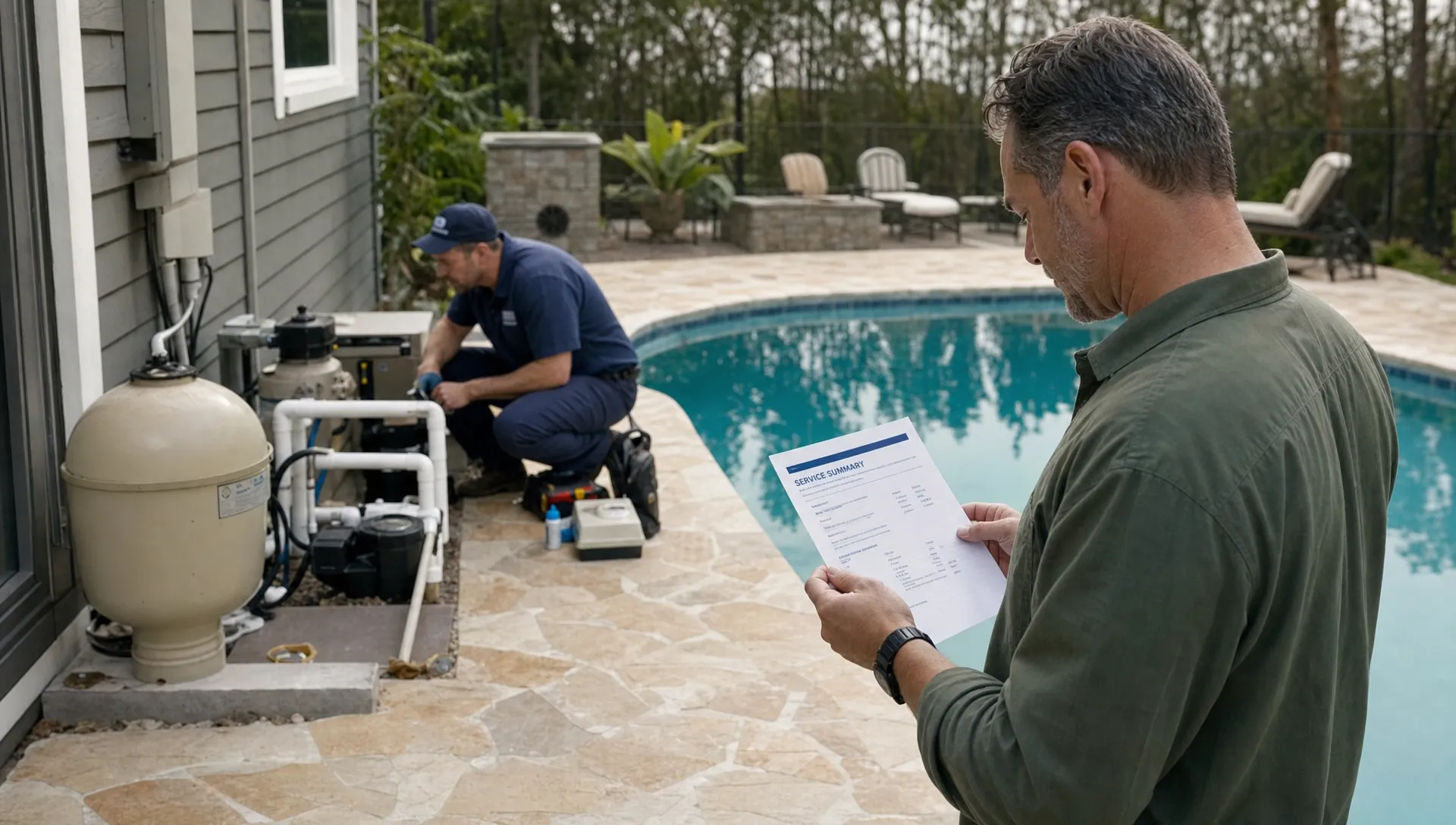
This system also protects your team. If a technician finds a broken cleaner, leaking pump, clogged basket or unsafe condition, the homeowner should see it promptly. Clear documentation prevents the pool company from being blamed later for pre-existing conditions.
6. An equipment tracking system for every property
Equipment tracking is one of the easiest systems to postpone and one of the most valuable once the season gets busy.
When a customer calls about a pump issue, your office should not have to ask, “Can you send us a photo of the equipment pad again?” The record should already show the pump brand, model, horsepower if relevant, filter type, heater details, automation system, cleaner type, salt system and install or repair history when known.
This matters because repairs often move quickly during peak season. If your team already has model numbers, photos and past notes, you can quote faster, bring the right parts and avoid sending a senior technician just to identify equipment.
Equipment history also helps sell preventive work. Rising filter pressure, repeated low flow, noisy motors and recurring heater errors are easier to explain when the customer can see the pattern. Instead of sounding like a surprise upsell, the repair recommendation is supported by service history.
A strong equipment system should answer three questions before a repair visit is scheduled: What is installed, what has happened before and what does the technician need to bring?
7. A repair opportunity and estimate pipeline
Pool service routes create repair opportunities every week. The problem is that many of those opportunities never become revenue because they are captured casually.
A technician notices a cracked lid, weak pump, failing valve, worn O-ring, noisy motor or light issue. They text the office. The office is busy. The customer asks about it three weeks later, or worse, calls another company. Multiply that by an entire season and the lost revenue can be significant.
A repair pipeline gives every opportunity a status. New issue, needs estimate, estimate sent, approved, scheduled, completed and invoiced is often enough. The exact labels matter less than the discipline of moving work forward.
The system should connect the field observation to the estimate. Photos, equipment details and technician notes should travel with the repair opportunity so the person quoting does not have to reconstruct the situation. If approval is needed, the homeowner should receive a clear description of the issue, the recommended fix and the next step.
This is where pool companies start to operate more like mature contractors. Articles about contractors scaling with CRM software often point to the same operational shift: once estimates, follow-ups and customer history are visible to the team, the owner no longer has to personally remember every opportunity. That is how a business moves from reactive service to managed growth.
8. A billing, payments and collections workflow
Peak season can hide cash-flow problems because revenue activity feels high. The danger is doing the work faster than you bill or collect for it.
A billing system should connect completed service to invoicing with as little manual re-entry as possible. If a technician completes a visit, adds chemicals, documents a repair or finishes an approved job, the office should have the information needed to bill accurately.
Online payments reduce friction for homeowners and save office time. A homeowner portal can also reduce repetitive questions about past invoices, service history and payment status. For larger repairs, financing options can help customers approve work that might otherwise be delayed, as long as the terms and responsibilities are clear.
The preseason audit should focus on failure points. Which jobs were completed last season but invoiced late? Which customers regularly needed reminders? Which repair invoices required back-and-forth because the scope was unclear? Which payment methods created the most office work?
Pool companies that connect routes and billing tend to have fewer gaps between work performed and money collected. If this is a current pain point, SplashIQ’s article on pool service software for teams that need routes and billing explains how scheduling, field visits and invoicing fit together.
9. A technician scorecard and capacity planning system
You cannot manage peak season by gut feel alone. Technician scorecards help owners and managers see what is actually happening across routes.
A useful scorecard does not need to shame people or reduce service quality to a single number. It should make coaching easier. Track the metrics that reflect reliability, consistency and customer impact: completed stops, missed or rescheduled visits, average route time, photo completion, water-log completion, repair opportunities identified, callbacks and customer complaints.
Capacity planning is the other half of the system. Before peak season, look at each route and ask whether the workload is realistic. If one technician has more complex pools, more drive time or more high-touch customers, a raw stop count will not tell the full story.
This is also the time to decide when you will hire, when you will stop accepting new weekly service in certain areas and which neighborhoods deserve more marketing because they improve route density. Waiting until every technician is overloaded usually leads to rushed hiring, weaker training and more customer churn.
How to audit your systems before peak season
You do not need to rebuild the entire business in one week. Start by finding the places where work disappears.
Walk through a real customer journey from lead to invoice. Where does information get copied from one place to another? Where does the office wait for a technician update? Where do customers call because they lack visibility? Where do estimates stall? Where does the owner have to make decisions that someone else could make with better records?
Use this simple preseason audit:
| Question | Healthy sign | Warning sign |
|---|---|---|
| Can every lead be seen in one place? | Each inquiry has a status and next step | Leads live in texts, voicemail and memory |
| Can routes be adjusted without chaos? | Jobs are grouped by zone and technician capacity | Every schedule change requires manual reshuffling |
| Can a new tech follow the service standard? | Checklists and property notes are clear | Quality depends on who trained them verbally |
| Can homeowners see what happened? | Service summaries and photos are easy to send | Customers call to confirm basic visit details |
| Can repair opportunities be tracked? | Issues move through an estimate pipeline | Recommendations disappear after the route |
| Can billing happen quickly after work? | Completed work flows into invoicing | The office waits on notes or re-enters details |
| Can managers coach technicians fairly? | Scorecards show patterns over time | Feedback is based on complaints and anecdotes |
Once you identify the weakest link, fix that first. A pool company with great routes but poor billing should prioritize invoice workflow. A company drowning in customer calls should improve homeowner notifications and proof of service. A company losing repair revenue should build a repair pipeline before buying more leads.
Why these systems matter more as the company grows
A solo operator can run a surprising amount of the business from memory. A three-truck company cannot. A ten-truck company absolutely cannot.
Growth creates more handoffs: lead to office, office to technician, technician to estimator, estimator to homeowner, completed work to billing and billing to payment. Every handoff needs a system. Without one, the business becomes dependent on constant interruptions.
That is why many contractors adopt CRM and field-service systems as they scale. The software is not valuable because it is software. It is valuable because it turns repeated decisions into visible workflows. For a pool company, that means the office can see what is scheduled, technicians can see what each property needs and homeowners can see what was done.
Peak season rewards companies that prepared before they were busy. The companies that wait until the phones are ringing usually spend the season patching problems instead of improving margins.
Frequently Asked Questions
When should a pool company set up these systems before peak season? Ideally, review and implement core systems 60 to 90 days before your busiest months. That gives your team time to test routes, clean up customer records, train technicians and adjust workflows before volume spikes.
What is the most important system for a small pool company? Start with a CRM and scheduling system. If leads, customer records and routes are organized, it becomes much easier to add water logs, repair tracking, billing workflows and technician scorecards later.
Do pool companies really need technician scorecards? Yes, if the scorecards are used for coaching and planning rather than punishment. They help identify overloaded routes, inconsistent documentation, training needs and technicians who are creating strong repair opportunities.
How can a pool company reduce homeowner complaints during peak season? Most preventable complaints come from poor communication, missed expectations or lack of proof. Arrival notifications, completion summaries, photos, water-quality logs and clear repair notes help homeowners understand what happened and why.
Can CRM software help contractors scale their businesses? CRM software helps contractors scale when it centralizes customer history, follow-ups, estimates and job details. For pool companies, the same principle applies: growth is easier when the team can work from shared records instead of texts, spreadsheets and memory.
Put the systems in place before the rush
Peak season is not the time to discover that your pool company is held together by spreadsheets, paper checklists and the owner’s phone.
SplashIQ brings CRM, smart route scheduling, water-quality logs, equipment tracking, homeowner notifications, before and after photos, online payments, homeowner financing, an offline field app and technician scorecards into one operating system built for pool service companies.
If you want your office, technicians and homeowners working from the same source of truth before the next rush, start with SplashIQ and build the systems your peak season will depend on.