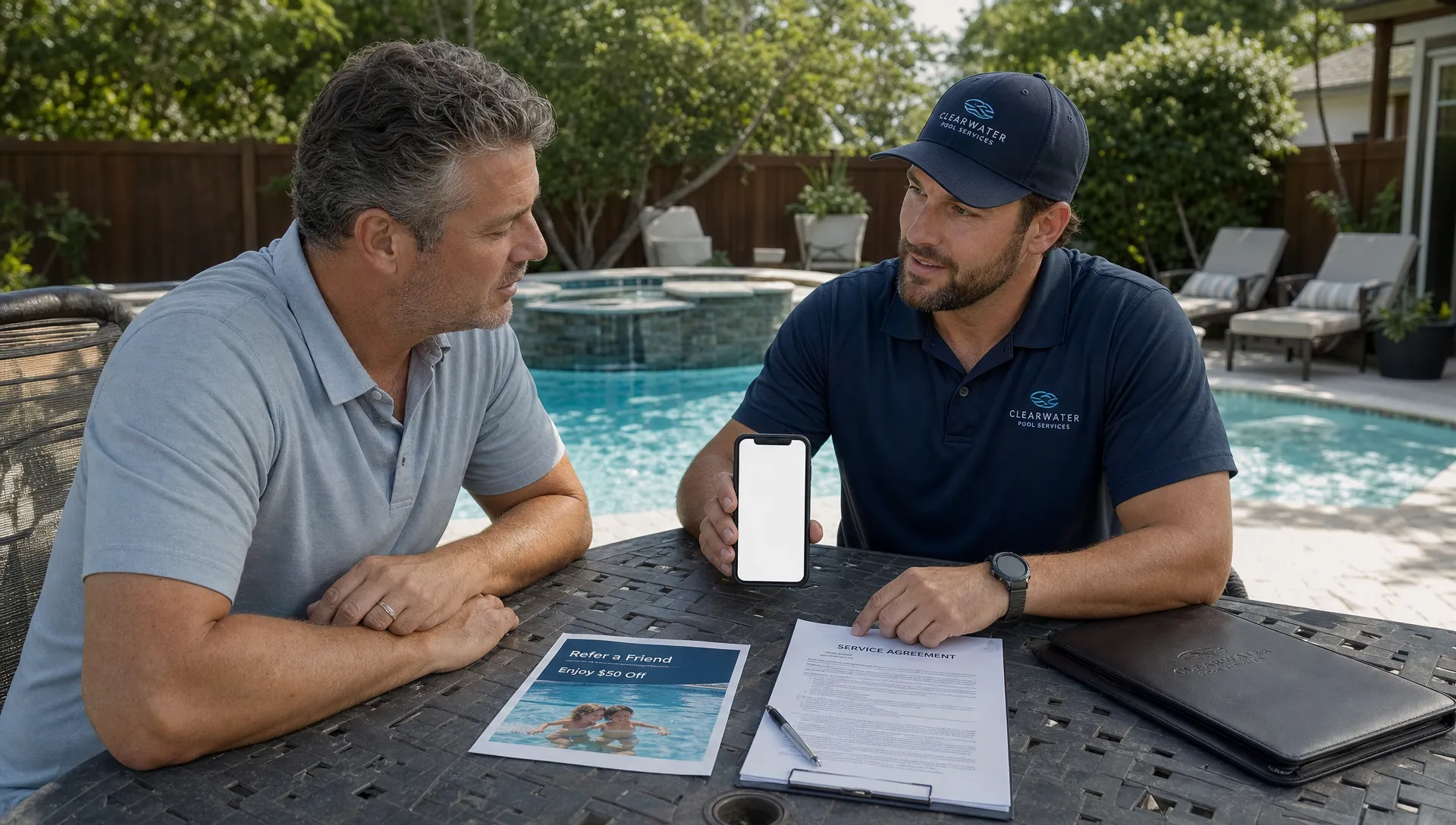
A homeowner’s recommendation can bring you a new pool account, but a casual “tell your neighbors” request is hard to manage. The right crm marketing tools help connect that recommendation to a named lead, a completed sale and a reward your office can verify. For a pool service company, the goal is not simply more referrals. It is more suitable recurring accounts without missed follow-ups, disputed credits or promises your technicians cannot fulfill.
Define what qualifies before offering a reward
Start with a written definition of a successful referral. A submitted name is not the same as a paying customer, and a one-time cleanup may not justify the same incentive as recurring service.
For a pilot program, you might require the referred homeowner to be a new customer, live within your service area and pay their first two monthly service invoices. That is an example policy, not a universal rule. Choose conditions that match your billing cycle and economics.
Specify who receives the reward, when it becomes available and whether accounts must remain in good standing. Decide how you will handle two customers claiming the same referral, existing prospects and canceled accounts.
Keep the terms short enough for a homeowner to understand before sharing the offer. Your office should not have to invent an answer when someone asks where their credit went.
Choose crm marketing tools that preserve the referral record
A referral program needs more than an email sender. It needs a connection between the referring customer, the prospective customer and the event that makes a reward payable.
Build that connection using supported fields, tags or structured notes. If your software lacks a dedicated referral module, a consistent manual process can support an initial pilot.
| Record | What to capture | Why it matters |
|---|---|---|
| Referring customer | Customer identifier and reward eligibility | Prevents confusion between similar names |
| New prospect | Name, service address and preferred contact method | Supports qualification and follow-up |
| Attribution | Referrer identifier and date submitted | Makes competing claims easier to resolve |
| Permission | How the prospect requested contact | Separates an introduction from marketing consent |
| Progress | Inquiry, qualified, quoted, won or lost | Shows where referrals stall |
| Reward | Pending, approved and issued dates | Helps prevent duplicate payouts |
Keep the lead source separate from its current status. “Customer referral” describes where an inquiry came from. “Quote sent” describes what happens next. Overwriting one with the other destroys useful reporting.
Also assign an owner to every open referral. Even excellent records will not produce a booked account if everyone assumes someone else is returning the call.
Ask after the homeowner has seen good service
The most useful role for crm marketing tools is helping your team identify an appropriate moment to ask, rather than sending the same promotion to every customer.
A completed visit alone does not prove satisfaction. Better signals include a homeowner thanking your technician, a resolved equipment problem or a positive response to a service update. Use those signals to create a review task for the office, then check that the customer has no unresolved concern.
Exclude accounts with active complaints, billing disputes or incomplete work. Asking an unhappy homeowner to recommend you can make an existing problem feel ignored. A shared process for handling customer callbacks and service concerns makes that check easier to organize.
Technicians can make a brief, natural introduction: “If a neighbor needs pool service, our office can explain our referral offer.” They should not negotiate rewards at the pool gate or collect a neighbor’s contact details without permission.
Have the office deliver the terms through an appropriate communication channel. That keeps the explanation consistent and gives homeowners something accurate to share.
Let the referred homeowner start the conversation
A customer’s recommendation is not permission to add their neighbor to a marketing list. The cleaner approach is to give the customer an invitation they can forward, then let the neighbor request contact.
That invitation can point to a quote form or provide your office number and a referral identifier. If your form supports it, include a “Who referred you?” field. Otherwise, make that question part of intake.
Configure your crm marketing tools, where supported, to retain the original referral source alongside later interactions. A homeowner may receive a recommendation on Monday, search your business on Wednesday and call on Friday. Recording only the last interaction can hide the referral’s contribution.
At intake, verify the service address, requested work and service-area fit before promising availability. Check for an existing customer or lead record so a second form submission does not create a second reward claim.
Your pool lead follow-up workflow should then take over: assign responsibility, record the next action and close out unsuitable inquiries with a clear reason. Referral leads deserve prompt attention, but they still need qualification.
Set rewards using contribution margin, not invoice value
A reward can look modest beside monthly revenue and still consume most of the account’s early contribution. Estimate what remains after direct service costs before choosing an incentive.
For example, suppose a new account pays $120 per month and has $80 in direct monthly service costs. That leaves $40 per month before office overhead, acquisition costs and other expenses. After two months, the account has generated $80 in contribution before referral rewards.
If you offer a $40 credit to the referring customer and a $20 credit to the new customer, the combined $60 incentive leaves only $20 from those first two months before those other expenses. These are illustrative figures, not pool industry benchmarks or recommended reward amounts.
Use your actual labor, chemicals, travel and payment-processing costs. Test whether the offer still works when a customer cancels soon after qualifying.
The role of crm marketing tools here is to make the promised reward and its qualifying conditions visible, not to decide what you can afford. Have one person approve the reward after checking paid invoices and another record its issuance through your billing process, if your team size allows.
Do not assume your software supports automatic account credits. Confirm the billing workflow before advertising a credit-based offer.

Write messages that explain the next step
Referral messages work best when the homeowner can understand the offer without calling for clarification. Include the benefit, qualifying condition and action to take. Link to full terms if the invitation cannot comfortably contain them.
Invitation to an existing customer: “Know a neighbor looking for recurring pool service? Share our contact details and ask them to mention your name when requesting a quote. If they qualify and pay their first two monthly service invoices, we’ll apply the referral credit described in our program terms.”
Acknowledgment to a referred prospect: “Thanks for requesting a pool service quote and letting us know who referred you. Please confirm your service address and the type of help you need so we can check coverage and availability.”
Reward confirmation: “Your referral has met the program requirements. We’ve approved your reward and will confirm when it has been issued.”
Adapt these examples to your actual offer. Do not promise an automatic credit or a particular posting date unless your process supports it.
Use crm marketing tools to stop invitations after someone declines and to avoid repeated requests. For incentivized recommendations, provide disclosure wording such as “I may receive a service credit if you sign up.” The FTC’s endorsement guidance explains disclosure of material connections.
Measure paid accounts and reward costs
A program that generates many introductions can still lose money. Review the full path from inquiry to retained customer, not just the number of invitations sent.
| Metric | Calculation or check | What it reveals |
|---|---|---|
| Qualification rate | Qualified referred leads ÷ referred leads | Whether recommendations fit your service |
| Paid conversion rate | New paying accounts ÷ referred leads | Whether referrals become customers |
| Referral acquisition cost | Rewards and attributable program costs ÷ acquired accounts | What each acquired customer costs |
| Reward accuracy | Check issued rewards against approved claims | Whether administration is reliable |
| Early retention | Accounts still active at a defined checkpoint ÷ acquired accounts | Whether customers stay beyond qualification |
Define “acquired account” consistently. For example, you might use the first paid recurring-service invoice rather than a signed estimate. Keep reporting periods consistent too: a lead submitted yesterday has not had the same opportunity to convert as one submitted six weeks ago.
Include staff administration time and any attributable software or campaign expense in acquisition cost, not just the advertised reward. Track new-customer discounts separately enough to avoid overlooking them or counting them twice.
Your crm marketing tools should help you reconcile these numbers against actual customer and billing records. If a report shows ten rewarded referrals but only eight qualifying accounts, resolve the discrepancy before increasing promotion.
Evaluate contractor growth stories and software demonstrations
Vendor articles can help you see how service businesses organize growth. ServiceTitan’s contractor case studies are a starting point for exploring contractors’ use of connected business software. Read them as vendor-published customer accounts, not proof that buying a platform will reproduce another company’s results.
Look for operational details: how inquiries reached the office, who owned follow-up, which processes changed and whether staffing expanded alongside revenue. Those details are more transferable than a headline growth percentage.
For informal owner perspectives, browse Reddit discussions in r/sweatystartup about contractor CRM software. These posts can suggest questions about adoption, manual work and follow-up, but they are anecdotes rather than verified product documentation.
When evaluating crm marketing tools, ask the provider to demonstrate one complete referral using sample records. Follow it from homeowner introduction through qualification, paid service and reward approval. Confirm which steps are native features, which need configuration and which remain manual. A demonstration of your workflow is more useful than a long feature checklist.
Frequently asked questions
Should we reward the introduction or the completed sale? For a recurring-service acquisition program, tying the main reward to a clearly defined paid-customer milestone limits spending on unqualified names. Explain that milestone before anyone participates.
Can we run a referral program without dedicated referral software? Yes. A small pilot can use consistent customer identifiers, structured records and manual approval. Dedicated tracking becomes more valuable when referral volume makes reconciliation difficult or multiple employees handle the same account.
Should we reward both homeowners? A two-sided offer can give the new customer a reason to act, but both rewards count toward acquisition cost. Compare the combined expense with expected contribution rather than assuming a larger offer is better.
Can referred homeowners receive automated texts? Do not treat a friend supplying a phone number as permission for marketing texts. Have the prospect request contact, document the appropriate consent and review applicable messaging requirements before enabling automation.
What matters most when selecting crm marketing tools for referrals? Prioritize reliable attribution, clear ownership, permission records and reward reconciliation. Confirm those capabilities directly rather than assuming a general marketing feature includes referral management.
Connect the program to everyday pool service
SplashIQ brings customer CRM, homeowner outreach, service notifications, water-quality logs, before/after photos and online payments into one platform for pool service businesses. Those connected operations can provide useful context for deciding when to ask for a recommendation.
Start with a limited pilot and written terms. Before expanding, confirm how your setup will record referral attribution, track qualification and handle reward approval, including any steps that need manual oversight.