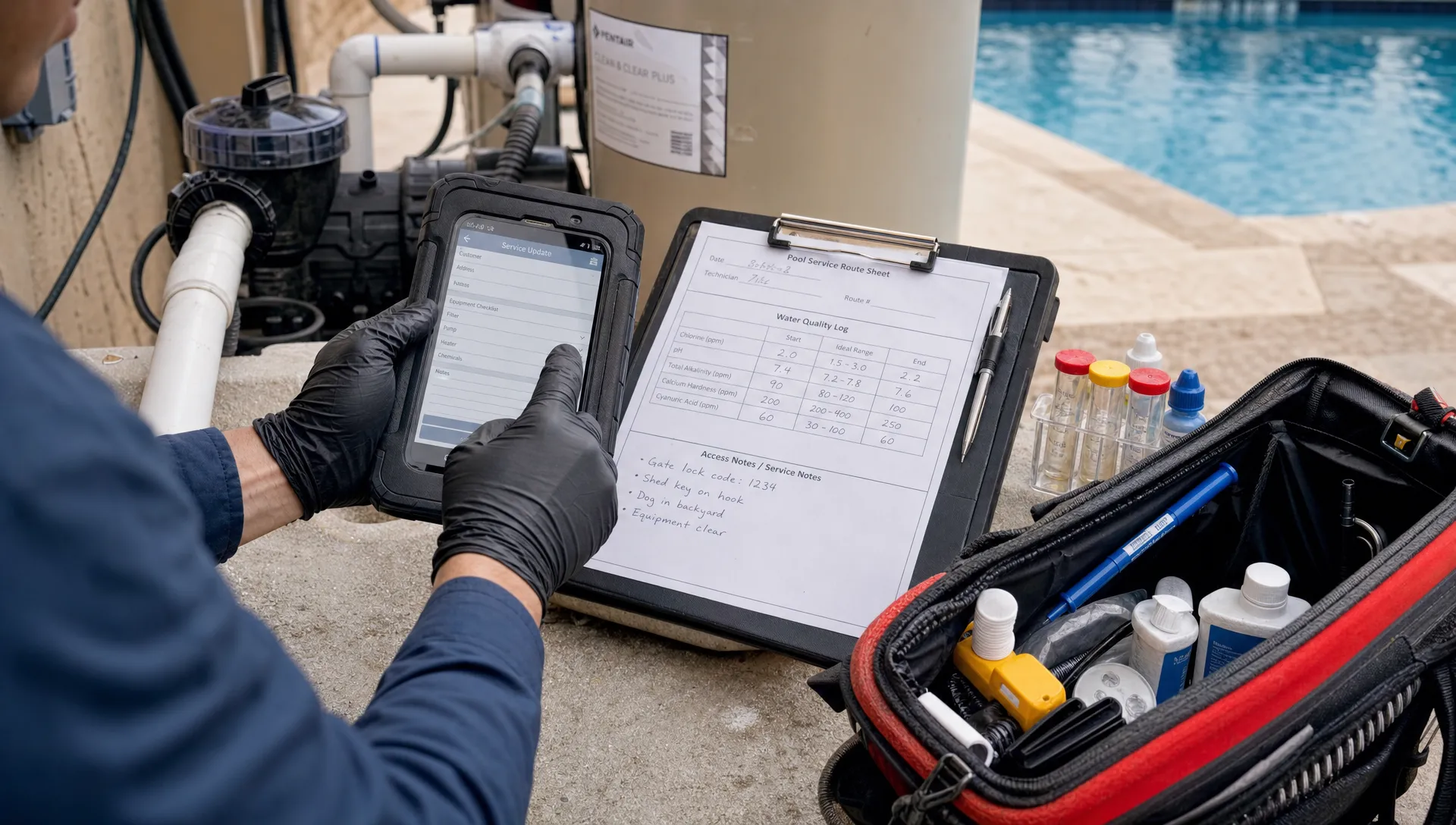
When homeowners search for “weekly pool service near me,” they expect dependable care, including during holiday weeks. But giving technicians time off can create crowded routes, longer gaps between visits and questions about billing. The solution is not to squeeze every stop into fewer days. It is to establish a holiday policy, assess which visits can safely move and communicate each change before it affects the customer.
For residential pool service companies, a workable holiday schedule starts with the interval between visits, not just the date the office closes.
Put your holiday service policy in writing
Decide how your company handles holidays before changing individual appointments. Otherwise, dispatchers may promise replacement visits that the field team cannot deliver, while technicians give customers different explanations.
Your service agreement should explain whether holiday visits move to another day, receive an agreed alternative service or fall within clearly disclosed planned closures. It should also explain how those arrangements affect charges.
Keep three situations separate: a planned holiday closure, a customer-requested cancellation and a missed visit caused by an operational problem. They may require different scheduling and billing decisions. Calling all three a “skip” makes disputes harder to resolve.
A homeowner comparing “weekly pool service near me” options should understand the holiday policy before signing, not discover it after finding the gate untouched.
If your existing agreement does not address holidays, communicate a proposed arrangement and obtain any necessary agreement rather than treating an announcement as permission to reduce service.
Give the office one consistent answer
Create a short internal reference covering closure dates, available replacement days, billing treatment and who approves exceptions. Include the contact process for urgent equipment or water-quality concerns, but do not imply that emergency coverage exists unless your company actually provides it.
Review this reference with technicians as well as office staff. Customers often ask the person standing beside their pool before they contact dispatch.
Rebuild the route around actual capacity
Map every affected stop before sending notices. Review technician availability, travel time, expected service duration and customer access restrictions. Confirm substitute technicians have the equipment and account information they need.
A team completing five eight-hour route days has 40 hours of work. Moving that workload into four days creates ten-hour days before unexpected repairs or traffic. A scheduling change does not remove the work.
For companies advertising “weekly pool service near me,” promising dependable visits requires more than placing every displaced appointment somewhere on the calendar. The replacement route must be achievable.
Use route-planning tactics that reduce drive time to keep neighboring stops together rather than scattering holiday makeups across the service area.
| Situation | Scheduling approach | Check before confirming |
|---|---|---|
| A holiday affects one route day | Move stops to nearby available days | Both the preceding and following service intervals |
| Several technicians request leave | Assign qualified coverage or redistribute selected stops | Technician capacity, account knowledge and access |
| A customer expects heavy pool use | Discuss whether an additional visit is appropriate | Scope, availability and any additional charge |
| No suitable replacement slot exists | Escalate for an account-specific decision | Water condition, contract terms and customer agreement |
Preserve some capacity for exceptions. A route that depends on every visit going perfectly leaves no room for a locked gate, equipment failure or an unexpectedly dirty pool.
Check both sides of every moved visit
Moving a Thursday visit to Wednesday shortens one interval but lengthens the next. If the preceding visit was Thursday and the following visit returns to Thursday, the gaps become six days and eight days.
That is different from simply saying the pool was serviced “during the holiday week.” Record actual visit dates so the next technician can see the real interval.
Before extending a gap, review recent water-quality readings, sanitizer delivery, filtration operation, debris load and expected swimming activity. A shaded pool with stable readings may present different scheduling concerns from a heavily used pool with recurring sanitizer loss.
Customers searching for “weekly pool service near me” should receive a pool-specific explanation when their normal interval changes, not a blanket promise that every pool can wait.
The CDC’s healthy swimming guidance provides useful background on maintaining safe swimming conditions. A holiday does not remove the need to manage disinfectant and pH.
Do not compensate for a longer interval by automatically adding extra chemicals. Treatment should follow measured conditions, product labels and applicable requirements. Commercial accounts may also have testing and operating obligations that cannot be satisfied by simply moving a weekly visit.
Explain what “weekly pool service near me” means during holidays
Give customers a specific revised date or service window, not just an office-closure announcement. Send the initial notice once the replacement route is confirmed, then provide a reminder close to the changed visit.
The notice should identify the affected appointment, replacement timing, access instructions and any billing implications. Make it clear whether the customer needs to respond.
A practical message might read:
Our office and field team will be closed Thursday for Thanksgiving. Your regular Thursday pool service is scheduled for Wednesday instead. Please provide gate access during your usual service window. Your monthly charge is unchanged under your service agreement. Contact us before Tuesday if the revised day creates an access problem.
Use the billing sentence only when it matches that customer’s agreement. If timing is not confirmed, say when you will provide confirmation instead of presenting a tentative date as final.
For firsthand homeowner questions, browse holiday-related discussions in Reddit’s r/pools community. Treat individual posts as anecdotes, not standards for chemistry, pricing or contractual obligations. They can help identify questions worth answering in your own notices.
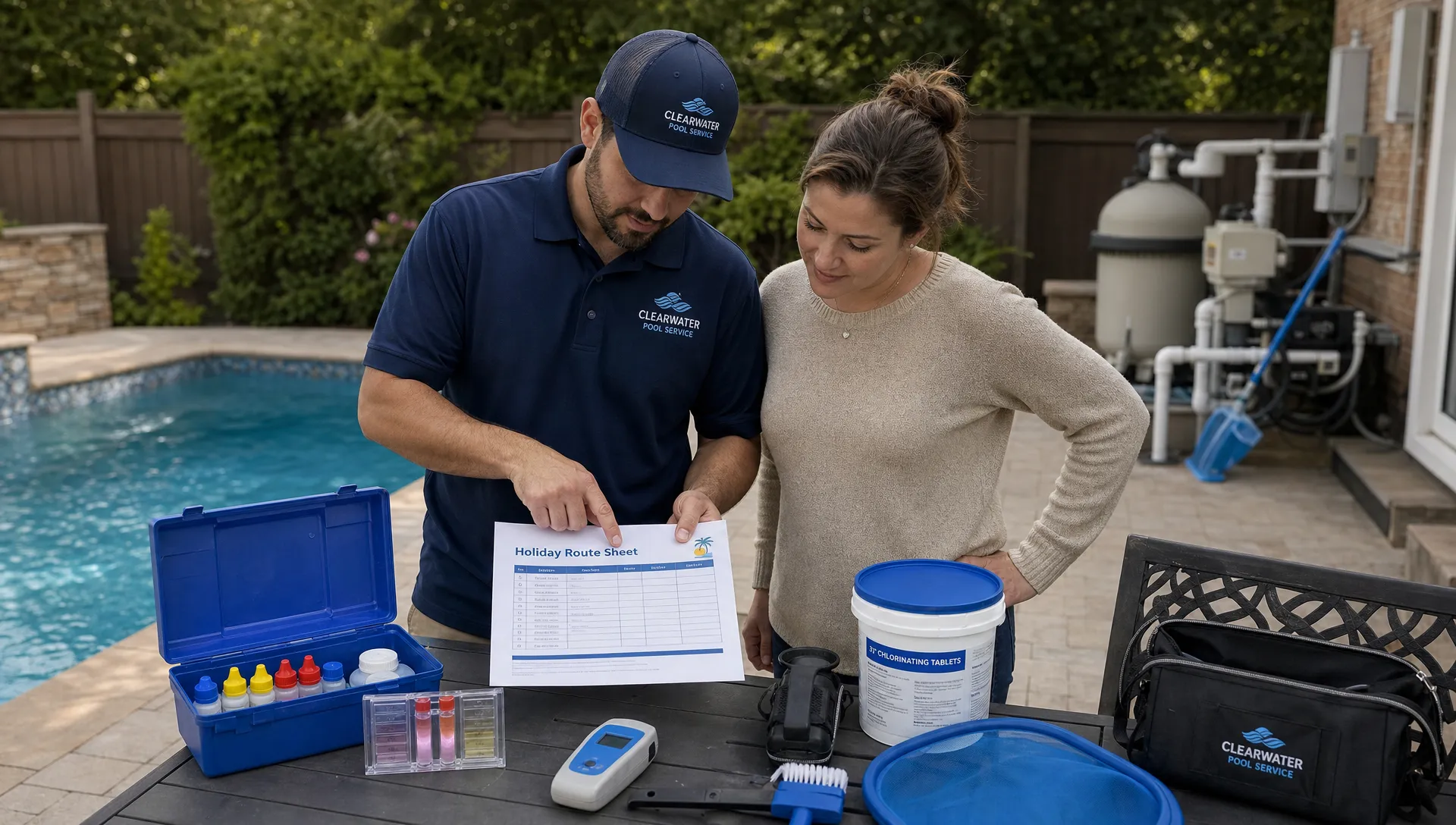
Make holiday billing match the agreement
A monthly invoice does not, by itself, establish whether a holiday closure earns a credit. The answer depends on the promised service and agreed pricing structure.
Under per-visit billing, charges should reflect the visits and other work authorized under the agreement. Under a flat monthly arrangement, the contract should explain how planned closures and service frequency are treated. Do not assume that charging monthly automatically permits missed visits without adjustment.
For homeowners who found you through “weekly pool service near me,” an unexplained skipped appointment can look like a broken promise even when the invoice remains familiar. Explain the arrangement before the holiday rather than relying on fine print afterward.
Keep a clear distinction between a completed visit, a rescheduled visit, an access failure and a canceled appointment. An arrival notification is not proof that the contracted work was completed.
When a credit or additional visit is appropriate, record the reason and obtain any required approval. This gives the office a defensible answer when a customer asks about the invoice weeks later.
Keep holiday exceptions in the customer record
Holiday changes become harder to manage as a company adds technicians and routes. A calendar may show the new appointment, but the technician also needs gate instructions, recent readings, equipment issues and any promise made by the office.
Keep the revised schedule and relevant customer communication connected to the service record. Before the route begins, confirm that the covering technician can access the information needed to perform the visit.
Leads from a “weekly pool service near me” search should enter this same customer-management process once they become accounts. Holiday commitments made during sales should not remain buried in an email or a salesperson’s memory.
For further reading about contractors using CRM and field-service software as they grow, ServiceTitan’s contractor customer stories offer vendor-published examples. Read them for operational lessons rather than treating reported outcomes as a guarantee for another business.
SplashIQ supports customer CRM, smart route scheduling, water-quality logs, equipment tracking and an offline field app. Those capabilities can help keep scheduling decisions connected to the information technicians need, without relying entirely on paper notes or separate spreadsheets.
Close the loop after the holiday
Once the affected routes are complete, reconcile planned appointments against actual service records. Identify unfinished work, access failures and visits that still need rescheduling before returning to the normal calendar.
Use a consistent weekly service checklist so substitute technicians document the same core information as the regular technician. Checklists are especially useful when holiday coverage puts someone at an unfamiliar property.
Review overtime, callbacks, customer complaints and credits with the team. If the same route repeatedly needs excessive overtime, change its holiday coverage plan rather than repeating the same compression next year.
Also verify the first normal visit after the holiday. Customers comparing “weekly pool service near me” providers judge reliability across the whole month, not just whether a makeup visit appeared during the closure week.
Frequently asked questions
Can weekly pool service skip a holiday week? Not automatically. Any planned closure should match the service agreement, applicable requirements and the pool’s care needs. If a replacement visit is necessary, arrange it rather than assuming the pool can wait until the following week.
Is it better to service a pool before or after a holiday? Neither option is universally better. Compare the intervals before and after the moved appointment, then consider water conditions, equipment operation, access and expected pool use.
Should customers receive a credit for a holiday closure? Follow the agreed billing terms and applicable requirements. A flat monthly price does not automatically settle the question. Explain any credit, replacement visit or planned closure clearly and document the decision.
What if the homeowner is away during the replacement visit? Confirm authorized access and any changed gate or security arrangements. If access is unavailable, record the failed visit and communicate the next step. Never mark a visit complete when the required work was not performed.
Keep the holiday plan connected to daily operations
A dependable holiday schedule needs four things: clear terms, realistic capacity, pool-specific decisions and a documented follow-through. Set those expectations before changing the route.
If holiday planning currently means reconciling spreadsheets, texts and paper service notes, explore how SplashIQ connects pool service scheduling, field records and customer communication. Keeping those functions together gives the office and field team a shared basis for managing exceptions.