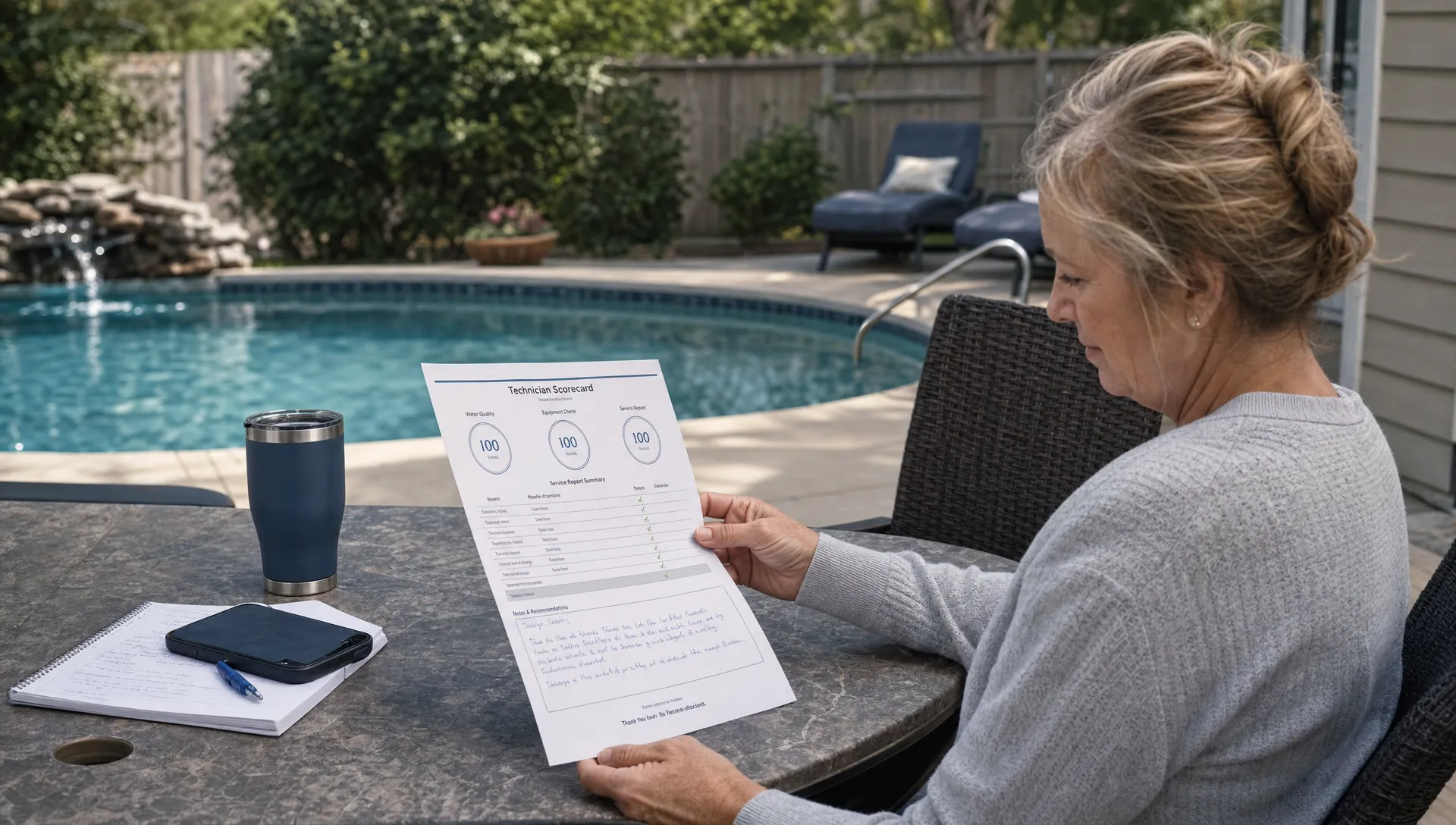
A fair scorecard for pool service technicians should measure reliable service, sound judgment and clear follow-through, not simply how many pools someone finishes before lunch. A dense route of screened pools is different from a spread-out route with heavy debris, aging equipment and access problems. Treating those assignments as equivalent can reward rushed work and penalize your strongest problem-solvers.
The most useful scorecards focus on work technicians can control, make exceptions visible and give managers something specific to coach. They also distinguish an honest report of a problem from a failure to address it.
The five metrics below provide a practical starting point. Each includes a calculation, an illustrative example and a fairness rule. Use them to improve individual performance, rather than turning every operating problem into a technician problem.
What makes a scorecard fair for pool service technicians?
Before calculating scores, define eligible work. Customer cancellations, unsafe conditions, documented access failures and office-directed schedule changes should not automatically count against a technician. Record those exceptions separately so they remain visible to management.
Compare similar assignments and experience levels. Route density, service scope, pool condition and equipment complexity affect workload. A trainee receiving supervised assignments should not be ranked directly against an experienced technician handling difficult recovery work.
Give technicians access to the underlying records and a way to challenge incorrect classifications. A score is not useful if nobody can explain which visits produced it.
Keep individual evaluation separate from business-wide pool maintenance metrics. Company revenue, customer retention and total route profitability matter, but they also reflect pricing, sales decisions and office performance.
Finally, establish a baseline before setting targets. The numerical examples in this article illustrate the calculations, not industry benchmarks. Publish the measurement window, exception rules and minimum sample requirements before using results in performance reviews.
1. Reliable completion of eligible visits
This metric measures whether assigned service gets completed within the agreed service window. It is more useful than raw stops per day because it evaluates commitments without assuming every route requires the same effort.
Formula: Eligible visits completed within the service window ÷ eligible assigned visits × 100.
Suppose a technician receives 50 visits during a measurement period. Two are removed from the denominator because documented customer cancellations made service unnecessary. Completing 46 of the remaining 48 on time produces a 95.8% completion rate.
For pool service technicians, the service window should reflect the promise made to the customer. If the agreement is a particular service day rather than an exact arrival time, do not score against an arrival deadline that was never communicated.
Fairness rule: Record blocked access and other exceptions promptly, with enough detail for review. A legitimate access failure should not become a missed-service penalty, but arriving at the wrong property should not be classified as an access exception.
Use a low score to investigate missed commitments. The solution might be better preparation, clearer escalation or a route adjustment. Do not assume the answer is faster work, especially when the office assigned more work than the route could reasonably accommodate.
2. Verified service-standard adherence
Visit completion does not establish service quality. This metric checks whether a sample of completed visits meets your documented standards for the contracted service.
Formula: Audited visits meeting the defined service standard ÷ eligible audited visits × 100.
An illustrative result of 18 passing visits out of 20 audited visits produces a 90% adherence rate. Decide beforehand which requirements are essential and what constitutes a failure. Otherwise, different supervisors may score the same work differently.
An audit might verify required cleaning tasks, appropriate water testing, treatment decisions and recognition of equipment problems. Use direct observation or suitable evidence for each requirement. A photograph can help verify visible debris removal, but it cannot establish whether a water test was performed correctly.
Pool service technicians should be evaluated on appropriate actions, not whether every pool immediately reaches a desired condition. A pool with equipment failure or a developing algae problem may require escalation and follow-up despite a correctly performed visit.
Fairness rule: Sample visits across technicians and route conditions rather than auditing only complaints. Keep supervisor standards consistent and show the technician what failed.
Use the results to identify a skill to practice. “Improve service quality” is vague; “repeat the testing procedure under supervision” gives the technician a clear next step.
3. Preventable callback rate
Callbacks can reveal problems that completion logs miss. However, counting every return visit as a technician failure discourages honest reporting and penalizes employees for equipment faults or customer decisions.
Formula: Confirmed technician-preventable callbacks ÷ eligible completed visits × 100.
If two preventable callbacks are attributed to 160 completed visits, the rate is 1.25 callbacks per 100 visits. Lower is better.
Choose a review window that fits the service involved, then apply it consistently. For example, you might review returns within seven days of routine maintenance. That is an operating choice, not a universal standard. Keep planned follow-ups, repair visits and unrelated failures out of the numerator.
A fair review for pool service technicians asks what happened, what was reasonably knowable during the original visit and whether the expected action was taken. A newly failed pump is different from a visible leak that was neither documented nor escalated.
Fairness rule: Have a supervisor confirm attribution and let the technician provide context. Do not assign blame solely because their name appears on the previous service record. Count one unresolved incident consistently rather than repeatedly penalizing every return associated with it.
Use a longer rolling window when visit volume is low. One callback across a small number of visits can create a dramatic rate without establishing a meaningful performance pattern.
4. Actionable service-record rate
A completed form is not necessarily a useful record. This metric asks whether the next person can understand the pool’s condition, the work performed and any required follow-up without reconstructing the visit by phone.
Formula: Reviewed visits with complete, actionable records ÷ eligible reviewed visits × 100.
Define the required fields by service type. Routine maintenance records may need water readings with units, treatment amounts, completed tasks and relevant equipment observations. A blocked visit needs an access explanation rather than water readings that could not be taken.
If 47 of 50 reviewed records meet the appropriate requirements, the actionable-record rate is 94%.
For pool service technicians, documentation should capture decisions as well as activity. “Pump issue” is less useful than a specific observation, its effect on service and the person notified. Consistent records also help managers distinguish a recurring equipment problem from a preventable service error, as explained in this guide to using better records to prevent callbacks.
Fairness rule: Set a realistic submission deadline and account for connectivity failures. An offline record synchronized after reconnection should not receive the same treatment as a forgotten report.
Keep this metric distinct from the quality audit. Service-standard adherence evaluates the work; record quality evaluates whether the work and findings are understandable. Establish rules against multiplying penalties for the same underlying mistake.
5. Customer communication follow-through
Communication scoring should measure required actions, not popularity. Star ratings and general satisfaction scores can reflect billing disputes, repair prices or office responsiveness that a field technician does not control.
Formula: Required technician-owned communications completed on time ÷ eligible technician-owned communications × 100.
Eligible communications might include reporting blocked access, escalating an equipment concern or explaining an incomplete service task. Specify the recipient, deadline and approved communication channel for each situation.
If 36 of 40 required communications are completed correctly and on time, the follow-through rate is 90%. Audit whether the message contained the information needed to act, not simply whether a message exists.
Pool service technicians should not lose points because an automated notification failed to deliver when they correctly completed the action that triggers it. Separate technician responsibilities from software delivery, office follow-up and customer response.
Fairness rule: Do not encourage unnecessary messages to inflate activity. Score required communication opportunities, protect customer privacy and follow company rules on who can discuss pricing or authorize repairs.
For qualitative context, homeowner discussions in Reddit’s r/pools community can provide questions to investigate about service expectations and explanations. Treat posts as anecdotal input, not verified performance evidence or a source of technician benchmarks. Look for issues to check against your own service records.
Combine the metrics without creating misleading rankings
A composite score can summarize performance, but managers should still examine the five underlying results. A strong documentation score should not hide repeated service failures.
The following weights are an illustrative starting point, not a validated industry model:
| Metric | Illustrative weight | Better direction |
|---|---|---|
| Reliable completion of eligible visits | 20% | Higher |
| Verified service-standard adherence | 30% | Higher |
| Preventable callback rate | 25% | Lower |
| Actionable service-record rate | 15% | Higher |
| Customer communication follow-through | 10% | Higher |
Before combining results, convert every metric to a comparable scoring scale. In particular, do not average a raw callback rate with positive completion percentages. Define callback scoring bands using your baseline and comparable service assignments, then publish those bands.
A composite score for pool service technicians should also display the measurement period and sample sizes. Mark insufficient data as insufficient data, not as zero performance or perfect performance. Avoid comparisons when one technician has two audited visits and another has twenty.
Start with coaching before attaching compensation consequences. Review the scorecard over a pilot period, check disputed cases and identify incentives that could encourage rushed visits, hidden problems or unnecessary communications.
Use CRM records to support growth, not just surveillance
As a contractor adds technicians and customers, informal knowledge becomes harder to share. Customer history, service assignments and documented follow-up provide the evidence needed to assess performance without relying on memory.
ServiceTitan’s guide to CRM software for contractors offers adjacent-industry reading on managing customer relationships as contracting operations grow. It is vendor-authored guidance, not independent proof that adopting CRM automatically produces growth.
The practical lesson for a pool company is to make records usable across the office and field. A manager should be able to connect a missed commitment with its scheduling context, or a callback with the original service findings, before drawing a conclusion about an employee.
Software cannot establish fairness by itself. Your definitions, review process and coaching decisions determine whether a scorecard helps people improve or simply creates a more polished ranking.
Frequently asked questions
Should speed be a scorecard metric? Use visit duration to investigate workload and unusual patterns, not as a standalone quality score. A shorter visit can reflect an easier pool, efficient work or skipped tasks. Review the service context before deciding which explanation fits.
How often should managers review scores? Review exceptions and coaching needs regularly, then use a longer rolling period for formal evaluation. Pool service technicians need enough eligible visits and audits for the results to be meaningful. Monthly reviews may be a practical starting point, with longer windows for callbacks or low-volume assignments.
Can scorecards determine bonuses? They can inform bonus decisions once definitions are stable, employees understand the rules and disputed records have been reviewed. Avoid using a new scorecard immediately for compensation. Check applicable employment requirements before changing a pay program.
Should customer ratings replace communication scoring? No. Ratings can provide useful feedback, but they mix technician performance with factors outside the technician’s control. Investigate specific comments and use verified incidents for coaching rather than automatically converting a rating into a penalty.
Build a scorecard your team can explain
SplashIQ brings scheduling, water-quality logs, equipment tracking, customer communication and technician scorecards into one platform for pool service businesses. Its field technician scorecards provide a place to start evaluating performance alongside operating records.
Before introducing a score, write down what counts, what is excluded and how a technician can correct an error. The first review should end with a specific coaching action or an operating fix, not just a number.