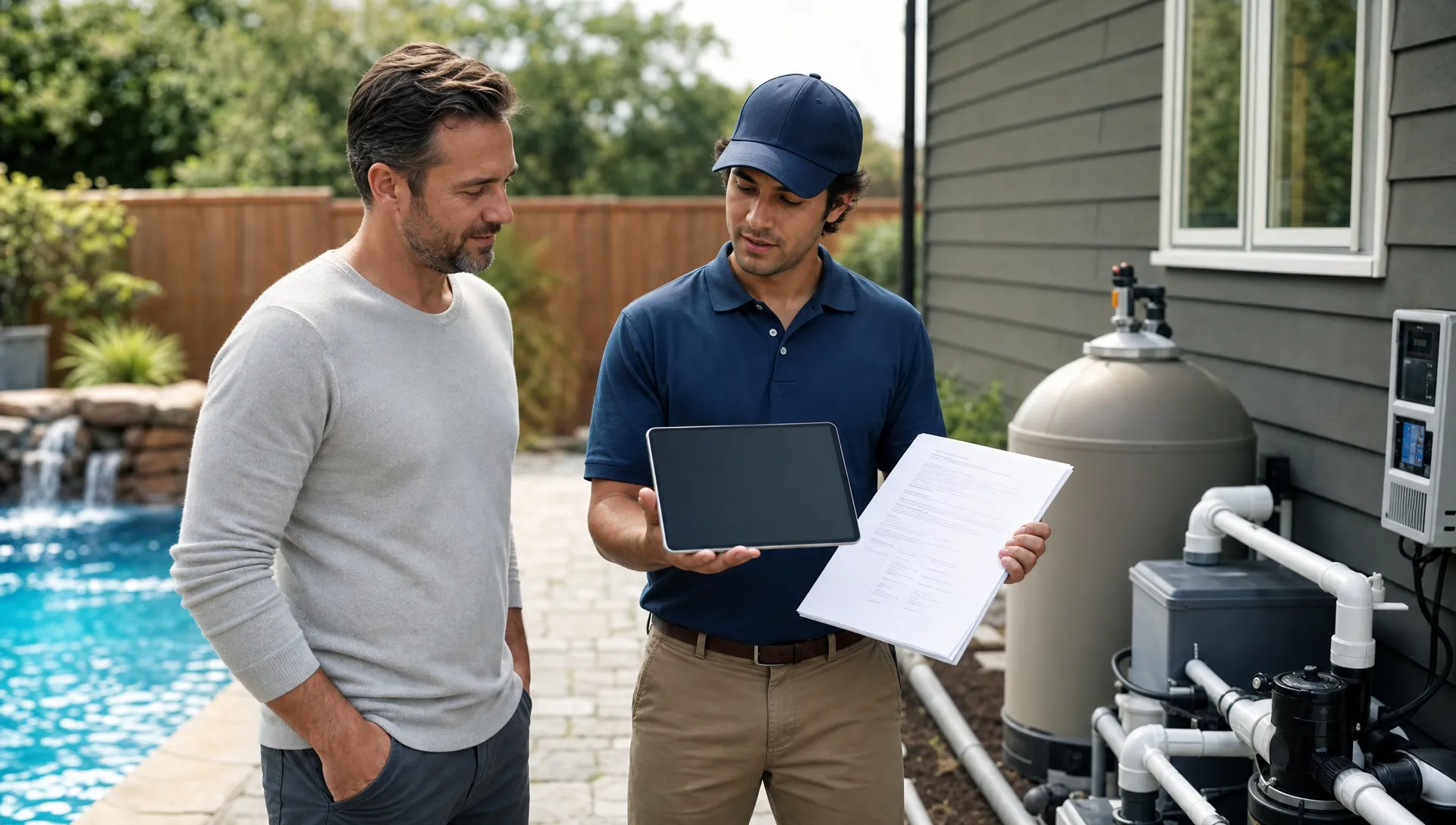
Choosing a pool service company is not just about finding someone who can show up with a net and a test kit. You are trusting that company with the water your family swims in, the equipment that protects a major home investment, and access to your backyard week after week.
The right provider should make pool ownership feel easier, not more confusing. They should be able to explain what they do, document what they find, communicate before repairs, and keep your pool safe and usable through weather, heavy swim weeks, and equipment issues.
Whether you are hiring weekly pool maintenance for the first time or replacing a company that has gone quiet, this guide will help you evaluate a pool service company with confidence.
Start with the basics: licensing, insurance, and local fit
Before comparing prices, confirm that the company is legitimate and qualified to do the kind of work you need. Requirements vary by state and municipality, so a small weekly cleaning route may be regulated differently from equipment repair, plumbing, gas heater work, or electrical work.
Ask direct questions:
- Is your business licensed where required for pool service or repair work?
- Do you carry general liability insurance?
- Are technicians trained to handle pool chemicals safely?
- If you repair pumps, heaters, automation, or electrical components, who performs that work and what license do they hold?
A trustworthy company should not be offended by these questions. Professional operators are used to them. If a company avoids the topic, gives vague answers, or says licensing “does not matter,” that is a signal to slow down.
Local fit matters too. Pools in Phoenix, Tampa, Dallas, San Diego, and the Northeast do not all face the same weather, water chemistry, freeze risk, debris load, or seasonal schedule. A strong provider should understand your region’s common problems and be able to explain how their service plan adapts to them.
Check reputation beyond star ratings
Online reviews are useful, but they are only a starting point. A five-star average can hide inconsistent communication, while a few bad reviews may not tell the whole story if the company responded professionally.
Look for patterns in reviews. Do customers mention reliable arrival windows, clear photos, clean invoices, and quick responses? Or do complaints repeat the same themes, such as skipped visits, surprise charges, green water, or difficulty getting someone on the phone?
Reddit can also be helpful if you use it carefully. Search local subreddits, r/pools, and r/HomeImprovement for discussions about pool service companies in your area. Reddit articles and threads often reveal practical homeowner concerns that do not always show up in polished review profiles, such as whether a company actually brushes walls, how they handle filter cleanings, or whether they send the same technician consistently. Treat Reddit as a reality check, not the final verdict, since anonymous comments can be incomplete or biased.
Good reputation sources include:
- Google reviews with detailed comments, not just ratings
- Local Facebook or neighborhood groups
- Reddit threads for your city or pool ownership questions
- Referrals from pool builders, inspectors, or trusted neighbors
- State licensing board records, where applicable
The goal is not to find a company with zero complaints. The goal is to find a company that communicates clearly, fixes mistakes, and has a consistent track record.
Ask what is included in every visit
Many homeowner frustrations start with a simple mismatch: the homeowner assumes “pool service” includes everything, while the company has a narrower definition. Before you hire anyone, ask for a written service scope.
A standard weekly visit may include skimming, brushing, emptying baskets, checking equipment, testing water, adding chemicals, and leaving a service record. But some companies charge separately for filter cleans, phosphate treatments, salt cell cleaning, algae recovery, vacuuming, or storm cleanup.
That does not automatically make them untrustworthy. Different pricing models can be fair. What matters is whether the boundaries are clear before the first invoice.
| Question to ask | Why it matters | Trustworthy answer |
|---|---|---|
| What tasks are completed at every visit? | Prevents assumptions about brushing, vacuuming, and equipment checks | A written checklist or service description |
| Are chemicals included? | Chemical costs can change monthly pricing | Clear explanation of included and extra chemicals |
| How often do you clean filters? | Dirty filters cause pressure and flow problems | Defined schedule or condition-based process |
| Do you test and record water chemistry? | Logs help identify trends before problems grow | Regular readings with documented results |
| How do you report issues? | Homeowners need proof and context | Photos, notes, estimates, and approval steps |
If the company cannot explain its standard visit process, that is a concern. Consistent service depends on repeatable work, not memory.
Look for water chemistry documentation
Water that looks clear can still be out of balance. Poor chemistry can irritate swimmers, damage surfaces, shorten equipment life, and create recurring algae problems. A reliable pool service company should be able to tell you what they test, how often they test it, and how they record results.
At minimum, ask how they monitor sanitizer, pH, alkalinity, and other readings relevant to your pool type. If you have a saltwater pool, ask about salt levels and salt cell maintenance. If you have a plaster pool, ask how they think about calcium hardness and overall balance.
Documentation is important because chemistry problems are rarely random. They usually develop through patterns: missed readings, overcorrection, poor circulation, clogged filters, heavy usage, rainfall, or equipment running too little. For pool service operators, this is why avoiding pool water chemistry mistakes that lead to repeat visits is often a process issue as much as a technical issue.
For homeowners, the takeaway is simple: do not settle for “we added what it needed” as the only explanation. You should be able to see what was tested and what changed over time.
Evaluate how they communicate about repairs
Even with excellent weekly maintenance, pool equipment eventually needs attention. Pumps wear out, filters crack, heaters fail, valves leak, automation gets outdated, and cleaners stop moving the way they should.
The difference between a trustworthy company and a frustrating one often shows up during repairs.
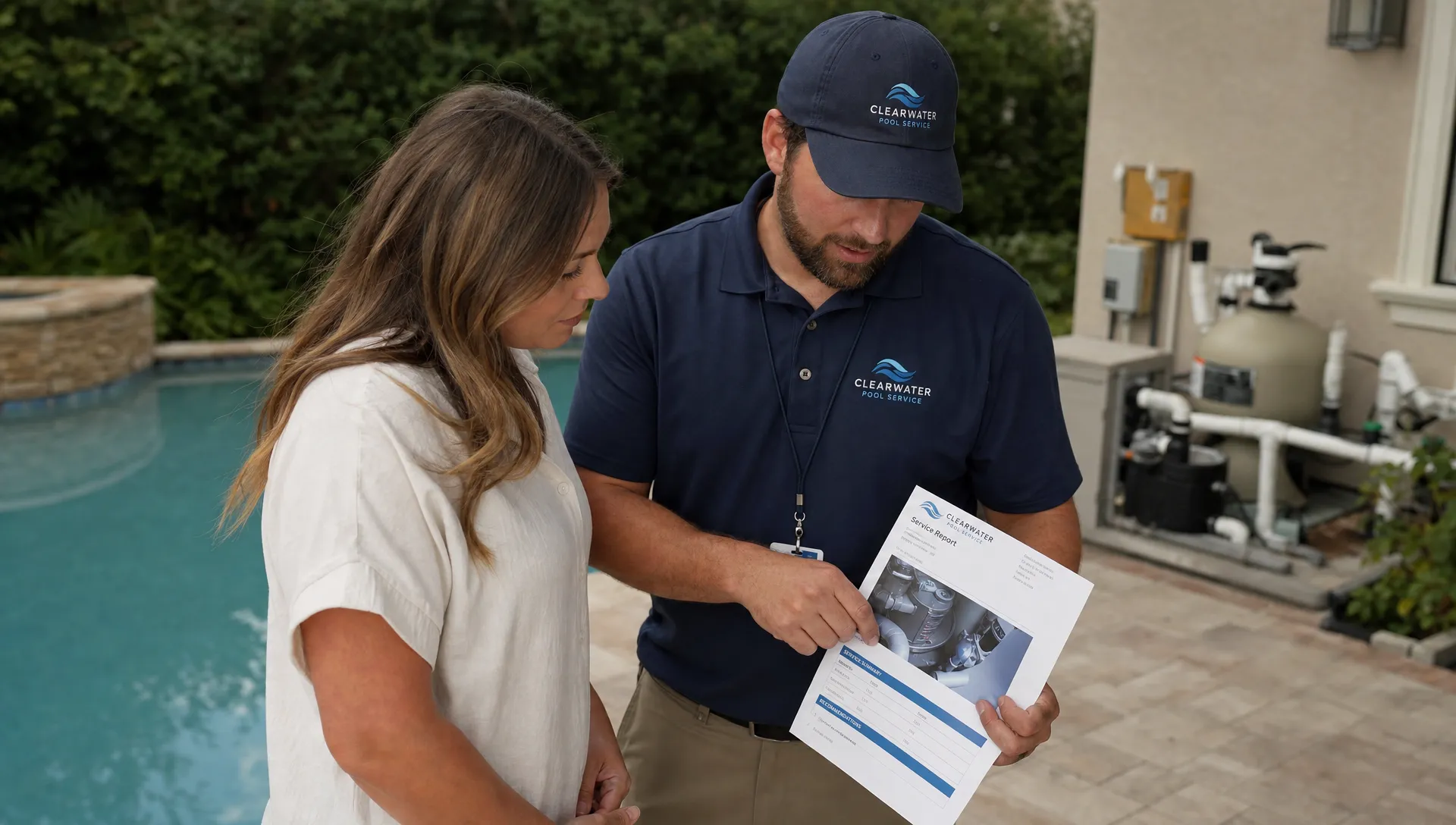
A professional repair process should include a clear diagnosis, photos when possible, the affected equipment, the risk of waiting, and the estimated cost before work begins. If there are multiple options, such as repair versus replacement, the company should explain the tradeoffs without pressuring you.
This matters because homeowners approve repair work faster when they understand the issue. A cracked filter manifold, failing pump seal, or leaking heater union is easier to approve when the technician provides a photo, a plain-English explanation, and a clear next step. Pool companies that want to improve this process can learn more about how pool equipment repairs get approved faster when communication is structured and visual.
For homeowners, be cautious if a company regularly performs billable work without approval, gives only verbal explanations for expensive repairs, or cannot tell you which piece of equipment was serviced.
Compare pricing by scope, not just monthly cost
The cheapest pool service company is not always the best value. A low monthly price can become expensive if the company rushes visits, skips brushing, fails to catch equipment issues, or charges frequent add-ons that were never discussed.
When comparing quotes, ask each company to define what is included, what is excluded, and when extra charges apply. You may find that one company appears more expensive but includes chemicals, routine filter cleanings, photo reports, and better communication. Another may quote a lower number but charge separately for common tasks.
You should also ask about billing terms. Do they bill monthly in advance, after service, or per visit? Can you pay online? How are skipped visits handled during storms, freezes, or holidays? What is the cancellation policy?
A fair price should support reliable service. Pool companies have real costs: technician wages, fuel, insurance, chemicals, vehicles, tools, software, office time, and training. If a price seems too good to be true, the company may be cutting time somewhere, and that often shows up in missed details.
Choose a company with systems, not just good intentions
Many pool service problems happen because a company grows beyond what its informal systems can handle. A solo owner may remember every gate code and equipment quirk. A larger team cannot rely on memory. They need organized customer records, routes, service histories, water logs, repair notes, photos, and billing workflows.
This is where trustworthy operators stand out. They can answer questions like:
- How do technicians know what was done on the last visit?
- Where do you store gate codes, equipment details, and service notes?
- How do you track water readings over time?
- What happens if my regular technician is out?
- How do you make sure invoices match completed work?
The principle is not unique to pool service. Any business handling customers, payments, compliance, and operational details needs purpose-built systems. For example, regulated digital operators may rely on a modular iGaming platform to organize payments, fraud controls, analytics, and back-office workflows. In pool service, the same broader lesson applies: trust improves when the business runs on a dependable system instead of scattered notes and memory.
For pool companies, software can make that consistency easier. SplashIQ is built for pool service businesses that need CRM, route scheduling, water-quality logs, equipment tracking, homeowner communication, and payments in one workflow. If you run a service team and want a deeper look at the operational side, this guide to managing pool service and repairs more effectively explains why connected records matter.
For homeowners, you do not need to know every tool a company uses. But you should feel confident that they can track your pool’s history and communicate without chaos.
Watch for common red flags
A single awkward phone call does not always mean a company is bad. Busy seasons are real, and pool service teams often work outdoors in demanding conditions. Still, certain warning signs should make you reconsider.
Be careful if a company refuses to put pricing or scope in writing. Be cautious if they promise perfect water without asking about pool size, equipment, trees, screen enclosure, usage, or current condition. Watch out for companies that cannot explain whether repairs are handled in-house or subcontracted.
Other red flags include missed appointments without communication, no proof of insurance when requested, inconsistent invoices, no service records, repeated “chemical dump and go” visits, and pressure to replace equipment before diagnosing the problem.
Trustworthy companies are not perfect. But when something goes wrong, they communicate, document, and take responsibility.
Ask about technician consistency and training
The person who visits your pool matters. A good technician notices subtle changes: a pump that sounds different, a filter pressure trend, a cleaner that keeps getting stuck, a return flow issue, or a small leak forming at the pad.
Ask whether you will usually have the same technician. If not, ask how the company keeps service consistent when different technicians cover the route. Larger companies can still provide excellent service if they have strong notes, checklists, photos, and quality controls.
Training matters too. Pool chemistry, circulation, equipment diagnostics, and customer communication all require judgment. A professional company should be able to explain how new technicians are trained and how service quality is checked.
If they use technician scorecards, supervisor reviews, photo documentation, or callbacks tracking, that is usually a good sign. It means the company is managing quality rather than hoping every visit goes well.
Decide what “trust” means for your pool
Not every homeowner needs the same level of service. A rental property, luxury pool, saltwater pool, older equipment pad, or heavily used family pool may require more documentation and faster communication than a simple low-use backyard pool.
Before making a decision, define your priorities. Do you want the lowest monthly cost, the most detailed reporting, the fastest repair response, or the most hands-off experience? The best pool service company for you is the one whose process matches your expectations.
A practical hiring process looks like this: call two or three companies, ask the same questions, compare written scopes, check reputation patterns, and choose the provider that communicates most clearly. If one company takes time to understand your pool before quoting, that is often a good sign.
A final checklist before you hire
Before signing up, make sure you can answer yes to the most important trust questions.
- The company explained what is included in each visit.
- Pricing, billing terms, and add-on charges are clear.
- The company can document water chemistry and service history.
- Repairs require approval before billable work begins.
- Reviews show consistent communication and reliability.
- The company has insurance and appropriate licensing where required.
- You know how to reach them when something goes wrong.
If you cannot answer yes, ask more questions. A reliable company will welcome clarity because it helps both sides avoid misunderstandings.
Frequently Asked Questions
How often should a pool service company come to my house? Most residential pools are serviced weekly, especially in warm climates or during swim season. Some pools may need more frequent attention after storms, heavy usage, algae problems, or equipment issues.
Should pool service include chemicals? It depends on the company’s pricing model. Some include standard chemicals in the monthly fee, while others charge separately for specialty chemicals, algae treatments, salt, or phosphate removers. Ask for this in writing.
Is it normal for a pool company to skip service during bad weather? Severe weather can make service unsafe or ineffective. What matters is communication. A trustworthy company should explain how weather delays are handled and whether missed tasks are completed later.
How do I know if my pool technician actually came? Many professional companies provide service notes, photos, door hangers, app notifications, or emailed reports. If you are unsure, ask what visit verification they provide.
What should I do if I am unhappy with my current pool service company? Start by documenting the issue and asking for a clear fix. If problems continue, compare other providers using written scopes, reviews, and service documentation. Avoid switching based on price alone.
Build the kind of pool service homeowners can trust
For homeowners, choosing a pool service company comes down to proof, process, and communication. For pool service businesses, those same factors are what turn one-time customers into long-term accounts.
If your team is growing beyond spreadsheets, paper checklists, and scattered text messages, SplashIQ helps connect CRM, scheduling, field operations, water-quality logs, equipment tracking, homeowner billing, and payments in one operating system built for pool service companies.