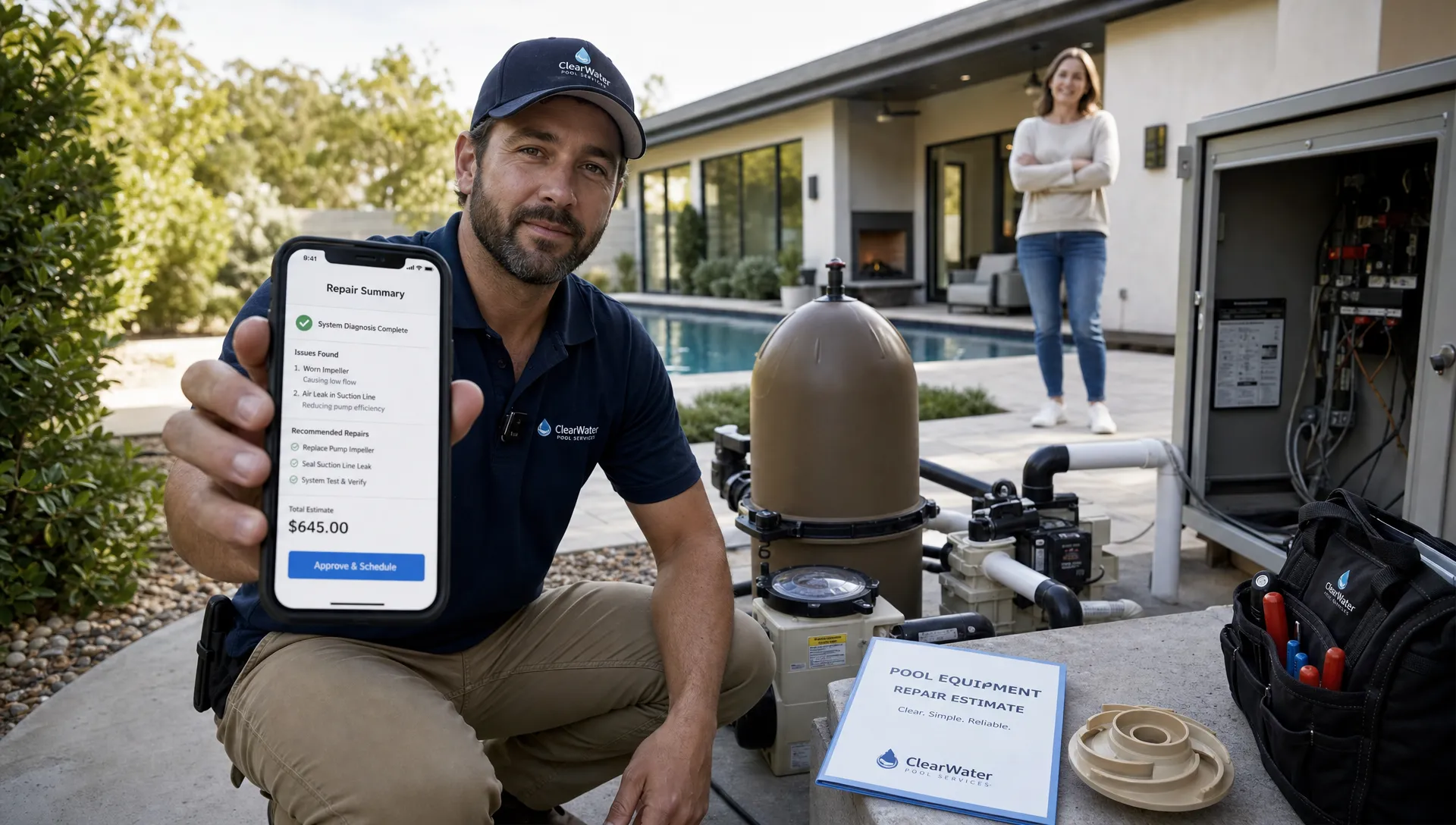
A homeowner rarely approves a pool repair just because a technician says it is needed. They approve when the problem is clear, the risk feels real, the price is understandable, and the next step is easy.
That is especially true for pool equipment repairs. Pumps, filters, heaters, automation panels, chlorinators, valves, and cleaners can all feel technical and expensive to the customer. When the homeowner does not understand what failed or why it matters, the repair quote gets delayed, forwarded to a spouse, compared on Reddit, or buried in an inbox until the problem becomes urgent.
For pool service companies, faster approvals are not about pressuring customers. They are about removing doubt. A strong repair workflow gives homeowners enough context to make a confident decision without a long back-and-forth.
Why homeowners hesitate on pool equipment repairs
Most approval delays start before the quote is sent. The homeowner may like your company and trust the technician, but equipment repairs trigger a different level of scrutiny than routine weekly service.
Homeowners hesitate because they are often asking themselves several questions at once: Is this repair really necessary? Is the price fair? What happens if I wait? Is replacement smarter than repair? Did the equipment fail because of age, chemistry, installation, or maintenance? Can I pay later, or do I need to pay now?
This is why Reddit posts in pool communities are so revealing. In r/pools and similar forums, homeowners often share photos of pumps, filters, heaters, or quote screenshots and ask other pool owners whether the recommendation makes sense. The comment threads usually circle back to missing information: model numbers, age of the equipment, pressure readings, error codes, leak location, water chemistry history, and whether the technician explained repair versus replacement.
The lesson is simple. If your repair recommendation does not answer the questions a homeowner would ask Reddit, the homeowner may go to Reddit for the answer.
The approval-ready repair package
A repair quote should not be just a price. It should be a short, evidence-based case for action. The most effective pool companies treat every repair recommendation like a small approval package.
| Approval element | Why it speeds up approval | What to include |
|---|---|---|
| Clear diagnosis | Reduces doubt about whether the repair is necessary | Failed component, symptoms, test results, pressure readings, error codes, or leak location |
| Equipment context | Helps the homeowner understand age, compatibility, and urgency | Brand, model, serial number when available, estimated age, warranty notes if known |
| Photos | Makes the issue visible instead of abstract | Leaks, cracked housings, damaged seals, corroded parts, worn baskets, bad valves, before and after photos |
| Risk of waiting | Explains why timing matters without sounding alarmist | Possible water-quality issues, equipment strain, higher utility use, safety concerns, or escalation risk |
| Options | Gives the homeowner control | Repair, replacement, good-better-best choices, or temporary workaround when appropriate |
| Simple authorization | Removes administrative friction | Digital approval, scheduled repair date, payment link, financing option when applicable |
This package does not need to be long. In many cases, a few photos, a concise technician note, and a well-structured estimate are enough. The key is consistency. Every technician should capture the same core information so the office can send a quote quickly and professionally.
If your team is still coordinating repairs through texts, paper notes, and spreadsheets, approvals will naturally slow down. A connected workflow, like the one described in a better way to manage pool service and repairs, keeps customer records, field notes, scheduling, approvals, and invoicing from becoming separate conversations.
Build trust before the estimate is sent
The fastest repair approval is often earned during the service visit. The technician sees the equipment pad, captures evidence, and sets expectations before the homeowner ever receives the quote.
A strong field process starts with equipment tracking. When the technician can see past repairs, installed equipment, model details, and service history, the recommendation feels informed rather than improvised. This matters for repeat issues, aging equipment, and cases where one symptom could have multiple causes.
Water-quality logs can also support the repair story. A heater damaged by scale, a salt system struggling due to chemistry imbalance, or a filter under stress from recurring debris all become easier to explain when the service history is visible. The goal is not to blame the homeowner. The goal is to connect the repair recommendation to objective observations.
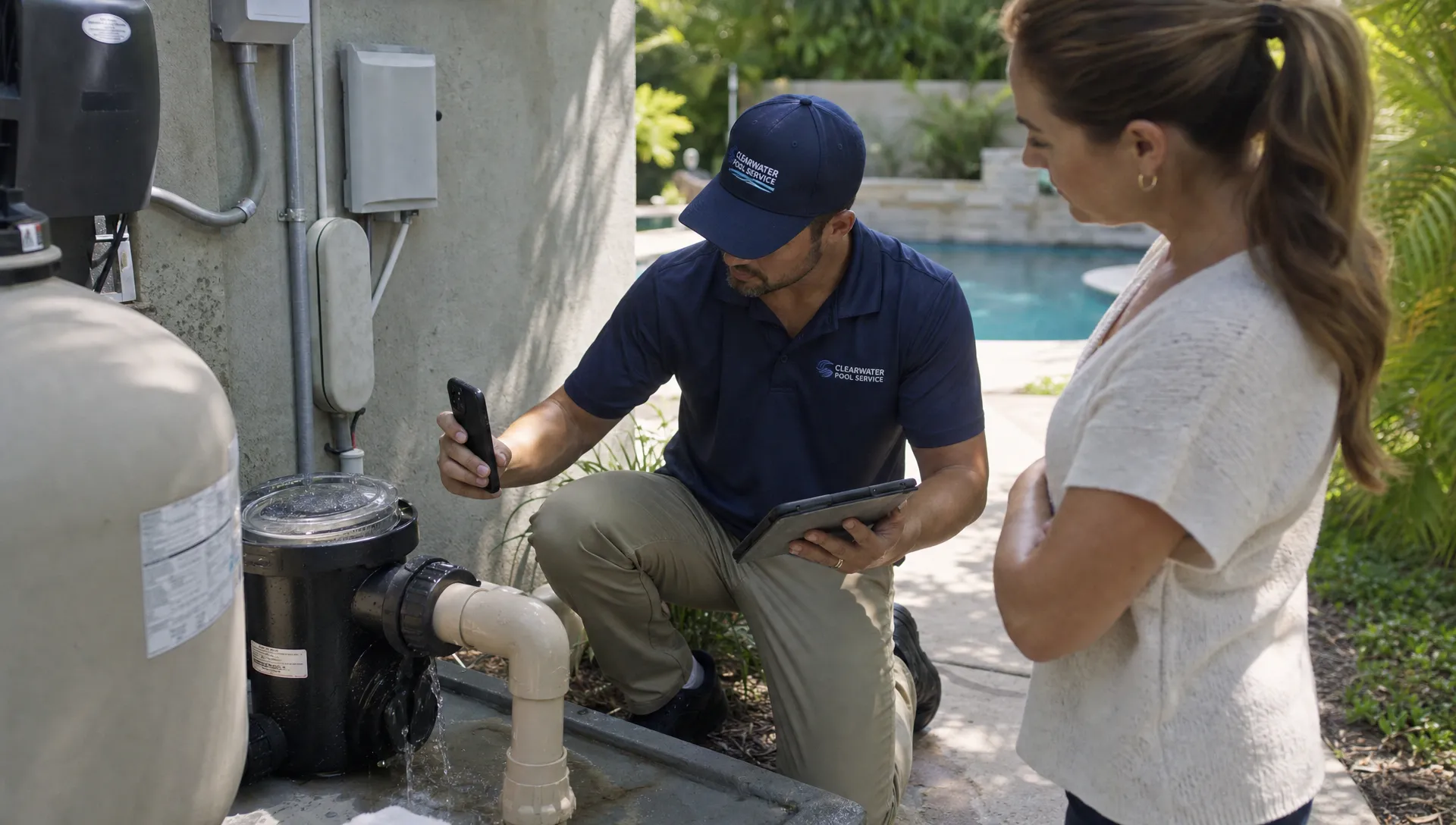
Photos are equally important. A homeowner may not understand a multiport valve, capacitor, pump seal, filter manifold, or heater exchanger, but they can understand a clear image of a leak, crack, scorch mark, corrosion, or debris returning to the pool. Before and after photos also reinforce that the repair was completed correctly.
For companies with multiple technicians, standardization is the difference between a persuasive quote and a vague one. An offline field app can help techs capture notes and photos even when cell service is weak at the equipment pad. Technician scorecards can then help managers identify whether some team members are consistently getting better documentation, fewer callbacks, or higher approval rates.
Make the recommendation easy to compare
Homeowners approve faster when they do not feel trapped between yes and no. If the repair is urgent, say so clearly. If there are reasonable options, show them.
A single expensive number can create sticker shock. A structured comparison turns the decision into a choice. For example, instead of only quoting a pump replacement, the recommendation may explain whether a minor repair is possible, whether replacement is more cost-effective due to age, and what the homeowner gains from each option.
| Recommendation style | Customer reaction | Better approach |
|---|---|---|
| Pump is bad, replacement is $X | Feels abrupt and expensive | Pump motor is failing, here is the symptom, here is the repair option, and here is when replacement makes more sense |
| Filter needs repair | Too vague to approve quickly | Filter pressure is rising and debris is returning to the pool, photos attached, repair now may help prevent an emergency call |
| Heater error code found | May feel technical and unclear | Heater shows this code, these checks were completed, and the next recommended step is this part or diagnostic visit |
| Automation issue | Hard for homeowner to visualize | App control is not communicating with the panel, photos and equipment details attached, here are the likely next steps |
This is especially useful for filters because the symptoms can be easy to ignore until the pool turns cloudy or circulation drops. If filter issues are a recurring source of emergency calls in your business, the guidance in pool filter repairs that help avoid emergency calls pairs well with a faster approval workflow.
Reduce authorization and payment friction
Even when the homeowner agrees with the repair, the approval can stall if the process is inconvenient. If they have to call the office, print a form, search for an invoice, or wait for someone to resend payment instructions, momentum drops.
The smoother path is to give the homeowner one place to review the recommendation, approve the work, and handle payment. A homeowner portal can make this feel organized instead of transactional. It also creates a record of what was recommended, what was approved, and what was completed. For more on what customers expect from that experience, see these homeowner portal features customers actually want.
Payment friction matters in every service industry. Travel agencies, for example, deal with deposits, card payments, reconciliation, fraud prevention, and cash-flow complexity, which is why all-in-one payment platforms such as Elia Pay focus on simplifying payment management for that market. Pool service companies have a different workflow, but the operating principle is similar: customers move faster when authorization and payment are clear, secure, and easy to complete.
For pool companies, that can mean online payments, digital approvals, stored customer communication history, and homeowner financing for larger repairs when appropriate. A failed heater, variable-speed pump replacement, or automation upgrade may be too large for an instant yes if the only option is full payment today. Offering a financing path can help a homeowner move forward before equipment failure affects the entire pool season.
Use scheduling to preserve the yes
A fast approval still loses value if the repair is not scheduled quickly. Once a homeowner authorizes the work, they expect the company to move from explanation to execution.
This is where scheduling and field operations connect directly to revenue. If approvals sit in an inbox, the homeowner may change their mind, the part may be forgotten, or the next visit may happen without the correct equipment on the truck. A smart scheduling process helps the office assign the repair to the right technician, coordinate parts, and fit the work into the route without unnecessary drive time.
Timing also affects trust. If the quote says the repair is important but the company cannot schedule it for weeks, the message feels inconsistent. If the company communicates the earliest available repair window, confirms what will happen, and keeps the homeowner updated, the approval feels validated.
For urgent issues, be specific but measured. A repair recommendation should distinguish between immediate safety concerns, high risk of additional damage, comfort and convenience issues, and preventive repairs. Homeowners can handle urgency when it is explained honestly.
Write repair notes homeowners can understand
Technician notes are often written for the office, not the customer. That is understandable, but it slows approvals when the note becomes the basis of a quote.
A good homeowner-facing repair note uses plain language while preserving technical accuracy. Instead of writing that the pump is cavitating, explain that the pump is pulling air and losing prime, which can reduce circulation and put extra strain on the system. Instead of writing that the filter has high differential pressure, explain that pressure is rising faster than normal, which may restrict water flow and affect cleaning performance.
The best repair notes usually include four pieces of information: what the technician found, how they confirmed it, why it matters, and what is recommended next. That structure gives the office a clean path to quote the work and gives the homeowner a clear reason to approve it.
This also helps when multiple decision-makers are involved. Many pool repair approvals are delayed because one spouse saw the technician but another spouse pays the bill. A clear written summary allows the first person to forward the recommendation without becoming the translator.
Track approval speed like an operational metric
If you want homeowners to approve pool equipment repairs faster, measure the workflow instead of guessing. Approval delays are often caused by small process gaps that only become visible when tracked.
| Metric | What it reveals | Operational improvement |
|---|---|---|
| Time from visit to quote | How quickly the office turns field findings into recommendations | Standardize technician notes and quote templates |
| Quote view rate | Whether homeowners are actually seeing the recommendation | Improve delivery method and customer contact accuracy |
| Approval rate by repair type | Which repairs need better explanation or options | Build better templates for pumps, filters, heaters, and automation |
| Approval rate by technician | Whether documentation quality varies across the team | Coach technicians with examples of strong notes and photos |
| Time from approval to scheduled repair | Whether the company preserves momentum after yes | Connect approvals to scheduling and parts coordination |
These metrics are not just for management reports. They help companies improve the customer experience. If homeowners routinely delay heater approvals, maybe the quote needs clearer photos, replacement-versus-repair guidance, or financing. If pump repairs are approved quickly but filter repairs lag, maybe the symptoms are not being explained in homeowner-friendly terms.
Common repair situations that need extra clarity
Some equipment repairs are naturally harder for homeowners to approve because the value is not immediately visible. A green pool is obvious. A worn shaft seal, weak capacitor, aging actuator, or clogged filter manifold may not be.
Pump repairs need clear symptom notes because homeowners often confuse motor noise, air leaks, low flow, and priming problems. Filter repairs need pressure readings, photos, and a simple explanation of how poor filtration can lead to repeat water-quality issues. Heater repairs need safety-conscious language, especially when gas, electrical, or manufacturer-specific diagnostics are involved. Automation repairs need screenshots or photos when possible because the issue often involves communication between controls, relays, sensors, and apps.
Replacement recommendations need even more care. Homeowners may suspect that replacement is being recommended because it is more profitable. To build trust, explain why repair may not be the best use of money if the unit is old, parts are limited, efficiency is poor, or repeated failures are likely. When repair is the better choice, say that too. Honesty on smaller decisions earns trust on larger ones.
Faster approvals come from confidence, not pressure
Pool equipment repairs are approved faster when the homeowner feels respected, informed, and in control. That requires more than a technically correct diagnosis. It requires a workflow that turns field observations into a clear recommendation, sends it quickly, makes approval simple, and schedules the work while the need is still fresh.
For growing pool service companies, this is where operational software becomes more than an office convenience. A connected system for CRM, route scheduling, field notes, water-quality logs, equipment tracking, homeowner communication, online payments, and repair approvals helps every team member support the same customer experience.
The result is not just faster approvals. It is fewer lost quotes, fewer emergency callbacks, more consistent technicians, and homeowners who understand the value of the work being done.
Frequently Asked Questions
Why do homeowners delay approving pool equipment repairs? Homeowners usually delay when the diagnosis is unclear, the price feels surprising, the urgency is not explained, or the approval and payment process is inconvenient. Clear photos, plain-language notes, and simple authorization can reduce hesitation.
What should be included in a pool repair quote? A strong quote should include the diagnosed issue, equipment details, photos, repair or replacement options when relevant, the risk of waiting, total cost, expected timing, and a simple way to approve the work.
Do photos really help homeowners approve repairs faster? Yes. Photos make hidden equipment problems easier to understand. A cracked filter part, leaking pump seal, corroded heater component, or damaged valve is much easier to approve when the homeowner can see the issue.
How can pool companies avoid sounding pushy about urgent repairs? Use specific, factual language. Explain the risk of waiting, separate safety issues from convenience issues, and give options when appropriate. Urgency should be based on the condition of the equipment, not sales pressure.
Can software help improve repair approval rates? Software can help by centralizing customer records, equipment history, field notes, photos, approvals, scheduling, and payments. That makes the recommendation clearer for the homeowner and easier for the office to manage.
Make repair approvals easier to say yes to
If repair approvals are slowing down your routes, revenue, or customer experience, the problem may not be the repair itself. It may be the workflow around it.
SplashIQ helps pool service companies replace scattered spreadsheets, paper checklists, text threads, and disconnected payment steps with one operating system for offices, technicians, and homeowners. From equipment tracking and before-after photos to homeowner portals, online payments, and scheduling, it gives your team a cleaner path from first diagnosis to final invoice.