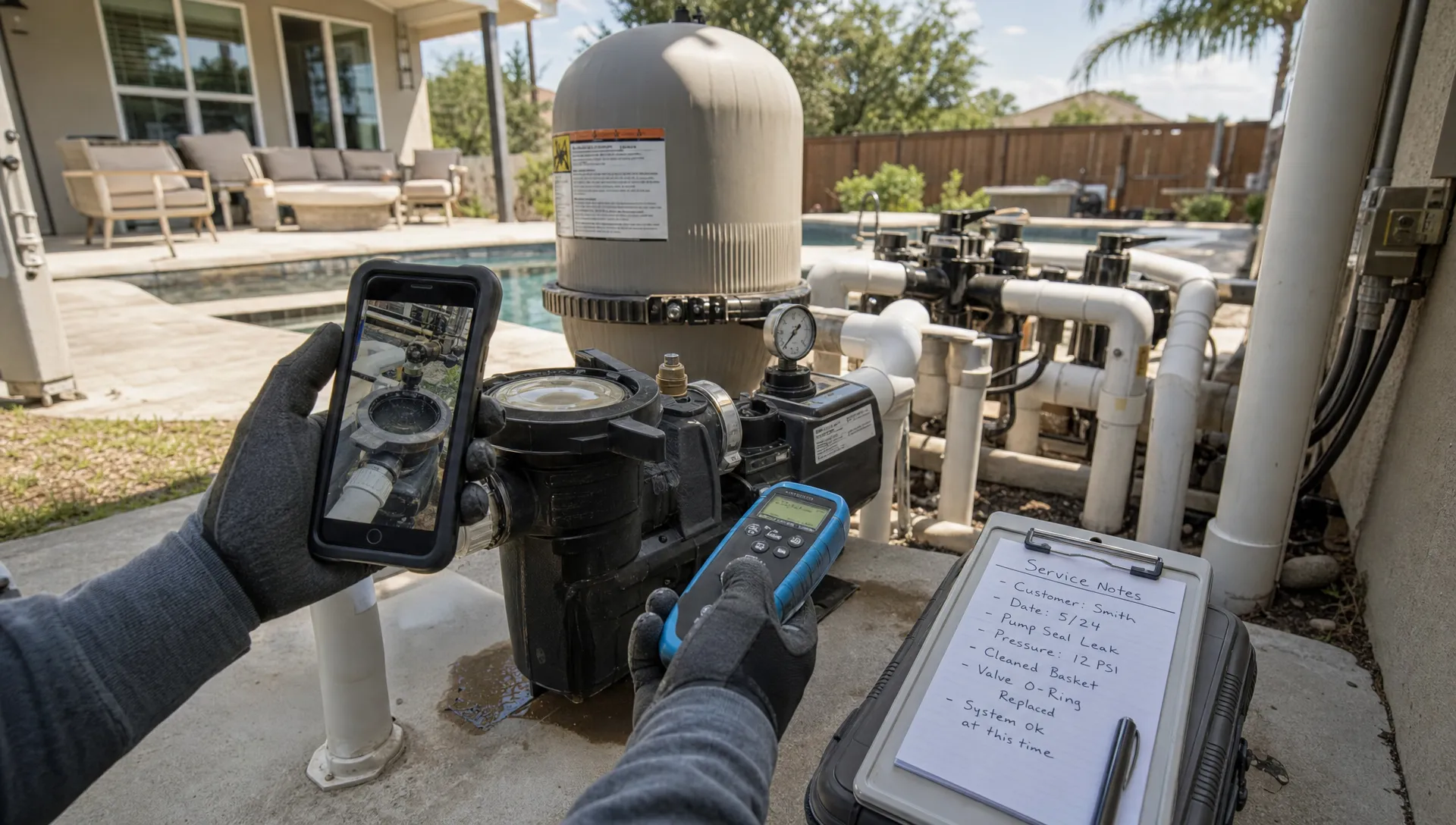
For pool service companies, pool repairs often lose momentum between the equipment pad and the homeowner’s approval. The technician sees the leak, the pressure spike or the failing part, but the customer receives a short message that does not explain what happened, why it matters or what the next step costs. That gap turns legitimate work into delayed approvals, extra phone calls and unfinished jobs sitting on the schedule.
A clear repair process is not just a better estimate template. It is a shared workflow that connects field notes, photos, equipment history, homeowner communication, scheduling and payment. When each step is visible, your office can move faster and homeowners can approve with more confidence.
Why good repair findings still stall
Many repair recommendations fail because they arrive as conclusions instead of evidence. A homeowner hears “your pump needs work” or “the filter is bad” and immediately wonders whether the recommendation is urgent, optional or padded. The issue may be real, but the explanation does not carry enough context.
When pool repairs are presented only as a line item, even an honest recommendation can feel like a surprise expense. Homeowners want to know what the technician saw, whether the issue affects safety or water quality, what happens if they wait and whether the quoted work actually solves the problem.
Reddit is useful for hearing that unfiltered homeowner reaction. Searches in r/pools for repair quote questions and r/swimmingpools for pump repair discussions often show homeowners posting photos, prices and technician comments to ask strangers if the recommendation sounds reasonable. Reddit posts are anecdotes, not technical standards, but they reveal the approval questions your customers may be asking silently.
Build the repair record before you ask for approval
The best time to make pool repairs easy to approve is before anyone writes the estimate. A good repair record starts during the service visit, while the technician can still capture the symptom, equipment condition and surrounding context.
At minimum, your team should document the observed issue, the affected equipment, the likely cause, the consequence of waiting and the recommended next step. A short note like “leak at pump seal, visible water on equipment pad while running” is stronger than “pump leaking.” Add a photo and the homeowner can see what the technician saw.
This is where paper checklists and scattered texts break down. The technician may send a photo to the office, the office may rewrite the issue in an estimate and the homeowner may receive a generic line that strips out the most useful detail. A connected record keeps the diagnosis intact.
SplashIQ is built for that kind of handoff, with water-quality logs, equipment tracking, before/after photos and customer records in one operating system for pool service teams. If you want a deeper look at approval-specific documentation, this related guide on pool equipment repairs homeowners approve faster covers the evidence homeowners expect.
Capture five pieces of field evidence
A repair recommendation becomes easier to trust when it includes enough evidence to answer the homeowner’s first objections. Your field team does not need to write a long report, but it does need a repeatable standard.
- The visible symptom, such as water loss, weak flow, noise, rust, pressure change or debris returning to the pool
- The equipment involved, including model details when available
- A photo or short video showing the issue clearly
- A plain-language consequence of waiting
- The recommended action, including whether it is repair, replacement or further diagnosis
This structure keeps the message concise without making it vague. It also helps the office avoid calling the technician after every visit to ask what the note meant.
A simple workflow for pool repairs that get approved
A repair workflow should make the next action obvious for the technician, office and homeowner. If every job has to be interpreted from scratch, approvals slow down and mistakes creep in.
| Stage | Team action | What the homeowner receives |
|---|---|---|
| Find | Technician documents the symptom, equipment and photo evidence | A clear explanation of what was found |
| Diagnose | Office or lead tech confirms the likely cause and repair path | A recommendation tied to the observed issue |
| Quote | Estimate includes scope, price, urgency and optional notes | A decision-ready repair proposal |
| Approve | Homeowner approves digitally or asks a specific question | A simple path to say yes or request clarification |
| Schedule | Office assigns the job to the right route or repair tech | A confirmed visit window and arrival notice |
| Close | Technician completes work with photos and notes | Proof of completion, invoice and payment link |
The goal is not to remove human judgment. The goal is to stop every recommendation from becoming a custom communication project.
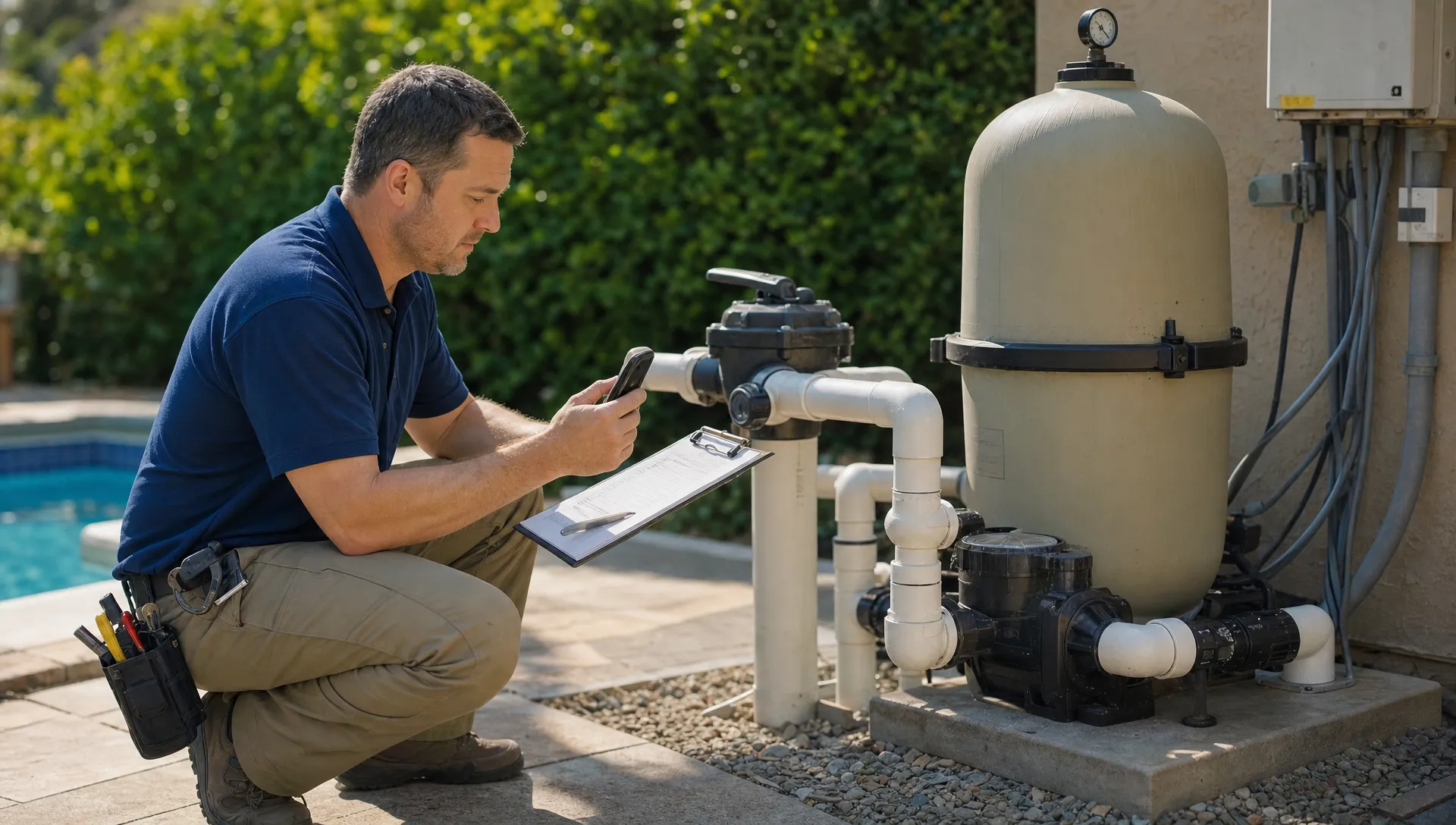
Translate technical findings into homeowner decisions
For pool repairs, the approval question is rarely “does this part have a problem?” The real question is “do I understand this well enough to spend money today?” Your wording should help homeowners make that decision without turning your staff into salespeople.
Technical accuracy still matters, but the message should connect the issue to the homeowner’s outcome: clear water, reliable circulation, lower risk of emergency failure or protection of more expensive equipment. Avoid scare tactics. A calm explanation of risk is more credible than an alarmist warning.
| Vague repair note | Clear approval-ready wording |
|---|---|
| Pump leaking | Water is leaking at the pump seal while the system runs. We recommend replacing the seal to reduce water loss and protect the motor area. |
| Filter pressure high | Filter pressure is higher than normal for this pool and flow is weaker than expected. We recommend inspecting and servicing the filter before circulation gets worse. |
| Heater not working | The heater did not start during the visit. We recommend a diagnostic visit to identify whether the issue is ignition, flow or another component. |
| Cleaner not moving | The cleaner is not moving consistently and suction appears weak. We recommend checking the cleaner, hose and suction line before replacing parts. |
This kind of language reduces back-and-forth because it explains what was seen, what it affects and what you recommend. It also protects your team from overpromising, since the message distinguishes between a confirmed fix and a needed diagnostic.
Use CRM discipline to scale the repair process
Contractor-focused articles from Jobber Academy and Buildertrend have made the same operational point about CRM software: as contractors grow, customer history, estimates and follow-ups cannot live in one person’s texts or memory. That lesson applies directly to pool companies.
For pool repairs, CRM discipline means every customer record should show the current equipment, recent service notes, open repair recommendations, approval status, scheduled work and payment history. Without that single view, an office manager may not know whether a homeowner has approved, a technician may not know what was promised and an invoice may go out late.
This is also where many companies start to feel the pain of scale. One owner can remember a handful of special cases. Ten technicians cannot run on memory. If your company wants to grow beyond daily firefighting, the repair workflow needs a system of record.
SplashIQ connects CRM, scheduling, field operations, homeowner notifications and online payments so repair work can move from finding to finished without bouncing across spreadsheets. For a broader operating model, see a better way to manage pool service and repairs.
Set approval rules so urgent work does not wait
Not all pool repairs need the same approval path. A small repair found during weekly service should not follow the same process as a high-cost equipment replacement or a safety concern. Your team needs rules that match urgency, cost and risk.
A simple approval policy can define which items require homeowner approval, which require a diagnostic quote and which should trigger an urgent call. The exact thresholds depend on your business, contracts and local requirements, but the categories should be clear to your team.
| Repair category | Example situation | Recommended communication |
|---|---|---|
| Routine recommendation | Minor leak, worn part or declining performance | Send photo, estimate and approval request |
| Diagnostic needed | Heater, automation or intermittent electrical issue | Explain what is unknown and quote the diagnostic visit |
| Urgent risk | Active leak near equipment, major circulation failure or unsafe condition | Call or text immediately, then document in writing |
| Larger project | Multiple components, upgrade or replacement decision | Provide scope, options and scheduling expectations |
These categories help technicians avoid guessing what to say. They also help homeowners feel that the response matches the situation rather than being a one-size-fits-all sales push.
Close the loop after approval
Approved pool repairs should move quickly into scheduling, completion and billing. If the homeowner says yes but the work sits unscheduled, you risk losing trust and creating extra admin work for your office.
The handoff should include the approved scope, parts or equipment notes, technician assignment, route placement and customer notification. After completion, send proof of work, before/after photos where useful, updated notes and a payment request. The faster that loop closes, the less cash is trapped between completed work and collected revenue.
This matters because repair revenue can be profitable, but only if it is controlled. Delayed invoices, missing approvals and unclear scopes can turn good work into cash-flow friction. Pool contractors who want tighter financial habits can pair this workflow with these pool contractor accounting habits that protect cash flow.
FAQ
How do you get pool repairs approved faster? Send a clear recommendation with photo evidence, plain-language diagnosis, urgency, price and a simple approval action. Homeowners approve faster when they understand the problem and the next step.
Should technicians quote repairs in the field? It depends on your company policy and the complexity of the work. Simple items may be quoted from the field, but diagnostics, larger repairs and equipment replacements often need office review so pricing, scope and scheduling are accurate.
What should be included in a pool repair estimate? Include the issue found, the affected equipment, the recommended work, price, any diagnostic limits, photos when available and what happens after approval. Avoid vague line items that force the homeowner to ask basic questions.
How can CRM software help a pool service company grow? CRM software helps centralize customer records, equipment history, estimates, approvals and follow-ups. As a company adds technicians and office staff, that shared record reduces missed communication and keeps jobs moving.
Turn repair findings into approved work with SplashIQ
If repair approvals still depend on texts, paper notes and someone remembering to follow up, your team is carrying avoidable friction. SplashIQ gives pool service companies one app for CRM, scheduling, water-quality logging, equipment tracking, homeowner communication, photos, payments and field operations.
Use SplashIQ to turn pool repairs from scattered findings into clear, approved jobs your office and technicians can manage from start to finish. Learn more at SplashIQ.