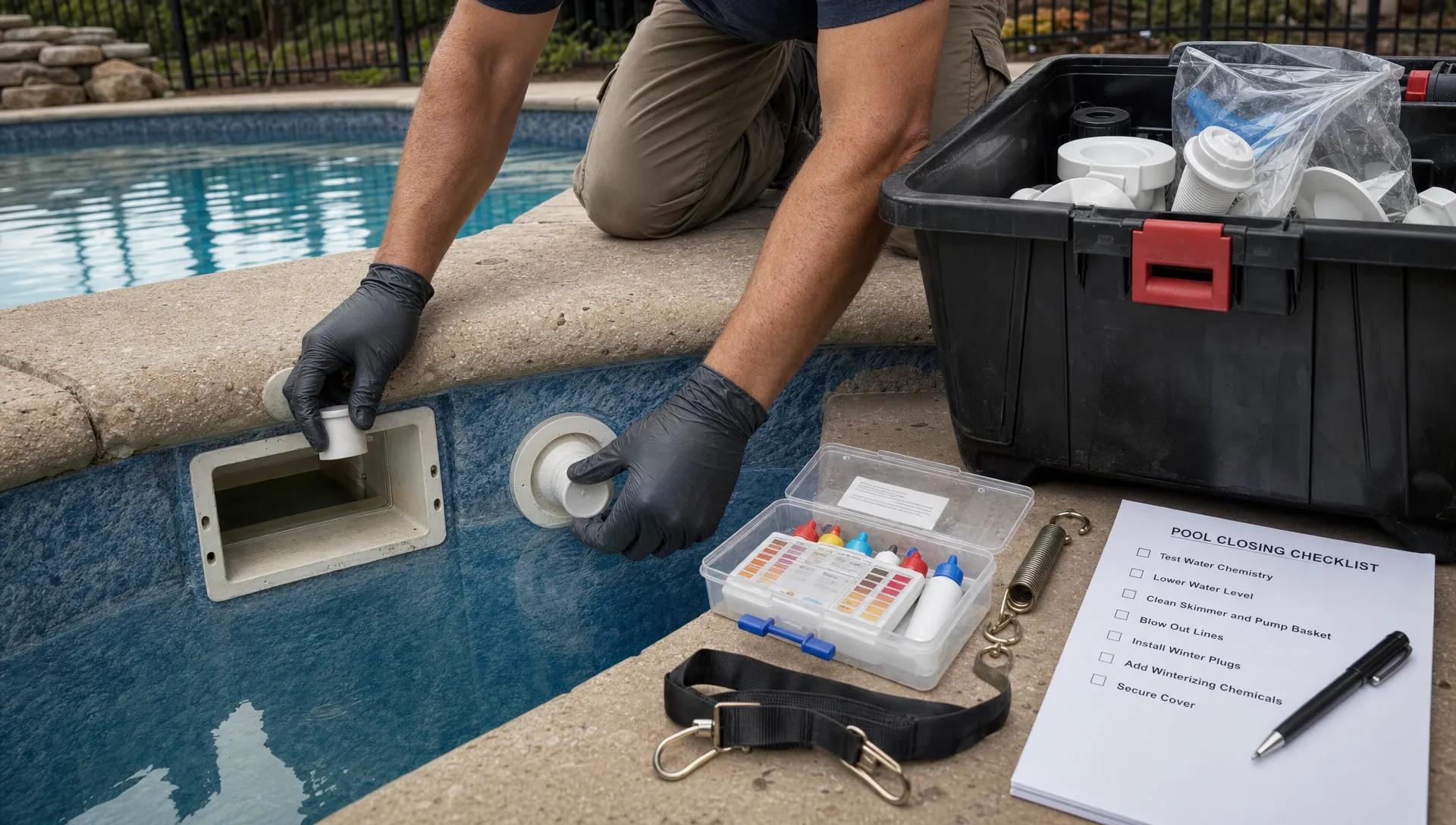
For pool service companies, pool closings are not just an end-of-season task. They are a high-volume operational sprint where missed plugs, vague notes, weak customer communication and late invoices can turn into spring callbacks. A good checklist protects the pool, gives homeowners confidence and helps your team enter the offseason with clean records instead of loose ends.
The best closing process does two things at once. In the field, it standardizes the technical work needed to winterize the pool. In the office, it keeps scheduling, homeowner approvals, documentation, billing and follow-up moving without depending on memory. That matters even more when your best technicians are handling dozens of properties per week.
Why pool closings need a repeatable checklist
A closing visit has more risk than a routine cleaning because the consequences show up months later. A missed drain plug, unbalanced water or undocumented equipment issue may not become obvious until the first warm week of spring, when every homeowner wants service at once.
A checklist reduces that risk by turning the job into a defined workflow. It also gives managers a consistent way to train seasonal helpers, review technician performance and answer homeowner questions with proof instead of guesswork.
The same lesson appears in contractor business content from Jobber Academy and ServiceTitan's blog: companies scale more reliably when customer records, scheduling, estimates and follow-up live in a shared system instead of separate notebooks, text threads and spreadsheets. Pool companies face the same challenge, just with seasonal pressure added.
A repeatable system also makes spring easier. If your closing notes include water readings, equipment condition, photos and exceptions, your team can plan openings with fewer surprises. SplashIQ has covered the same operational value from the other side of the season in its guide to pool openings made easier with digital checklists.
Pre-close planning before crews arrive
Well-run pool closings begin before anyone lifts a cover, handles a plug or adds winter chemicals. The office needs to confirm the scope, property access, homeowner expectations and any repairs that should be handled before the system is winterized.
Start by segmenting accounts. A simple above-ground pool, a plaster pool with attached spa and a pool with automation, heater, water features and multiple pumps should not be treated as the same job. Route planning should reflect job complexity, travel time, crew skill and chemical inventory.
Homeowner communication should happen early enough to avoid last-minute schedule churn. Send a confirmation that explains the closing date, arrival window, what the homeowner should do before the visit and what is included. If the homeowner needs to clean out toys, unlock gates, lower water, approve a cover repair or move furniture, say so plainly.
For voice-of-customer research, monitor Reddit's r/pools. Homeowners regularly discuss cloudy spring openings, cover questions, winter plug confusion and uncertainty about whether a service was done properly. Those threads are useful reminders that customers do not always understand the technical work, but they do notice when communication is unclear.
| Planning item | What to confirm | Why it matters |
|---|---|---|
| Service scope | Closing type, spa, water features, cover handling, add-ons | Prevents underpriced or incomplete visits |
| Access | Gate codes, pets, locked equipment areas, parking | Reduces wasted drive time |
| Pool condition | Heavy debris, algae, low water, known leaks | Helps assign the right crew and time window |
| Equipment notes | Pumps, filters, heaters, automation, valves | Reduces missed winterization steps |
| Billing status | Deposits, overdue balances, payment method | Protects cash flow before offseason |
The technical checklist for pool closings
The field checklist for pool closings should be specific enough that two qualified technicians would complete the work in the same order and document it the same way. It should not be so vague that close pool becomes the only instruction.
1. Inspect the pool and site condition
Begin with a site walkthrough. Note water level, debris load, surface condition, visible staining, cover condition and any safety issues around the pool area. If the pool is unusually dirty, green or low, document it before starting work so the homeowner understands the condition at arrival.
Technicians should also check whether the pool has attached features that change the closing process. Spas, waterfalls, laminars, booster pumps, slides, heaters and automation systems all need clear attention. If these details are buried in a technician's memory, your process is fragile.
2. Test and balance water
Water chemistry before winter matters because the pool will sit for months with limited circulation. Record readings for sanitizer, pH, total alkalinity, calcium hardness and stabilizer where relevant. The exact target ranges can vary by surface, sanitizer system and local conditions, so teams should follow manufacturer guidance and company standards.
The goal is not just to add a winter kit. It is to leave water in a condition that helps protect surfaces, equipment and the spring opening. Water-quality logs give managers a record of what was tested, what was added and whether the pool was already outside normal range before the closing.
3. Clean before winterizing
A pool should be closed as clean as practical. Skim, brush, vacuum or remove debris based on the package sold and the condition of the pool. Leaves and organic material left in the water can contribute to staining, algae and difficult openings.
If the homeowner declined a needed cleanup or if the pool requires extra labor, document the exception with photos and a plain-language note. This keeps the closing record accurate and gives the office a basis for follow-up or additional charges.
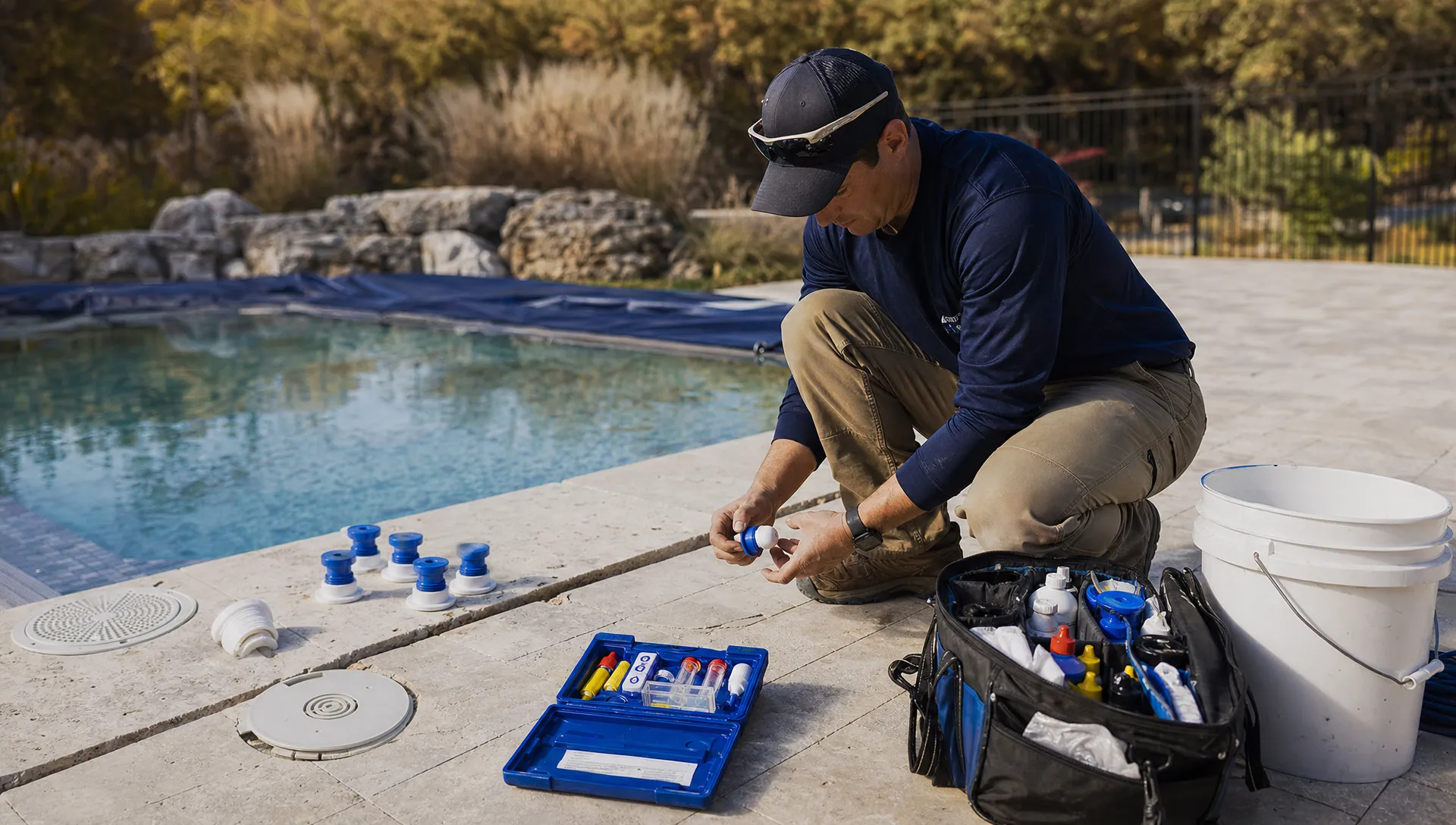
Winterize plumbing, equipment and accessories
For many companies, this is the highest-risk part of pool closings because small missed steps can create expensive freeze damage. The checklist should break the work down by system instead of relying on one broad winterize line.
Plumbing lines should be cleared according to the pool's configuration and local freeze conditions. Return lines, skimmers, main drains, cleaner lines, spa lines and water-feature lines may each require different handling. Winter plugs, gizmos, antifreeze where appropriate and valve positioning should be recorded clearly.
Equipment needs the same discipline. Pumps should be drained, plugs removed and stored in a predictable location. Filters should be cleaned or prepared based on filter type. Heaters, chlorinators, salt cells, automation components and booster pumps should be handled according to manufacturer instructions. When in doubt, document the model and consult the manual rather than guessing.
Safety also belongs in the checklist. The Pool Safely campaign from the U.S. Consumer Product Safety Commission is a good reminder that barriers, covers and drain safety are not just technical details. If a cover is torn, anchors are missing or a safety concern is visible, the technician should capture photos and escalate the issue.
| System | Checklist prompt | Documentation to capture |
|---|---|---|
| Skimmers and returns | Lines cleared, plugs installed, baskets removed if needed | Photo of plugs and skimmer treatment |
| Pump and filter | Drained, cleaned or prepared, plugs removed | Equipment photo and condition note |
| Heater | Drained or serviced per manufacturer guidance | Model, visible condition and any concerns |
| Cover | Installed, secured and inspected | Wide photo plus close-ups of damage |
| Accessories | Ladders, rails, toys, cleaners and fittings handled | Note where items were stored |
Document every exception while the crew is still onsite
Photos turn pool closings from a trust-me service into a documented job. They protect the homeowner, the technician and the business. Before and after photos also reduce office follow-up because the homeowner can see what was done.
A strong closing record should include arrival condition, water readings, chemicals added, equipment status, winterization steps completed, cover condition and anything excluded from the scope. If the pool was too dirty to close under the standard package, note that. If a heater showed corrosion, note that. If the cover has failing straps, note that too.
The wording matters. Homeowners do not always know what a multiport valve, bonding wire or hydrostatic relief valve is. Use technician notes internally, but translate customer-facing updates into practical language: We found a tear near the shallow-end cover strap and recommend repair before heavy snow.
This approach also helps turn findings into work that can be approved instead of forgotten. SplashIQ's article on turning pool repairs into clear, approved jobs covers the same principle: evidence, simple language and a defined next step make homeowner decisions easier.
Build the office workflow around the field checklist
After pool closings, the office should not have to chase technicians for missing notes or wonder whether a customer was billed. A smooth offseason depends on what happens immediately after the visit.
Create a closeout workflow that covers homeowner updates, repair opportunities, invoicing, payment follow-up and next-season planning. The homeowner should receive a concise service summary that confirms the pool was closed, lists important readings or services performed and flags any recommended repairs.
Billing should happen fast. Delayed invoices create cash-flow drag at the exact time many pool companies are moving from weekly service revenue into offseason work. If your company struggles here, the accounting habits in Pool Contractor Accounting Habits That Protect Cash Flow are a useful companion to the closing process.
A CRM can make this workflow easier because every customer, property, job note, photo and payment status stays tied to the same account. For pool companies using SplashIQ, that can mean linking scheduling, field notes, water-quality logs, equipment tracking, homeowner communication and billing in one operating system instead of passing information between disconnected tools.
Use closing season to prepare for a stronger spring
A CRM turns pool closings into a source of offseason revenue and spring planning data. The closing visit is often the last time your technician will see the property for months, which makes it the right moment to capture equipment age, visible defects and homeowner preferences.
Review closing records in batches after the rush settles. Look for heaters that need service, covers that need repair, filters near replacement, recurring access issues and customers who may benefit from a clearer maintenance plan. These notes can feed winter estimates, preseason outreach and better opening schedules.
Technician scorecards can also be useful when they are based on fair, visible standards. Managers can review completion rates, photo quality, callbacks, missing notes and customer communication patterns. The goal is not to micromanage good technicians. It is to identify training needs before small inconsistencies become expensive.
A closing process also helps with capacity planning. If certain routes regularly run long, if specific property types require more time or if winterization steps are frequently missed on complex pools, you can adjust staffing and scheduling next season instead of repeating the same problems.
A practical closing checklist your team can adapt
Use this as a starting point, then adjust for your region, pool types, local freeze conditions and company policy.
- Confirm service scope, pricing, access and homeowner responsibilities before the appointment.
- Review customer history, equipment notes and prior closing or opening issues.
- Inspect and photograph arrival condition, including water level, debris, equipment and cover condition.
- Test and record water chemistry before adding closing chemicals.
- Clean the pool according to the sold package and document any extra labor needed.
- Lower water if required by the pool type, cover type and company standards.
- Clear and protect plumbing lines, including returns, skimmers, cleaner lines, spa lines and water features where applicable.
- Drain and prepare pumps, filters, heaters, chlorinators and accessories according to manufacturer guidance.
- Remove or store ladders, rails, cleaners, baskets, fittings and plugs in a consistent location.
- Install and secure the winter cover, then document any damage or safety concerns.
- Send the homeowner a clear summary with photos, readings, completed tasks and recommended next steps.
- Invoice promptly and create follow-up tasks for repairs, estimates or spring opening reminders.
This list should live somewhere technicians can actually use it. Paper can work for very small teams, but it becomes harder to manage when routes, crews and customer expectations multiply. A digital checklist gives the office faster visibility and gives managers better records when questions come up months later.
Frequently asked questions
How far in advance should pool closings be scheduled? Most companies should start scheduling several weeks before the first expected freeze or heavy leaf drop. The exact timing depends on region, weather, pool usage and crew capacity, but waiting until the first cold snap usually creates route pressure and rushed work.
What is the most commonly missed step during a closing? Missed steps vary by company, but documentation gaps are extremely common. The technical work may be done correctly, yet missing photos, unclear notes or unrecorded water readings make spring disputes harder to resolve.
Should every closing include photos? Yes, photos are one of the simplest ways to prove arrival condition, completed work, cover installation and visible equipment issues. They also help office staff answer homeowner questions without interrupting technicians.
Can software really improve pool closings? Software helps when it connects the work that already needs to happen: scheduling, field checklists, water-quality logs, equipment notes, homeowner updates, billing and follow-up. It will not replace technical training, but it can make the process more consistent.
Turn closing season into a cleaner operating system
If pool closings still live across paper forms, spreadsheets, text messages and delayed invoices, the offseason will expose every gap. A shared workflow gives technicians clearer steps, homeowners better communication and managers the records they need when spring arrives.
SplashIQ is built for pool service businesses that want one place for CRM, scheduling, field operations, water-quality logs, equipment tracking, homeowner communication and payments. If your team is preparing for a busy closing season, use the checklist above as the operational foundation, then consider how much smoother it could run when every step is captured in the same system.