
Good pool pricing starts with one uncomfortable truth: every visit has to pay for more than the minutes your technician spends beside the water. A profitable rate covers labor, drive time, chemicals, admin, equipment knowledge, customer communication, callbacks, taxes, insurance and enough margin to keep the company healthy.
Many pool service companies underprice because they copy a competitor, charge what the previous owner charged or avoid a hard conversation with homeowners. That can work for a few accounts, but it breaks when fuel rises, chemical use spikes, routes spread out or a technician needs two extra stops to fix small issues that were never priced into the plan.
Build pool pricing around the real cost of a visit
The simplest way to think about pool pricing is to treat each visit as a small job with a required gross profit. You are not selling a skim-and-go stop. You are selling a maintained body of water, a functioning system, documented care and peace of mind for the homeowner.
Start with the visit, not the month. Monthly plans are easier for homeowners to understand, but the visit is where costs happen. A weekly account with four visits per month has four chances to consume labor, chemicals and route capacity. A biweekly account may require fewer stops, but it can also require heavier cleaning and more chemical correction per visit.
A rate that looks acceptable on paper can become unprofitable if it ignores small costs. Five extra minutes in the backyard, one additional tab, a customer text, a photo, a note about a pump seal and an invoice reminder are all part of the work.
What every service visit must cover
Your pool pricing should recover direct costs first, then contribute to overhead and profit. If the visit cannot pay its own way, the business is relying on busier months, repair work or owner underpayment to survive.
Direct costs are the items tied to the service itself. Labor is usually the largest one, but it is not the only one. A technician’s paid time includes driving, loading, notes, photos, parking, locked-gate delays and small customer questions. Chemical cost includes the normal treatment plus the extra product needed after rain, heavy use or neglected chemistry.
Overhead is the company layer that makes the visit possible. Scheduling, billing, software, insurance, phones, payroll fees, vehicle maintenance, uniforms and office work all need to be supported by service revenue. Profit is not what is left over by accident. It should be built into the target rate before you quote the homeowner.
| Cost category | What to include | Pricing mistake to avoid |
|---|---|---|
| Labor | On-site time, drive time, notes and customer contact | Pricing only the cleaning minutes |
| Chemicals | Routine treatment and expected seasonal variation | Treating chemicals as a tiny add-on |
| Route cost | Fuel, vehicle wear, traffic and route gaps | Charging the same for scattered accounts |
| Admin | Scheduling, billing, reminders and payment follow-up | Assuming office time is free |
| Risk and profit | Callbacks, warranty time, bad debt and margin | Hoping profit appears at month end |
Labor and route time are inseparable
A 25-minute service stop is not a 25-minute cost. If the account sits 18 minutes away from the previous stop and 15 minutes from the next one, that visit uses nearly an hour of paid capacity. Route density is one of the biggest pricing levers in a pool business because it changes how many billable visits a technician can complete in a day.
This is why scattered accounts should not automatically get the same rate as accounts in your strongest service zones. If you want to grow a tight route, price the outer edges carefully or require a higher minimum.
Chemicals vary by pool, season and expectation
A practical pool pricing model does not pretend every pool behaves the same. Screened pools, shaded pools, heated pools, salt pools, heavy-use pools and pools surrounded by trees all consume different levels of time and product.
If your rate includes standard chemicals, define what “standard” means internally. If it excludes specialty chemicals, make that clear in the agreement. The goal is not to surprise the homeowner. The goal is to avoid silently absorbing costs that belong to unusual conditions, special treatments or neglected water.
Choose a rate structure homeowners can understand
A strong rate card should be easy for the office to quote, easy for technicians to support and easy for homeowners to accept. You can still have nuance, but the structure needs rules.
For residential service, most companies use some version of weekly, biweekly, vacation care, chemical-only, seasonal open-close support and one-time cleanup. Each category should have a minimum price and clear boundaries. If you need a deeper guide to packaging service levels, SplashIQ’s article on residential pool maintenance plans homeowners understand is a useful companion to this rate-setting process.
The best service plans are framed around outcomes rather than task lists. Homeowners care about clear water, safe chemistry, visible proof of service and fewer equipment surprises. Your rate should support those outcomes, not just a checklist.
Monthly flat rates
Flat monthly rates are popular because they make budgeting simple. They also make billing predictable for the pool company. The risk is that some months have five service days, some pools require more chemistry than expected and some customers expect unlimited extras because they pay a monthly fee.
If you use flat rates, calculate them from annual service requirements. Decide how many visits are included, what chemicals are included, what is billed separately and how skipped visits are handled during storms, freezes, access problems or homeowner requests.
Per-visit rates
Per-visit pricing is transparent and works well for seasonal work, vacation coverage and some commercial accounts. It keeps revenue tied to actual visits, but it can feel less predictable to homeowners.
A per-visit model works best when the homeowner understands the service cadence and when your billing process is efficient. If every visit requires manual invoice creation, the admin cost can eat into the benefit.
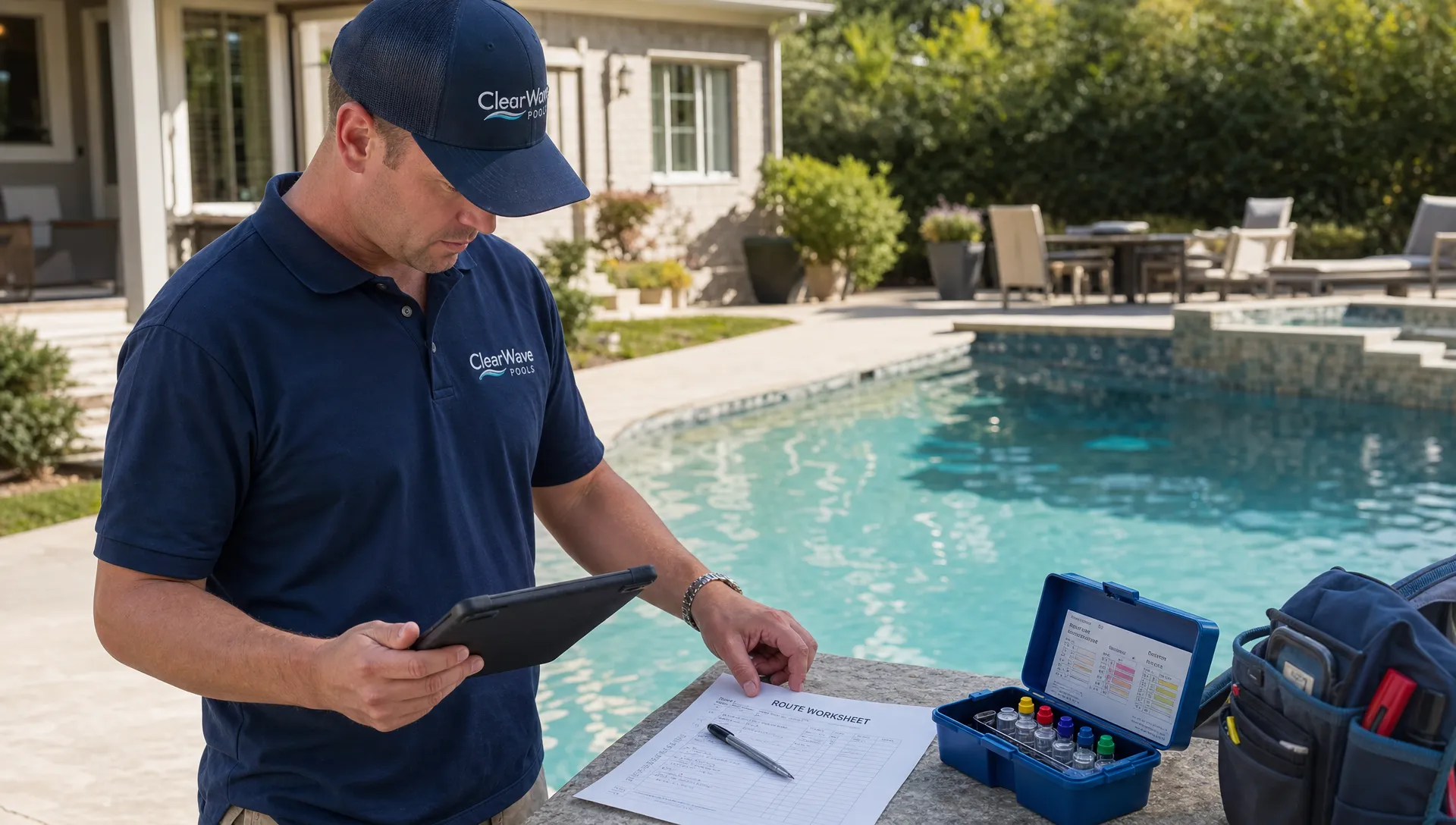
Turn the rate into a simple worksheet
A useful pool pricing worksheet does not need to be complicated. It needs to force honest math before anyone quotes a number.
Use a target hourly labor cost, expected minutes per stop, expected drive time, chemical allowance, admin allowance and target margin. Then add route modifiers and service modifiers. The exact inputs will differ by market, but the discipline is the same.
Here is a simple example for internal estimating only:
| Line item | Example input | How to think about it |
|---|---|---|
| Technician labor burden | $32 per hour | Wage plus payroll taxes, benefits and burden |
| Visit time | 35 minutes | Service plus notes and photos |
| Drive allocation | 20 minutes | Average between stops on this route |
| Chemicals and supplies | $9 | Normal expected visit usage |
| Admin and billing | $6 | Scheduling, messages and payment handling |
| Overhead contribution | $10 | Software, insurance, office and vehicles |
| Target profit | 15% to 25% | Built in before quoting |
This worksheet is not a public price sheet. It is an internal guardrail. It helps your team understand why a backyard with poor access, heavy debris and a long drive should not be quoted like a screened pool two houses away from an existing stop.
For a deeper look at margin math, see SplashIQ’s guide to pool service pricing models that protect your margins.
Use market signals without copying the market
Before changing pool pricing, gather market signals, but do not let them replace your own cost structure. Competitor quotes can tell you what homeowners hear in your area. They cannot tell you whether those companies are profitable, insured, paying technicians well or documenting visits properly.
Reddit posts and comment threads can also reveal what homeowners care about. In communities like r/pools and broader small-business forums, pool owners often compare monthly service rates, complain about unclear invoices or ask whether a charge for chemicals is reasonable. Those threads are not formal market research, but they are useful language research. They show the questions your proposals should answer before a homeowner has to ask.
Look for patterns in homeowner concerns: vague service descriptions, surprise chemical charges, no proof of visit, inconsistent technicians and uncertainty about what is included. Those complaints are pricing opportunities. A company that documents visits, explains water readings and communicates clearly can justify a premium more easily than a company selling “weekly pool service” with no detail.
Contractor growth articles from Jobber, Housecall Pro and ServiceTitan tend to return to the same operating lesson: scaling is easier when lead notes, customer history, scheduling, service records and billing live in a CRM instead of scattered texts or the owner’s memory. That lesson applies directly to pool service. Better data makes better rates possible.
Build rules for discounts, add-ons and exceptions
The most profitable pool pricing systems include rules for the situations that usually erode margin. Without rules, every exception becomes a one-off negotiation.
Discounts should have a reason. Route density is a good reason. Prepayment might be a good reason. Multi-property service can be a good reason if the properties are close and the scope is consistent. “The customer asked” is not a pricing strategy.
Add-ons should be named clearly. Filter cleaning, green-to-clean recovery, phosphate treatment, salt cell cleaning, storm cleanup, vacation restart, equipment inspection and one-time debris removal may not belong in a standard maintenance rate. If your team performs these tasks often, build them into your price book so technicians and office staff are not guessing.
Set a minimum service charge for small work. A homeowner may see a five-minute adjustment, but your company still handled scheduling, routing, travel, documentation and billing. Minimums protect the calendar from low-value stops.
Present rates with proof, not apology
Homeowners are more likely to accept a higher rate when they understand what the rate includes. Your proposal should make the value visible before the first visit.
Describe the service frequency, routine tasks, chemical policy, water testing, visit documentation, photo expectations, equipment notes and billing terms. If you offer online payments or a homeowner portal, mention it as part of the service experience. Clear expectations reduce pricing friction because the homeowner can compare your offer against a defined outcome, not just a monthly number.
It also helps to show what is not included. Exclusions are not negative when they are written plainly. They prevent future conflict and protect trust.
A clean proposal might explain:
- Standard weekly service includes routine cleaning, water testing, basic chemical balancing and a visit report.
- Specialty chemicals, repairs, heavy debris cleanup and neglected water recovery are quoted or billed separately.
- Missed access due to locked gates, loose animals or unsafe conditions may still incur a visit charge.
- Rate reviews may occur annually or when service conditions change materially.
Use software to keep rates aligned with reality
Pool pricing is easier to manage when your operating data is connected. If schedules live in one place, visit notes in another, chemical logs on paper and invoices in a separate system, you cannot easily see which accounts are profitable and which ones quietly drain time.
This is where pool service software becomes more than an admin convenience. SplashIQ is built for pool service companies that need CRM, scheduling, water-quality logs, equipment tracking, homeowner billing, route planning, before-and-after photos, online payments and field workflows in one operating system. When those pieces connect, pricing decisions become less emotional and more evidence-based.
A team can review which routes are too spread out, which accounts create frequent callbacks, which technicians need coaching and which homeowners need clearer communication. If route efficiency and billing are current pain points, the SplashIQ guide to pool service software for teams that need routes and billing explains how connected workflows reduce the gaps between the office and the field.
Technology adoption does not have to be intimidating. If your team is still building confidence with phones, apps, online payments or basic digital workflows, practical resources like easy-to-follow technology guides can help less technical users get comfortable with everyday tools before layering on more advanced systems.
Review prices on a set schedule
A rate that worked last year may not work now. Labor costs, insurance, fuel, chemicals, software and customer expectations all move over time. Review prices at least annually, and review them sooner when a route changes, a pool’s condition changes or a customer adds expectations beyond the original scope.
The cleanest reviews are based on documented service history. If you can show visit frequency, photos, water readings, repair notes and unusual service events, the conversation becomes concrete. You are not “raising prices because everything is expensive.” You are aligning the rate with the work required to maintain the pool properly.
Rate increases should be direct, respectful and specific. Tell the homeowner what is changing, when it changes and what the service continues to include. Give enough notice for the customer to process the change, but do not over-apologize for running a sustainable business.
Frequently Asked Questions
What is the best way to calculate pool pricing for a new customer? Start with expected labor time, drive time, chemical use, admin cost, overhead and target profit. Then adjust for pool size, debris load, access, equipment condition, service frequency and route fit.
Should chemicals be included in monthly pool service rates? They can be included if you define the limits clearly. Many companies include routine balancing chemicals but bill separately for specialty treatments, heavy recovery work or unusual chemical demand.
How often should a pool service company raise rates? Review rates at least once a year. You may need earlier changes when fuel, labor or chemical costs rise sharply, or when a specific pool requires more work than the original quote assumed.
Is it better to charge monthly or per visit? Monthly pricing is easier for homeowners to budget and can stabilize cash flow. Per-visit pricing is more transparent for seasonal or irregular work. The right choice depends on your service model, billing process and customer expectations.
How can software improve pricing decisions? Software helps connect routes, visit history, water-quality logs, equipment notes, billing and customer communication. That gives you better data on which accounts are profitable and which ones need a rate adjustment.
Set rates that keep the business healthy
The goal is not to be the cheapest pool company in town. The goal is to charge rates that let your team show up consistently, do the work properly, communicate clearly and earn enough margin to keep improving.
SplashIQ helps pool service companies replace scattered spreadsheets, paper checklists and disconnected billing with one workflow for the office, technicians and homeowners. If you want cleaner pricing decisions, start by making each visit easier to document, route, bill and review inside a system built for pool service operations.