A good residential pool maintenance plan does more than list chores. It tells a homeowner what will happen, how often it will happen, what proof they will receive and which problems cost extra. For pool service companies, that clarity matters because the customer is not buying “brushing, skimming and chemical balance” in isolation. They are buying fewer surprises, safer water, cleaner weekends and a reliable professional who notices issues before they become expensive.
Many homeowners struggle to compare pool service offers because most plans sound similar at first glance. One company says “weekly pool service,” another says “full-service maintenance,” another says “premium care.” Unless the plan explains outcomes, visit rhythm, exclusions and communication, the homeowner has to guess what is included.
Why Homeowners Struggle to Compare Pool Service Plans
Homeowners usually do not think like route managers. They think in terms of visible results: Is the pool clear? Is the water safe? Did anyone show up? Why did the pump sound different this week? That gap creates confusion when a plan is written from the contractor’s internal checklist instead of the homeowner’s point of view.
You can see this in Reddit communities such as r/pools, where homeowners often ask whether their pool service is doing enough, whether a green pool is normal after rain or whether a chemical charge is fair. These posts are not formal research, but they are useful voice-of-customer material. The recurring theme is simple: people are more patient when they understand what was done and why.
That is why a plan should answer four questions without making the customer call your office:
- What happens on a normal visit?
- What changes during storms, heavy use or seasonal transitions?
- How will the homeowner know the work was completed?
- What requires approval before it becomes an added charge?
Start Residential Pool Maintenance Plans With Outcomes Homeowners Recognize
The easiest way to make residential pool maintenance plans clearer is to translate tasks into outcomes. “Brush tile line” may be accurate, but “helps prevent buildup and staining at the waterline” is easier for a homeowner to value. The plan can still include technical details, but the headline promise should be something the customer recognizes.
A useful plan structure pairs each service activity with the homeowner-facing result and the proof your team will provide.
| Service activity | Homeowner outcome | Proof after the visit |
|---|---|---|
| Skim surface and empty baskets | Cleaner water flow and fewer visible leaves | Visit summary with completed tasks |
| Brush walls, steps and tile line | Less buildup in common problem areas | Before and after photos when needed |
| Test and balance water | Safer swimming conditions and better equipment protection | Water-quality readings with plain-language notes |
| Inspect visible equipment | Earlier warning on leaks, noise or pressure changes | Equipment note or repair recommendation |
| Check service area | Fewer missed gates, pets or access issues | Timestamped visit record and technician notes |
This framing helps sales conversations too. Instead of defending a checklist, your team can explain the value of prevention, consistency and documentation.
Use Tiers, But Keep the Differences Practical
Service tiers work best when each one fits a real homeowner situation. Too many tiers create decision fatigue, especially when the difference is only a few vague phrases. Three levels are usually easier to understand than five.
A basic tier might focus on weekly cleaning, basket checks and standard water testing. A more complete tier might add routine filter attention, more detailed equipment monitoring and photo updates. A premium tier could include more communication, seasonal readiness checks and priority scheduling for approved repair work. The names matter less than the clarity.
For residential pool maintenance, avoid making the lowest tier feel incomplete or risky. If every customer needs water testing, visible safety checks and basic cleaning, keep those in every plan. Reserve the tier differences for response speed, reporting detail, seasonal extras and the amount of proactive equipment oversight.
What Belongs in Every Plan
Every plan should define the baseline standard your company is willing to stand behind. That protects the homeowner and the technician. It also helps your office answer questions consistently when a customer asks why something was or was not done.
At minimum, include visit frequency, routine cleaning tasks, water testing, chemical handling, visible equipment inspection, service documentation and communication expectations. If your company uses photos, water logs or homeowner notifications, say so directly. The plan should also explain how missed access, severe weather, unsafe conditions or locked gates are handled.
This is where operational consistency matters. If your plan promises the same quality across every route, your internal process has to support that promise. SplashIQ’s guide on standardizing residential pool cleaning across routes goes deeper into turning service standards into repeatable field workflows.
What Should Be Clearly Outside the Plan
Exclusions are not negative when they are written plainly. They prevent surprise invoices and reduce awkward conversations after a technician finds a broken part or an algae problem caused by unusual conditions.
Common exclusions include major repairs, parts, green-to-clean recovery, drain and refill work, leak detection, severe storm cleanup, salt cell replacement, automation troubleshooting and work blocked by unsafe access. Your exact exclusions depend on how your company operates, but the principle is the same: do not bury them in fine print.
A better approach is to label them as “work that requires approval first.” That tells the homeowner you are not ignoring the issue and you are not charging without permission. It also creates a cleaner path from diagnosis to estimate.
Make Water Chemistry and Equipment Notes Plain Enough to Trust
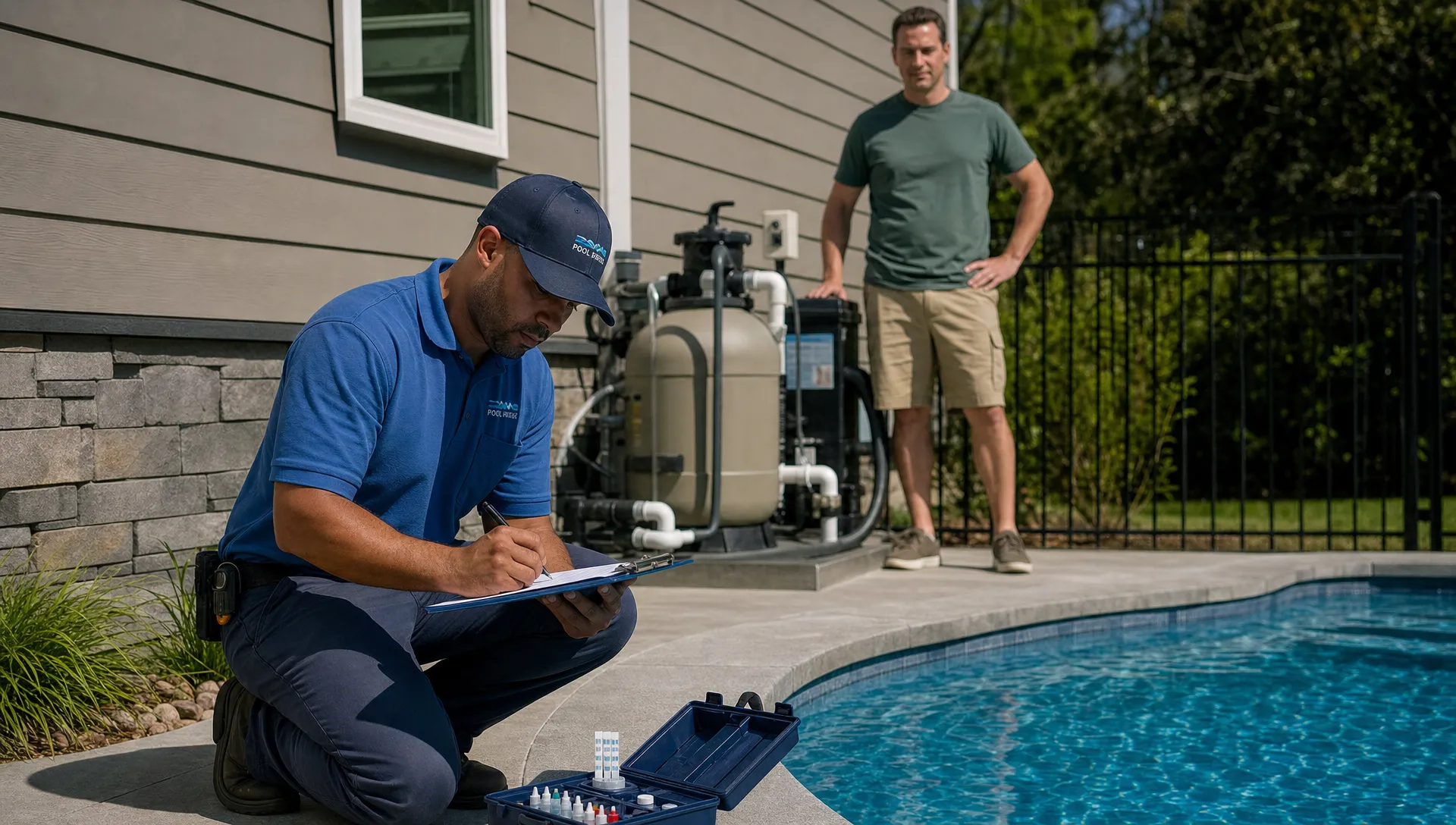
Water chemistry is one of the biggest trust builders in a service plan, but only if homeowners can understand the record. A log that says “pH 7.8, FC 2.0, TA 90” may be useful internally, yet it does not explain whether the pool is improving, stable or at risk.
A homeowner-friendly residential pool maintenance plan should describe how readings are captured and how context is shared. For example, after heavy rain or high bather load, the visit note can explain why chlorine demand changed or why additional balancing was required. The goal is not to teach a chemistry class. The goal is to show that your technician is making informed decisions.
The same applies to equipment. Homeowners do not always know the difference between a normal filter pressure change and a warning sign. If a tech notes rising pressure, weak flow, air in the pump basket or a noisy motor, the plan should explain how those observations become recommendations.
Use CRM Workflows to Make the Plan Match the Visit
Clear plans fail when the office, technician and customer record are disconnected. A salesperson may promise detailed updates, the dispatcher may only see a time slot and the technician may arrive without the property’s history. That is how a well-written plan turns into inconsistent service.
Articles from contractor software companies such as Jobber and ServiceTitan often make a similar point: CRM software helps contractors scale because it keeps customer history, estimates, scheduling, follow-ups and billing from scattering across notebooks, inboxes and memory. Jobber’s contractor CRM guide is a practical example of this broader shift in the trades.
For pool companies, the same idea applies to residential pool maintenance at route level. The customer record should show the plan, property notes, gate codes if appropriate, equipment details, chemical history, photos, open estimates and billing status. When that information follows the technician into the field, the plan becomes operational instead of theoretical.
| Homeowner promise | Office workflow | Technician proof |
|---|---|---|
| “You will know when we arrive” | Arrival notification tied to the route | Timestamped service event |
| “We track your water quality” | Required test fields in the visit record | Saved readings and notes |
| “We watch your equipment” | Equipment profile linked to the property | Inspection note with photos when needed |
| “We ask before repair charges” | Estimate and approval workflow | Approved work order before repair |
| “You can review service history” | Customer-facing records | Portal access or visit summaries |
SplashIQ is built around that connected workflow, with CRM, scheduling, field operations, water-quality logs, equipment tracking, homeowner communication and payments in one operating system for pool service businesses.
Put Communication in the Plan, Not Just the Pool Work
Many service complaints are really communication complaints. The pool may have been cleaned, but the homeowner did not know when the tech came. Chemicals may have been adjusted, but the customer only noticed a line item. A filter concern may have been spotted, but the repair recommendation came days later with no context.
A modern plan should state what the homeowner will receive after each visit. That might include arrival and completion notifications, a short task summary, water readings, photos when useful, equipment notes and clear next steps for repairs. If your company offers this level of visibility, it should be part of the plan’s value proposition, not an afterthought.
For more detail on what customers actually value, SplashIQ has a separate guide to pool updates homeowners appreciate after every visit. The short version is that proof matters most when it is specific, timely and easy to understand.
A homeowner portal can make this even cleaner. Instead of forcing customers to dig through texts and invoices, the portal gives them one place to see schedules, visit summaries, water history, photos, invoices and approvals. If you are deciding what belongs there, this breakdown of homeowner portal features customers actually want is a useful companion.
A Simple Plan Template You Can Adapt
A strong residential pool maintenance plan does not need to be long. In fact, shorter is usually better as long as the details are complete enough to avoid misunderstandings. Think of it as a one-page agreement supported by your service records.
Use a structure like this:
| Plan section | What to explain |
|---|---|
| Best for | The homeowner situation the plan fits, such as weekly upkeep, seasonal home or high-use pool |
| Visit frequency | Weekly, biweekly where appropriate or seasonal schedule details |
| Included service | Cleaning, water testing, chemical balancing process and visible equipment checks |
| Communication | Arrival alerts, visit summaries, photos, water logs and repair recommendations |
| Exclusions | Repairs, parts, unusual cleanup, unsafe access and work requiring approval |
| Billing and approvals | Payment timing, invoice delivery and how repair authorization works |
The language should be direct. Instead of “chemicals included subject to service conditions,” say what is included, what may cost extra and when the homeowner will be asked to approve additional work. Instead of “equipment monitored,” say that visible equipment will be checked during service and that repair recommendations will be sent with notes or photos.
This template also helps train new office staff. When someone calls asking about service, the team can explain the same structure every time. When a technician is assigned to a property, the field app can show the plan and the expected visit workflow.
How Clear Plans Improve Retention and Profitability
Understandable plans are not just a sales tool. They help protect margins. When homeowners know what is included, your office spends less time re-explaining routine charges. When technicians know what proof is required, fewer visits depend on memory. When approvals are documented, repair work moves faster and disputes become easier to resolve.
For residential pool maintenance companies trying to grow, this is the difference between adding customers and adding chaos. More accounts only help the business if route quality, billing accuracy and customer communication scale with them.
The best plans also make renewals easier. A homeowner who can see a season of completed visits, water logs, photos and equipment recommendations has a clearer reason to keep paying. The record shows ongoing prevention, not just a person who stopped by once a week.
Frequently Asked Questions
How detailed should a pool maintenance plan be? A plan should be detailed enough to explain visit frequency, included tasks, communication, exclusions and approval rules. It does not need to list every minor technician action if the main service standard is clear.
Should pool chemicals be included in the plan price? That depends on your business model. Some companies include standard chemical balancing and charge separately for unusual demand, specialty chemicals or recovery work. The important part is to explain the rule before service begins.
What is the best way to explain repairs in a maintenance plan? Say that visible equipment will be checked during routine visits, but repairs, parts and troubleshooting beyond normal service require homeowner approval. Photos and plain-language notes help customers approve faster.
Do homeowners care about water-quality logs? Many do, especially when there is a problem. Logs help explain trends after storms, heavy use or equipment issues. They also show that the service is based on measured conditions instead of guesswork.
Can software make residential pool maintenance plans easier to deliver? Yes, if the software connects the customer record, schedule, technician checklist, water logs, equipment notes, homeowner updates, approvals and payments. The plan becomes much easier to deliver when every role works from the same information.
Turn Clear Plans Into Consistent Service
Homeowners understand plans that are specific, visible and fair. They want to know what happens on each visit, how problems are documented and when they will be asked to approve extra work. Your team needs the same clarity so the plan can be delivered consistently across every route.
SplashIQ helps pool service companies connect CRM, scheduling, field work, water-quality logs, equipment tracking, homeowner updates and payments in one operating system. If your plans are clear on paper but hard to execute in the field, the next step is making the workflow match the promise.