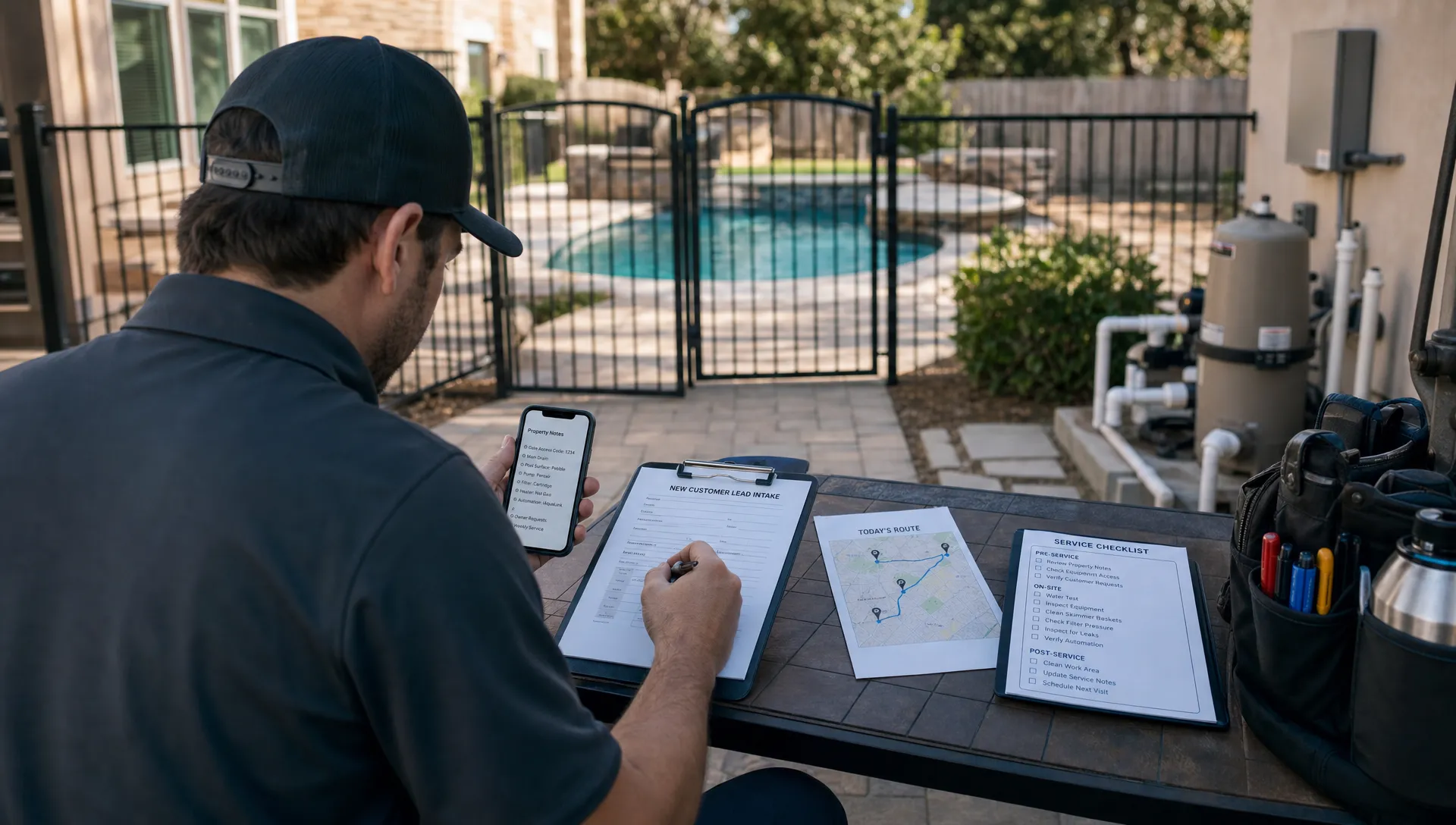
Starting a pool service business is exciting because the demand is visible. Every neighborhood has pools, every pool needs recurring care, and many homeowners would rather pay a reliable professional than spend Saturday balancing chemicals and cleaning baskets.
But the hard part is not finding water to service. The hard part is building a business that does not collapse under missed notes, inefficient routes, unclear pricing, callbacks, and slow payments.
Many new pool service owners start with a truck, a pole, a test kit, chemicals, and a spreadsheet. That can work for the first few customers. It usually starts to break when the route reaches 20, 40, or 80 pools and every customer has different gate codes, equipment quirks, service expectations, billing terms, and repair history.
The advantage of building better systems from day one is simple: you train the business to run professionally before growth makes professionalism harder.
A pool service business is more than a pool route
A route is the visible part of the business. The system behind it is what protects your time, reputation, and margins.
A well-run pool company needs to answer basic questions quickly:
| Business question | System you need early | Why it matters |
|---|---|---|
| Who is the customer and what do they own? | Customer CRM and property records | Prevents lost details and repeated questions |
| What needs to happen at each visit? | Service checklists and field notes | Keeps quality consistent across visits |
| Where should the technician go next? | Route scheduling | Reduces drive time and missed appointments |
| What chemicals were added? | Water-quality logs | Creates accountability and service history |
| What equipment is on site? | Equipment tracking | Speeds up repairs and replacement quotes |
| Has the customer paid? | Billing and payments workflow | Protects cash flow |
| What did the homeowner see? | Photos and service summaries | Builds trust and reduces disputes |
If you are still solo, this may feel like overkill. It is not. A solo operator has the least time to waste, and every sloppy process becomes more expensive when you hire your first technician.
Define the business model before you chase every job
When you are starting out, it is tempting to say yes to everything: weekly maintenance, green pool cleanups, openings, closings, filter cleans, heater repairs, automation upgrades, inspections, and one-off emergency calls.
Some variety is healthy, especially while you are learning demand in your market. But your systems need a default operating model. Most pool service businesses grow fastest when they know which work is recurring, which work is seasonal, and which work requires special quoting.
Before you print door hangers or run ads, decide:
- Your service area and maximum drive radius
- Your core weekly or biweekly maintenance package
- Which repairs you will handle in-house versus refer out
- Your minimum service charge for one-off visits
- How you will price chemicals, specialty treatments, and filter cleans
- Your billing schedule and payment expectations
Pricing deserves special attention because underpricing is one of the easiest ways to create a busy but unprofitable route. Your rate has to cover labor, chemicals, fuel, insurance, admin time, callbacks, payment processing, and profit. If you want a deeper framework, SplashIQ’s guide to pool service pricing models that protect your margins is a useful companion to this startup planning step.
Research the market like a technician and a homeowner
Good systems start with accurate assumptions. Before you choose software, write checklists, or set prices, listen to what pool owners complain about.
Reddit can be surprisingly useful here. Search posts in communities like r/pools, r/homeowners, r/smallbusiness, and r/sweatystartup for discussions about pool cleaners, route businesses, pricing, missed visits, algae problems, and repair communication. Do not treat Reddit as a pricing database, since markets vary widely. Treat it as a source of unfiltered customer language.
You will see patterns. Homeowners complain when they do not know whether the technician showed up. They get frustrated when a pool turns green and nobody can explain what changed. They worry about surprise repair bills. New service business owners often post about route density, hiring, customer cancellations, and whether to buy an existing route.
Those conversations tell you what your first systems should prevent:
- Missed or unverifiable visits
- Poor communication after service
- No clear record of chemical readings
- Untracked equipment issues
- Slow estimates for repairs
- Inconsistent billing and collections
A new pool business does not need to look huge. It needs to look organized, responsive, and trustworthy.
Build customer records from the first lead
The first time a homeowner contacts you, your system should capture more than a name and phone number. Even if they do not become a customer immediately, the lead may come back before swim season or after another company disappoints them.
A useful customer record includes contact information, property address, preferred communication method, service interest, pool type, gate access notes, pets on property, billing contact, and any urgency around repairs or water conditions.
Once they become a customer, the record should grow into a complete property profile. That profile should include the pool’s service history, equipment details, water-quality trends, photos, estimates, invoices, and homeowner conversations.
This is where many new operators lose control. They keep gate codes in text messages, equipment photos in a camera roll, invoices in one app, and service notes in a notebook. That may feel manageable until a customer asks, “What did you add last week?” or “When did you first mention the pump was leaking?”
A CRM gives every customer a home base. If you are comparing what to include, this overview of CRM best practices for service businesses explains why visibility matters so much once leads, visits, billing, and repairs overlap.
Design routes before the calendar fills itself
Route density can make or break a pool service business. Two companies with the same number of customers can have very different profits if one has tight neighborhoods and the other spends half the day driving.
From the beginning, divide your service area into zones. Assign preferred days to each zone, even if you do not have enough customers yet to fill every day. This helps you avoid the common startup mistake of letting customers choose any day they want.
A practical route system should consider geography, service duration, traffic, customer access windows, technician capacity, and urgent repair interruptions. You also need a way to reschedule without creating chaos when weather, sick days, or parts delays interrupt the plan.
For new businesses, the best scheduling rule is to protect tomorrow’s route while serving today’s customer. If every new customer gets squeezed into the next open slot without regard to location, you will eventually spend more time on the road than at the pool. SplashIQ’s article on smart scheduling tactics that cut drive time goes deeper into route density, zones, and appointment discipline.
Standardize every service visit
A professional pool visit should not depend entirely on memory. Even experienced technicians can miss steps when they are rushing, dealing with a locked gate, or trying to finish before a storm.
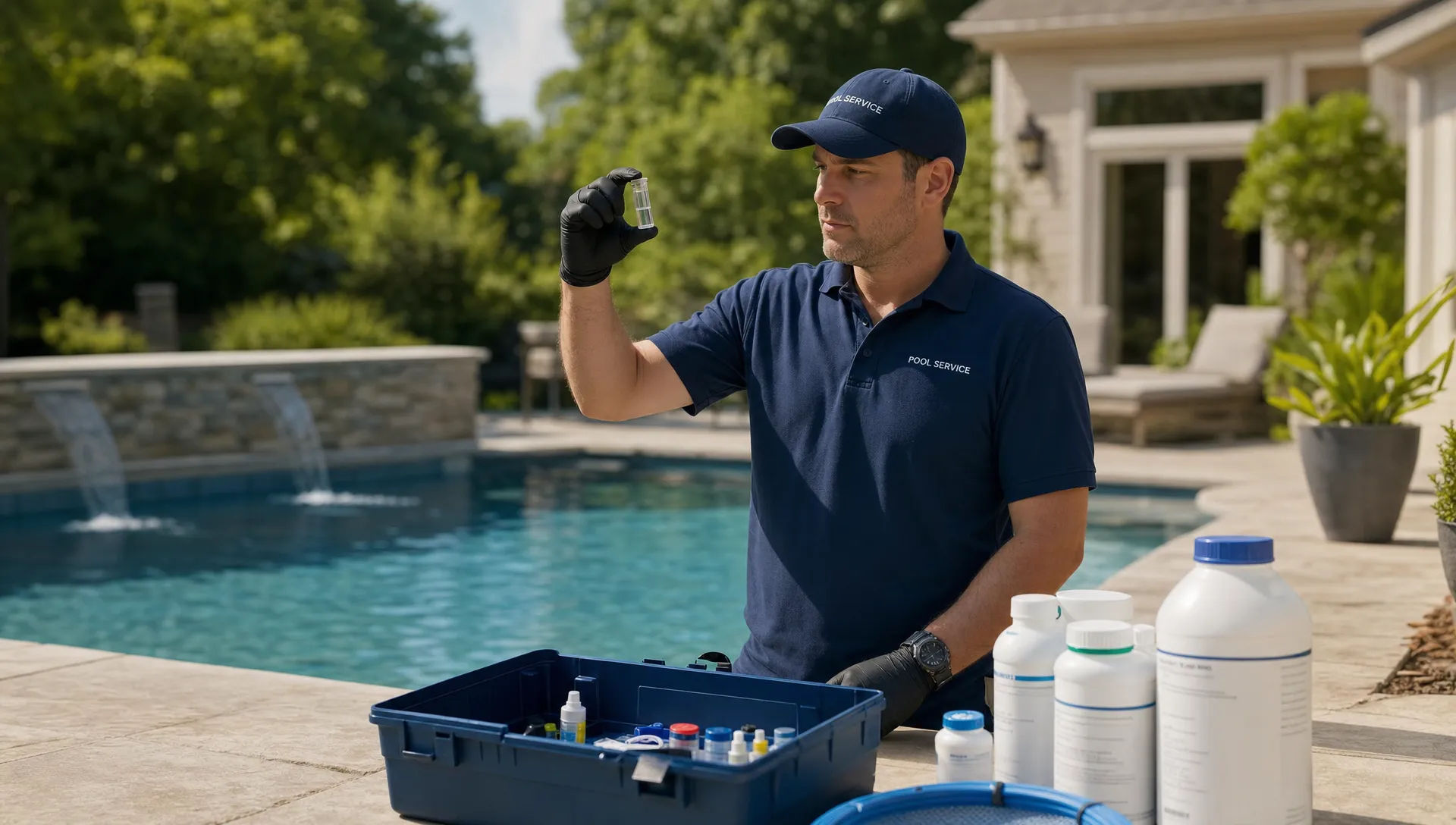
Your standard visit checklist should cover arrival confirmation, visual inspection, skimming, brushing, vacuuming as needed, basket cleaning, filter pressure check, water testing, chemical additions, equipment inspection, notes, photos, and customer-facing summary.
Water-quality logs are especially important. They give you a record of what was measured, what was adjusted, and whether the pool is trending toward a problem. Depending on the pool, you may track readings such as chlorine, pH, alkalinity, calcium hardness, cyanuric acid, salt, temperature, and other relevant values.
The goal is not paperwork for its own sake. The goal is to create proof and continuity. If the same technician returns next week, the log helps them see what changed. If a different technician covers the route, they can continue the service without guessing. If the homeowner questions the water condition, you can reference a real service history.
| Visit task | Paper or memory-based approach | Better system from day one |
|---|---|---|
| Arrival confirmation | Customer trusts that you came | Timestamped visit record or service note |
| Chemical readings | Written in a notebook or not recorded | Water-quality log tied to the property |
| Equipment issue | Mentioned verbally and forgotten | Photo, note, and repair follow-up |
| Service result | Homeowner may not see the work | Before and after photos when useful |
| Next action | Depends on technician memory | Follow-up task or estimate workflow |
Track equipment like future revenue depends on it
Equipment tracking is one of the most underrated startup systems in a pool service business. Every pump, filter, heater, salt cell, automation panel, cleaner, and valve setup can influence how long a visit takes and what repair opportunities appear later.
At minimum, record equipment type, brand, model when available, condition, visible leaks, unusual noises, installation concerns, and photos. If you notice aging or failing equipment, document it before it becomes an emergency.
This protects both the customer and your business. The homeowner gets a clearer explanation when a repair is needed. You avoid relying on vague memory. You can quote faster because the equipment information is already attached to the property.
Set billing up before unpaid invoices pile up
Cash flow problems often start quietly. A customer pays late once, then a second customer forgets, then the owner spends Sunday evening chasing invoices instead of planning the week.
Your billing system should be clear before the first recurring customer signs up. Decide whether you bill per visit, weekly, monthly, or after completed repair work. Put payment expectations in writing. Make it easy for homeowners to pay online, and decide how you will handle failed payments, late balances, and service pauses.
Photos and service notes can also support billing. When a homeowner receives a clear service summary, they are less likely to wonder what they are paying for. For repairs, documentation helps explain why a part is needed and what changed after the work was completed.
If you offer higher-ticket repairs or renovations, homeowner financing can be useful, but it should be handled as part of a professional estimate process. The important point is not to add every possible payment option immediately. The important point is to make billing consistent, visible, and easy to reconcile.
Communicate like a company bigger than you are
A new pool service business can win customers from larger competitors by communicating better. Homeowners do not always expect perfection, but they do expect updates, honesty, and follow-through.
Create templates for the moments that happen repeatedly: new lead response, estimate sent, service completed, gate locked, dog in yard, chemical concern, repair recommended, payment reminder, and weather delay.
Templates should not sound robotic. They should save time while still letting you add specific details from the visit. A message that says, “Your pool was serviced today” is fine. A message that says, “Your pool was serviced today, pH was adjusted, the pump lid O-ring is starting to crack, and we added a photo for reference” is much better.
A homeowner portal can also reduce back-and-forth because customers can see service history, billing information, and relevant updates without digging through texts or emails.
Build a rule-checking mindset, not a guessing culture
Strong service businesses do not rely on “I think that is how we do it.” They create simple ways to check the right rule, note, or process at the moment it matters.
You can see this mindset outside the pool industry too. Travelers use tools like a simple checker for airport liquid rules before packing because guessing at the airport can create avoidable problems. A pool company has its own version of that challenge: chemical handling, local requirements, warranty details, safety steps, access notes, and customer-specific instructions.
The lesson is not that every situation needs complicated software. The lesson is that repeatable work needs reliable reference points. If a technician has to guess which gate code works, which chemical was added last week, or which filter cartridge fits the property, your system is not doing enough.
Know when it is time to hire
Hiring your first technician is not just a workload decision. It is a systems test.
If your business depends on everything being in your head, hiring will expose every missing process. If your customer records, routes, checklists, photos, water logs, and billing workflows are already organized, a new technician has a much better chance of succeeding.
Track a few simple indicators before you hire:
| Metric to watch | What it tells you |
|---|---|
| Route completion consistency | Whether the current workload is sustainable |
| Callback frequency | Whether service quality is slipping |
| Drive time between stops | Whether you need better route density |
| Invoice turnaround | Whether admin work is falling behind |
| Estimate follow-up time | Whether repair revenue is being missed |
| Customer response delays | Whether communication needs support |
| Checklist completion | Whether work is standardized enough to delegate |
Technician scorecards can help once you have a team, but the principle applies even when you are solo. Measure the work you want to improve. If you only measure revenue, you may miss the operational problems that quietly reduce profit.
A simple first 90 days systems roadmap
You do not need to build a perfect operation before taking your first customer. You do need to build in the right order.
- Days 1 to 30: create the foundation: Define your service area, core packages, minimum pricing rules, lead intake process, customer record format, and standard service checklist.
- Days 31 to 60: tighten the route: Group customers by zone, set preferred service days, start tracking water readings consistently, photograph equipment, and standardize service summaries.
- Days 61 to 90: prepare for scale: Review margins, clean up customer records, document repair workflows, set billing rules, identify repeat issues, and decide what must be in place before hiring or expanding.
The goal is not to make the business feel corporate. The goal is to make it calm. A calm pool service business knows where the next job is, what happened last time, who owes money, which repair needs follow-up, and what the homeowner was promised.
Common mistakes to avoid when starting out
The first mistake is treating admin as something you will fix later. Later usually arrives when you are busiest, which makes cleanup painful.
The second mistake is pricing based only on competitors. Competitor pricing does not tell you their route density, labor cost, chemical cost, insurance, service scope, or profit target.
The third mistake is accepting customers anywhere. A faraway customer may feel like revenue, but if they damage route efficiency, they can cost more than they contribute.
The fourth mistake is failing to document repairs early. A small equipment note today can become a profitable and trusted repair recommendation later, but only if it is captured.
The fifth mistake is communicating only when something goes wrong. Regular, simple service updates build trust before there is a problem.
Frequently Asked Questions
Do I need software before getting my first pool service customer? Not necessarily, but you do need a real system. Starting with software can prevent scattered notes, missed follow-ups, and messy billing from becoming habits you have to undo later.
What should I track for every pool? Track customer details, access notes, service history, water-quality readings, chemical additions, equipment information, photos when useful, repair recommendations, invoices, and customer communication.
How should I price a new pool service route? Start with your true cost per visit, including labor, chemicals, fuel, insurance, admin time, callbacks, and profit. Then adjust for pool size, service frequency, route density, and special requirements.
Are Reddit posts useful when starting a pool service business? Yes, if you use them correctly. Reddit posts can reveal homeowner frustrations and operator challenges, but they should not replace local market research, licensing checks, or your own cost calculations.
When should I hire my first technician? Hire when demand is consistent, your routes are organized, your service checklist is documented, and your customer records are clear enough for someone else to follow without relying on your memory.
Start organized, then grow with confidence
Starting a pool service business with better systems from day one gives you a major advantage. You can respond faster, schedule smarter, document better work, bill more consistently, and earn homeowner trust before competitors even realize you are serious.
SplashIQ is built for pool service companies that want one operating system for CRM, scheduling, water-quality logs, equipment tracking, field work, homeowner communication, and payments. If you are building your company from the ground up, the right systems now can make every future route, technician, and customer easier to manage.