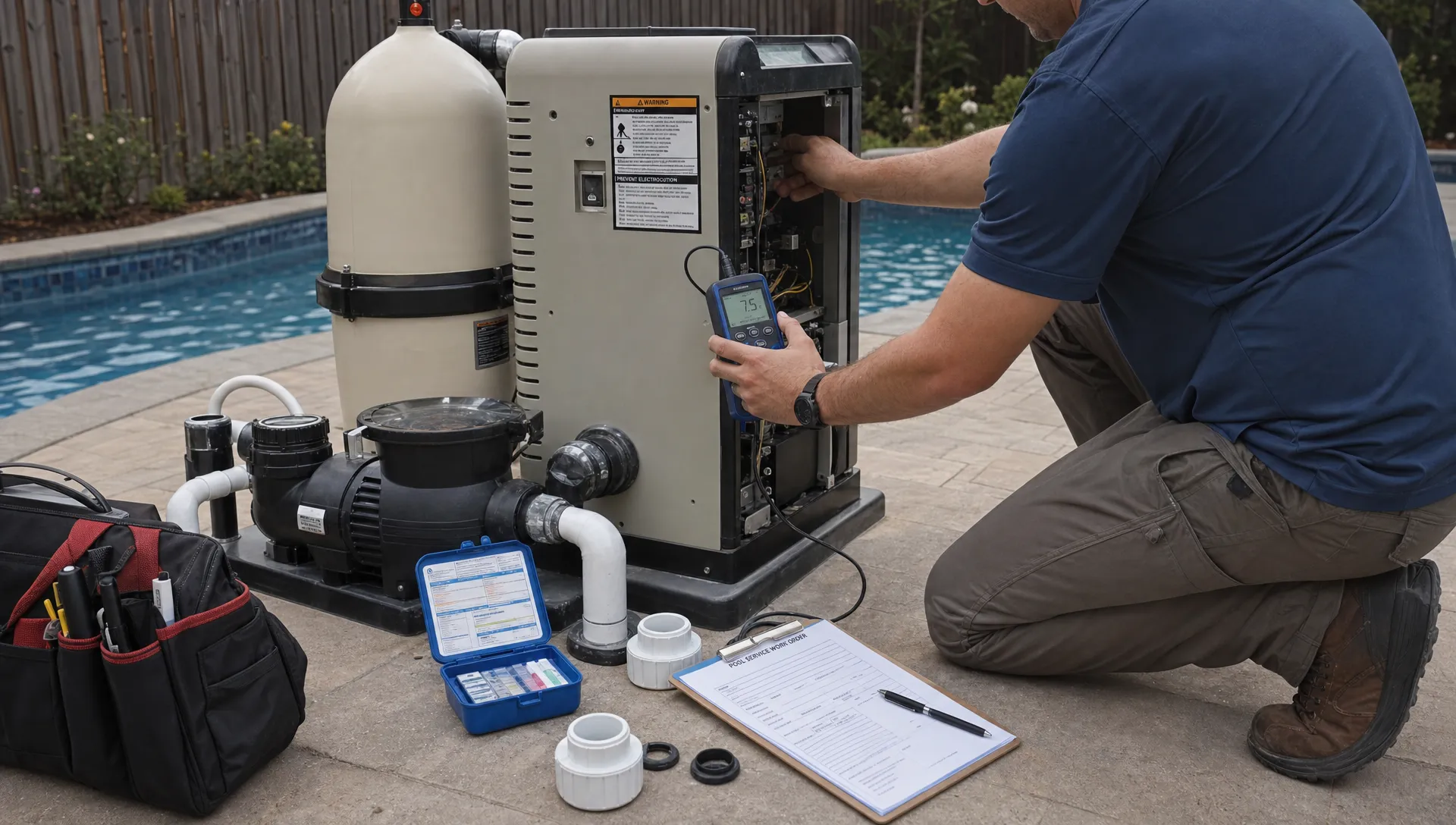
A homeowner calls at 10 a.m. with a stopped pump, cloudy water and guests arriving that evening. Your technicians already have full routes. Accepting same day pool service might prevent equipment damage or preserve an important customer relationship. It might also create overtime, missed stops and a promise your crew cannot keep.
For a pool service business, the right decision is not simply whether someone can squeeze in another address. It is whether a visit today changes the outcome enough to justify its effect on everyone else’s service. Separate the urgency of the problem from the homeowner’s preferred deadline, then check whether you have the right technician, enough time and a realistic next step.
Separate a safety emergency from an urgent service request
Some situations need immediate safety action, not a faster cleaning appointment. Suspected electrical hazards, smoke or a gas odor require people to stay away from the affected area and contact the appropriate emergency service or utility. A pool technician’s arrival window is not an emergency response plan.
For other calls, prioritize the consequence of waiting:
| Reported condition | Initial priority | What a visit today could accomplish |
|---|---|---|
| Pump stopped or circulation lost | Prompt assessment, especially when equipment damage or freezing is a concern | Identify the failure and determine whether a safe temporary measure or repair is possible |
| Significant unexplained water loss | Prompt assessment | Help identify the source and limit further damage |
| Cloudy or green water | Keep swimmers out when visibility or water quality is unsafe | Test, diagnose and begin treatment, potentially with follow-up |
| Heater not reaching the requested temperature | Usually a scheduling issue unless hazardous symptoms are present | Diagnose the problem, subject to technician qualifications and parts availability |
| Leaves, surface debris or cosmetic concerns | Usually lower priority | Complete a one-time cleaning if route capacity allows |
The strongest reason to accept same day pool service is that waiting could materially worsen the situation. A party deadline matters to the homeowner, but it does not establish a safety emergency or make a treatment work faster.
Get enough information before offering a slot
A short intake process prevents a vague request from turning into an unplanned repair project. Before dispatch, collect:
- The address, access instructions and a reachable decision-maker’s phone number.
- Photos of the water, equipment pad, equipment labels and any visible leak or error message, taken only from a safe location.
- Symptoms, when they started and whether circulation is currently operating.
- Recent chemical additions, maintenance or equipment work.
- The requested outcome, event deadline and authorization limit for diagnosis or repair.
Ask what the caller actually wants: cleaner appearance, restored circulation, a diagnosed heater fault or confirmation that the pool can reopen. Those are different jobs with different completion criteria.
A homeowner may bring advice from Reddit’s r/pools community. Those discussions can supply useful questions and vocabulary, but an online thread cannot establish this pool’s diagnosis or swimming safety. Record what the homeowner has already tried, including products added, rather than adopting another pool owner’s treatment plan.
Before confirming same day pool service, summarize the scope back to the caller: “Today’s appointment covers testing and diagnosis. Any repair, additional treatment or return visit depends on what we find and what you approve.”
Price the disruption, not just the work at the pool
An urgent visit can look profitable until you account for the route it disrupts. Evaluate the contribution from the job after incremental costs, not just the invoice amount.
A useful calculation is:
Urgent-job contribution = collected service revenue minus incremental labor, materials, travel and genuinely lost contribution from displaced work.
Include overtime when it is caused by the added visit. Include a customer credit if moving another appointment requires one. Do not subtract the full revenue of a recurring visit that will still happen tomorrow; count the actual added cost instead.
Consider this hypothetical example, not a suggested market price:
| Item | Illustrative amount |
|---|---|
| Urgent visit revenue | $225 |
| Additional labor and materials | $95 |
| Additional travel cost | $20 |
| Contribution lost from work that cannot be recovered | $130 |
| Net contribution from accepting the call | -$20 |
Without the lost work, the same visit would contribute $110. That difference explains why location and available capacity can matter more than the headline fee.
Pricing for same day pool service should reflect the work and capacity it consumes. Explain the diagnostic or dispatch charge, what it includes and how additional work is approved before sending a technician. A clearly disclosed fee is easier to defend than an unexpected “emergency” charge added afterward.
Fit same day pool service into the route without breaking other promises
Start with the technician who has the right skills and equipment, then evaluate geography. The closest truck is not automatically the right truck if the call needs a repair specialist or tools that technician does not carry.
Look at total insertion time: the detour, parking and access, diagnosis, the likely work and the drive back to the route. A nearby address can still consume a large part of the afternoon.
Use route-planning tactics that reduce drive time to identify genuine capacity, rather than treating every gap between appointments as free time. Preserve enough room for realistic travel and normal variation at existing stops.
Before accepting the call, identify exactly which appointments could move. Contact those homeowners before their promised window passes, explain the revised timing and record the change. Do not silently trade one customer’s urgent request for several other customers’ missed visits.
Accept same day pool service only when you can name its route impact. If the plan depends on technicians skipping testing, rushing chemical handling or working past a safe stopping point, offer the next suitable appointment instead.
Promise a response, not an instant recovery
An arrival today is not the same as a completed repair today. Parts availability, equipment condition, authorization and treatment requirements can all prevent a first visit from resolving the problem.
Describe the commitment in stages: arrival and assessment, findings and approval, then treatment or repair. Each stage should have a clear owner and a documented next step.
For same day pool service, tell homeowners which stage you are promising before booking. “We can assess the pump this afternoon” is a stronger commitment than “We’ll have everything fixed before dinner” when nobody has identified the failure.
Use photos, equipment details and a concise explanation to help homeowners approve pool equipment repairs with better information. If the necessary part is unavailable, provide the next update time rather than an unsupported completion date.
Swimming readiness needs its own decision. Algae treatment, filtration problems or contamination may require more treatment, circulation, retesting or follow-up visits. Follow product labels and applicable requirements, using the CDC’s healthy swimming guidance as a public-health reference. Do not promise a universal waiting period after adding chemicals, and do not treat clear-looking water as proof that the pool is ready for swimmers.
Use the CRM to reduce repeated decisions
An urgent call is harder to manage when the office cannot find the equipment model, previous diagnosis or homeowner’s approval history. A shared customer record makes that information available without relying on one employee’s memory.
For background, Salesforce’s overview of CRM explains the role of centralized customer information. For contractor-focused business-growth articles, Jobber’s Academy is another useful resource when exploring how customer management supports scaling. Evaluate software-vendor advice against operational outcomes, not an assumption that buying a CRM automatically produces growth.
Make the urgent visit useful to the next technician
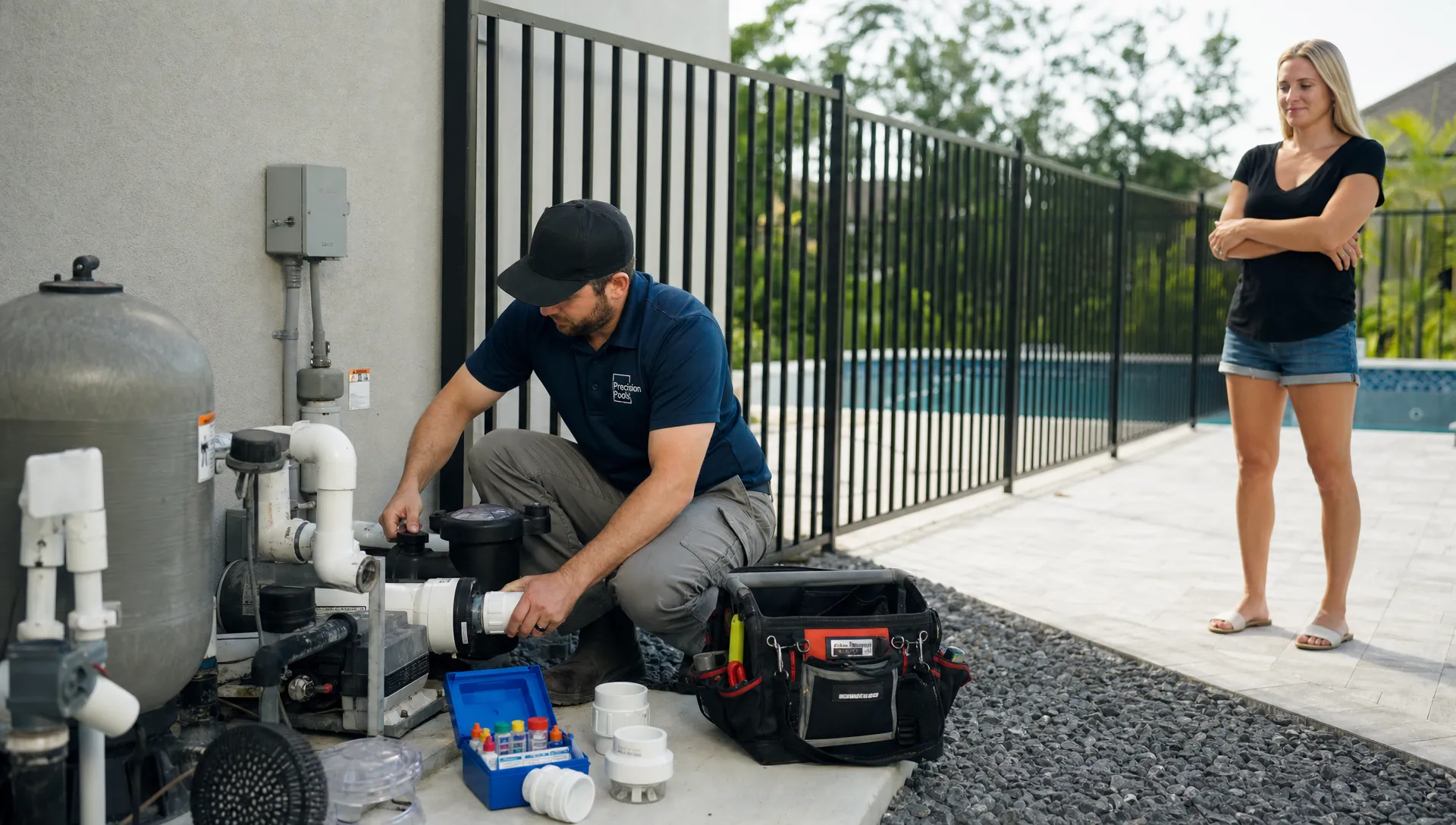
The record should show the original symptom, measured findings, work completed, approvals and unresolved issues. Attach relevant photos and leave a specific follow-up task. “Monitor pump” is less useful than a note explaining what was observed and when the next check is due.
SplashIQ brings customer CRM, smart route scheduling, water-quality logs, equipment tracking and before/after photos into the pool service workflow. Its offline field app supports field work where connectivity is limited, while homeowner arrival and service notifications support communication around the visit.
Those capabilities support same day pool service by keeping scheduling and field information connected. They do not create extra labor capacity, guarantee a replacement part or remove the need for professional judgment.
Review whether the urgent job was completed, required another trip or displaced scheduled work. If similar failures repeatedly generate rush calls, use that history to improve the reliability of recurring pool service, rather than normalizing constant route changes.
Set a policy your office can apply consistently
A written policy should define service-area limits, booking cutoffs, charges, approval requirements and the difference between an assessment and a completed repair. It should also make clear that availability depends on location, workload, technician qualifications and parts.
Choose how you will handle existing customers versus one-time callers. You might reserve limited capacity for active equipment failures while scheduling cosmetic cleanups around established commitments. Whatever the approach, staff should not have to invent the rules during a stressful call.
Make exceptions deliberately. Taking a lower-margin visit can be reasonable when it protects a long-term relationship or addresses a consequential problem. Record the reason so that the exception does not quietly become an unsustainable service promise.
The goal is not to reject same day pool service. It is to accept it when the response has a clear purpose and the business can deliver what it promises.
Frequently asked questions
Does same-day availability mean the pool will be fixed today? No. It may mean a technician can inspect, test or begin treatment today. Completion depends on the diagnosis, parts, approvals and any required treatment or follow-up.
Is a green pool an emergency? It needs attention and swimmers should stay out when visibility or water quality is unsafe. However, a green pool is not automatically an immediate equipment emergency, and a visit today does not guarantee swimming readiness by evening.
How much should an urgent visit cost? There is no universal price. Scope, travel, labor, materials and the effect on scheduled work all matter. Homeowners should receive the visit charge and approval terms before dispatch, with additional work quoted separately where appropriate.
When is one-time cleaning better than recurring maintenance? One-time cleaning can address an isolated need. Recurring maintenance provides repeated inspection, testing and upkeep. Neither replaces a qualified repair visit when equipment has failed.
What should homeowners send when requesting same day pool service? Provide the address, safe access details, symptoms, equipment information and photos taken from a safe location. Include recent treatments and the desired deadline, but expect the technician to confirm what is achievable.
Keep urgent work connected to the rest of the business
Before adding an urgent stop, confirm three things: waiting matters, the crew can respond responsibly and the homeowner understands the commitment.
If your office is coordinating those decisions across spreadsheets, paper notes and separate message threads, explore SplashIQ’s pool service operating system. Keep customer information, scheduling, field records and homeowner communication connected so an urgent visit does not become an undocumented exception.